
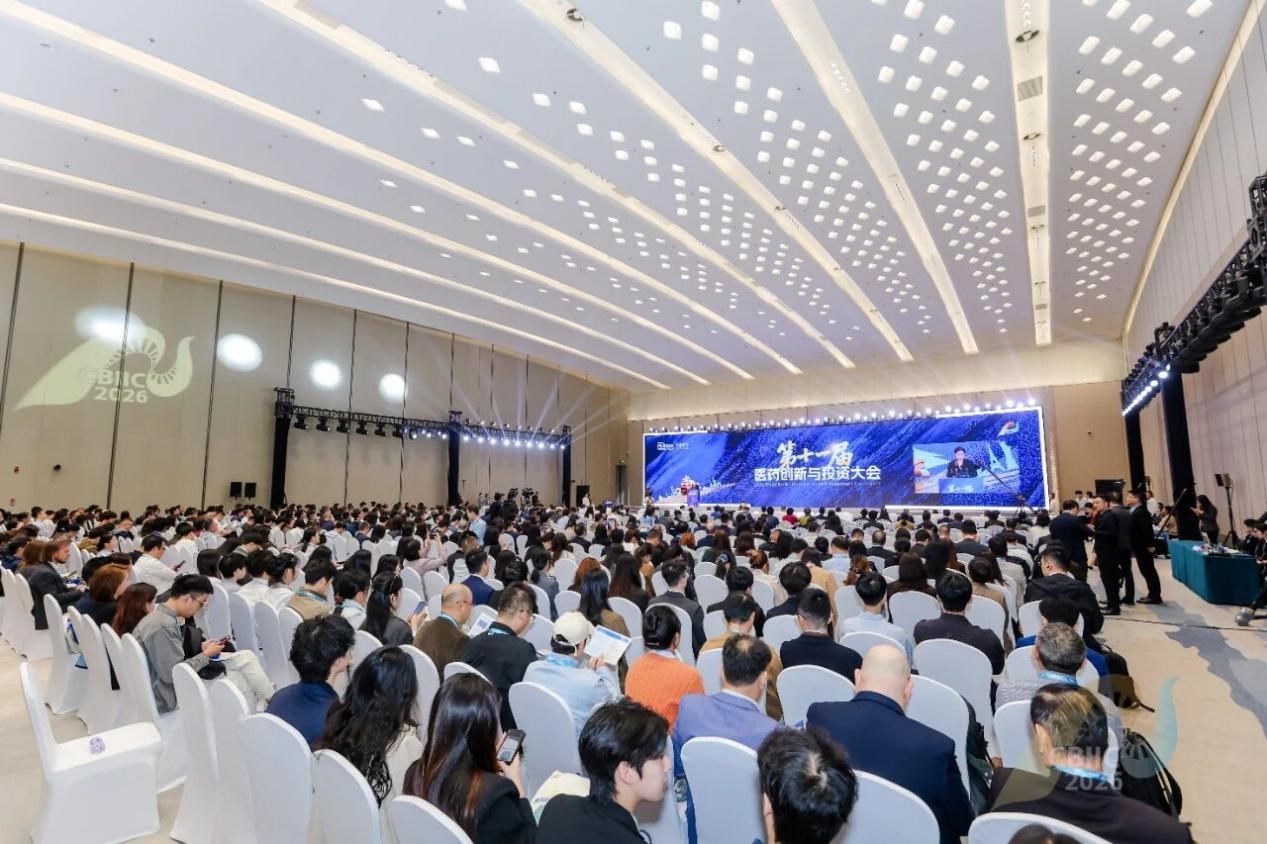
Nanjing, China--(Newsfile Corp. - November 5, 2026) - The China BioMed Innovation and Investment Conference (CBIIC) today announced the successful conclusion of its 2026 annual meeting, held in Nanjing, bringing together more than 2,000 participants from over 100 organizations to advance global partnerships and investment in China's biopharmaceutical sector. Co-hosted by the China Pharmaceutical Innovation and Research Development Association (PhIRDA) and Hong Kong Exchanges and Clearing Limited (HKEX), the conference featured 21 thematic forums and roadshow sessions, facilitating out-licensing deals and cross-border collaborations.
To view an enhanced version of this graphic, please visit:
https://images.newsfilecorp.com/files/11580/322827_c49941f604dc0a7e_001full.jpg
Since the beginning of this year, strong policy support is vigorously driving industrial growth. Biopharmaceutical industry has been designated as an emerging pillar industry for the first time, while the 15th Five-Year Plan for Pharmaceutical Industry Development has anchored the new development coordinates. Guided by the 15th Five-Year Plan, 60 Class 1 innovative drugs were approved in the first three quarters of this year, while the total value of out-licensing deals exceeded US$130 billion. The overseas expansion models are deepening from single out-licensing into diversified formats, including NewCo and Co-Co, and AI is becoming increasingly integrated into molecular discovery and clinical trial design, and now Chinese pharmaceutical companies are deeply engaged in global R&D and value creation with greater confidence. Co-hosted by China Pharmaceutical Innovation and Research Development Association (PhIRDA) and Hong Kong Exchanges and Clearing Limited (HKEX), 2026 CBIIC set up 21 thematic forums and roadshow sessions, bringing together more than 2,000 participants, including government officials, experts and scholars, entrepreneurs, investors, and media representatives, from more than 100 organizations, such as domestic and international investment institutions, innovative pharmaceutical companies, and research institutes.
At the opening ceremony, LIN Xiaoming, Director General of the Administrative Committee of Nanjing Jiangbei New Area, delivered remarks. He noted that pharmaceutical industry in Jiangbei New Area has reached a scale of nearly RMB 100 billion, with more than 1,300 companies and over 200 Class 1 innovative drug pipelines in development. He expected that the 2026 CBIIC would provide an opportunity to collaborate with experts and enterprises to promote high-quality development of industry.
On behalf of the host, REN Jinsheng, Vice President of PhIRDA and Chairman of Simcere Pharmaceutical Group, delivered remarks. He called for a continued commitment to clinical value and a long-term approach to pharmaceutical innovation, greater support for patient capital, and the adoption of AI to empower drug R&D.
HAO Haiping, President of China Pharmaceutical University, delivered a keynote speech. He noted that momentum in China's first-in-class drug R&D continues to build, although practical bottlenecks remain. It is imperative to develop new theories, technologies, and paradigms aligned with real clinical needs, deepen collaboration among universities, local governments, and enterprises, and bridge the gap between scientific innovation and market demands.
SONG Ruilin, Chief Expert of PhIRDA, shared his perspectives on "Reflections on China's Pharmaceutical Innovation Advancing into an Emerging Pillar Industry." Addressing key challenges, including constraints on returns arising from reliance on a single-payer system and gaps in original innovation, he proposed to shift commercial health insurance from a supplementary component to basic medical insurance to an industry engine, and establish a multi-tiered healthcare security system.
LI Wenshi, Executive Vice President of China Minsheng Bank, delivered a keynote speech. He noted that competition in innovative drugs has shifted from expanding pipeline numbers to realizing value throughout the entire development and commercialization process. Financial institutions must recognize the pharmaceutical industry's characteristics of high investment, long development cycles, and significant risks, moving beyond traditional fixed-asset assessments to a deeper understanding of drug pipelines and clinical value. He suggested that matching R&D cycles with patient capital, exploring medium and long-term financing based on the future cash flows of pipelines, and leveraging cross-border financial services and foreign exchange hedging instruments to support companies expanding overseas.
The first panel discussion, moderated by YANG Dajun, Chairman and CEO of Ascentage Pharma, and panelists included JIANG Jiandong, Academician of the Chinese Academy of Engineering, Dean of the School of Pharmaceutical Sciences at the Chinese Academy of Medical Sciences and Peking Union Medical College; CHEN Qiyu, Executive Director and Co-CEO of Fosun International; DING Lieming, Vice President of PhIRDA, Chairman and CEO of Betta Pharmaceutical; Sean SHAN, Vice President of PhIRDA, Senior Vice President and General Manager of Greater China, Central & South Asia at BeOne Medicines; LIANG Jin, Managing Director and Member of the Management Committee of the Investment Banking Department at CICC; and Dan LIU, Managing Partner of Pivotal bioVenture China. The panelists emphasized that China's innovative drugs are stepping into phase 2.0-shifting from original innovation to global value realization, where differentiated innovation driven by unmet clinical needs as a key determinant of competitiveness. For international expansion, companies should adopt flexible strategies, including independent overseas expansion, licensing-out, and NewCo models, while building differentiated competitive advantages rather than simply racing to match pipeline development.
The second panel discussion, moderated by XU Xiaolin, Founding Partner and Chairman of Huagai Capital, and panelists included LI Jia, Vice President of PhIRDA and Director of the Shanghai Institute of Materia Medica, Chinese Academy of Sciences; FAN Jie, President of Pharmaceutical BU, Huawei Technologies; REN Feng, Co-CEO and Chief Scientific Officer of Insilico Medicine; Bill WU, Executive Operating Partner of CBC Group and Chairman of Everest Medicines; LIU Wei, Co-Founder and CEO of BioMap and Kelvin TEO, Managing Director and Head of Asia Issuer Services at HKEX. The panelists noted that AI has already significantly improved efficiency for drug R&D in early-stages, including target discovery, molecular design, and toxicity assessment. Data is the core competitive strength in AI-driven drug discovery and development, and specialized AI companies must build their own data generation capabilities to establish sustainable technological advantages.
Company: China Pharmaceutical Innovation and Research Development Association (PhIRDA)
Contact Person: MA Mingyao
Email: mamy@phirda.com
Website: http://en.phirda.com/
Telephone:+86-13520846026
City:Beijing
To view the source version of this press release, please visit https://www.newsfilecorp.com/release/322827
Source: Kinfoome Presswire