
Vancouver, British Columbia--(Newsfile Corp. - October 20, 2026) - NexMetals Mining Corp. (TSXV: NEXM) (NASDAQ: NEXM) (the "Company" or "NexMetals") is pleased to announce an updated Mineral Resource Estimate for Selebi North (the "2026 Selebi North MRE"), one of two deposits comprising its past-producing Selebi copper-nickel-cobalt mines in Botswana. The 2026 Selebi North MRE, together with the previously announced Mineral Resource Estimate for Selebi Main (the "2026 Selebi Main MRE"; see news release dated October 1, 2026), comprise 8.95 million tonnes of Indicated Mineral Resources and 41.95 million tonnes of Inferred Mineral Resources (collectively, the "2026 MRE"). The 2026 MRE was completed by The MSA Group ("MSA") of Johannesburg, South Africa. Table 1 below compares the 2026 MRE with the 2024 Mineral Resource Estimate ("2024 MRE") for both deposits.
Table 1: 2024 MRE compared to the 2026 MRE
| Resource Category | Metric | 2024 | 2026 | % Change |
| Selebi North Indicated | Tonnage (Mt) | 3.00 | 8.95 | +198% |
| Copper grade (%) | 0.90 | 1.03 | +14% | |
| Nickel grade (%) | 0.98 | 1.08 | +10% | |
| Cobalt grade (%) | — | 0.06 | New | |
| Contained CuEq (Mlbs) | — | 412 | — | |
| Selebi North and Main Combined Inferred | Tonnage (Mt) | 24.72 | 41.95 | +70% |
| Copper grade (%) | 1.50 | 1.45 | −3% | |
| Nickel grade (%) | 0.92 | 1.01 | +10% | |
| Cobalt grade (%) | — | 0.05 | New | |
| Contained CuEq (Mlbs) | — | 2,255 | — |
Highlights:
2026 Selebi North MRE
Indicated Mineral Resources nearly triple to 8.95 million tonnes grading 1.03% copper and 1.08% nickel, from 3.00 million tonnes grading 0.90% copper and 0.98% nickel in 2024.
Inferred Mineral Resources increases 63% to 9.48 million tonnes grading 1.21% copper and 1.13% nickel, from 5.83 million tonnes grading 0.90% copper and 1.07% nickel in 2024.
Drilling drives resource growth and conversion. An additional 42,633 metres in 92 holes since the June 30, 2024 data cut-off supported resource expansion and conversion of approximately 20% of previously Inferred Mineral Resources to Indicated Mineral Resources, strengthening confidence for future mine planning.
Updated economic and technical inputs. The 2026 Selebi North MRE reflects updated metal price assumptions of US$5.10/lb copper, US$9.10/lb nickel and US$20.00/lb cobalt and incorporates previously reported metallurgical results demonstrating the ability to produce separate, clean copper and nickel concentrates that meet commercial smelter specifications (see news releases dated (September 3, 2025, and October 22, 2025).
New Geological Findings and Interpretations Underway
Selebi North's South Limb turns toward Selebi Main at depth, giving the first geological basis for a connection between the two deposits. Previously, the interpreted orientations of the two deposits did not suggest convergence, leaving limited geological support for potential continuity through the interpreted "Hinge Zone". New drilling establishes the South Limb flattening at depth and turning toward Selebi Main. That geometry is consistent with earlier borehole electromagnetic ("BHEM") surveys indicating continuity between the deposits. Both copper and nickel grades strengthen down plunge at Selebi North. Together, the structural, geophysical and geochemical evidence supports prioritizing the area between the deposits for further exploration.
Magnesium-rich rocks point to a possible intrusive keel. Continuing work by Dr. Peter Lightfoot, PhD, P.Geo., consulting geologist to the Company and internationally recognized nickel sulphide specialist and former Chief Geologist at Inco/Vale, has re-interpreted the Selebi intrusive system. Rocks historically logged as "amphibolite" are now recognized as a suite of primary igneous rock types — olivine pyroxenite, pyroxenite, olivine melagabbronorite and gabbronorite — altered to varying degrees. The most magnesium-rich of these, in previously released deep holes SMD-25-202 and SMD-25-204, both down plunge of the Selebi North South Limb toward Selebi Main, retain fresh olivine, the first silicate to crystallize from a magnesian nickel-bearing magma. Rocks of this kind are characteristic of the keel of an intrusion — its deepest, downward-projecting part, where dense magmatic sulphide can accumulate. Together with the structural study underway by TECT Geological Consulting, this work is defining the intrusion's geometry and the controls on sulphide distribution and is generating targets for further nickel-copper exploration.
Significant resource growth in 2026 and important geological findings set the stage for further expansion. Drilling at Selebi Main materially extended mineralization, while Selebi North's South Limb extends down plunge and turns toward Selebi Main. This emerging geological evidence of a potential connection, together with indications of an intrusive keel, points to potential growth opportunities within and between the deposits.
Project Funding Review & Selkirk PEA
Project funding review. Earlier this year, the Company engaged National Bank of Canada Capital Markets as financial advisor to evaluate project funding alternatives for its assets, with a focus on minimizing dilution to existing shareholders. The Company is working diligently to conclude its review. There can be no guarantee that this review will result in a transaction.
Selkirk Technical Study Advances. The Company has engaged DRA Global to complete a Preliminary Economic Assessment ("PEA") for Selkirk while the Company evaluates a range of strategic options for the asset.
Sean Whiteford, CEO of the Company, commented: "With 8.95 million tonnes Indicated Mineral Resources and 41.95 million tonnes Inferred Mineral Resources, and both deposits still open, we believe Selebi has the potential to become a world-class copper-nickel sulphide project. Growth in our mineral resources at both Selebi North and Selebi Main has exceeded our expectations and demonstrates the value of our investment in drilling and metallurgical work in 2025 and 2026."
"At Selebi North, we've nearly tripled the Indicated Mineral Resource while increasing copper and nickel grades, and the South Limb is changing direction toward Selebi Main. At Selebi Main, wide-spaced drilling has rapidly expanded tonnage in the newly defined Flexure Zone, delivering higher grades and thicker intersections. Dr. Peter Lightfoot's interpretation of deep drilling, which is detailed later in the press release, also supports further investigation of a potential intrusive keel, adding another dimension to our exploration targeting."
"These developments could have positive implications for future mine design and project economics. While we continue to advance the Selebi PEA, we are allowing additional time to better understand the scale and geometry of the expanding resource, inform the placement of critical infrastructure and evaluate alternative restart options. The structural study underway with TECT Geological Consulting will support this work by refining our understanding of the orebody's geometry and structural controls. The Company will provide further updates on the Selebi PEA, including expected completion timing, as the study advances."
"We continue to prioritize expenditures across drilling and technical studies, aligning the pace of work with available capital and directing the Company towards the opportunities we believe offer the greatest value creation for shareholders."
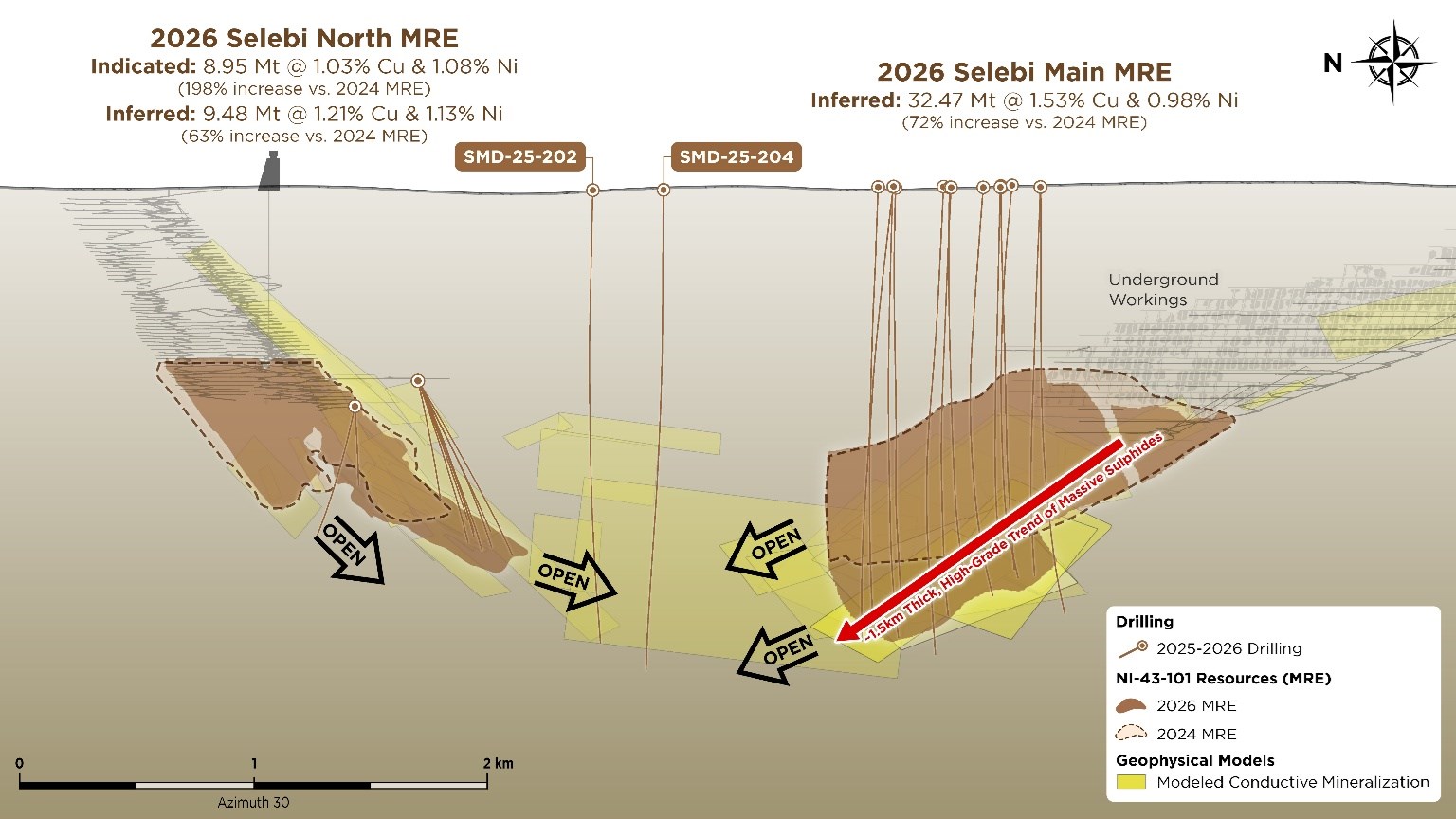
Figure 1: Long section of Selebi Mines highlighting the 2026 Selebi Main and Selebi North MREs.
To view an enhanced version of this graphic, please visit:
https://images.newsfilecorp.com/files/7759/319913_4cd39927d4d0aa00_002full.jpg
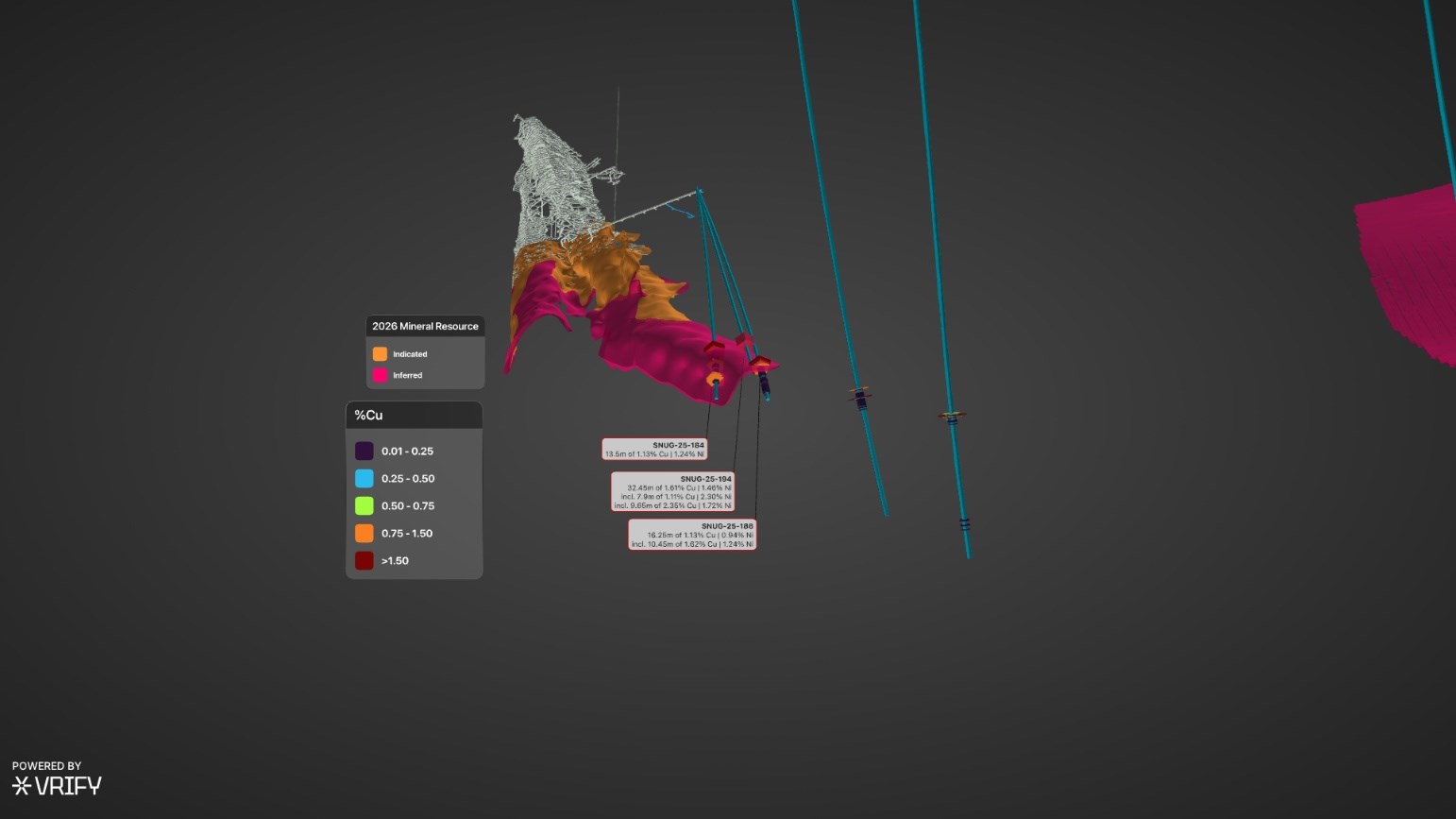
Figure 2: Selebi North's South Limb turns toward Selebi Main at depth, suggesting a potential connection between the deposits.
To view an enhanced version of this graphic, please visit:
https://images.newsfilecorp.com/files/7759/319913_4cd39927d4d0aa00_003full.jpg
Ultramafic Rocks and Potential Intrusive Keel
Dr. Peter Lightfoot's examination of the most magnesium-rich rocks in previously released deep holes SMD-25-202 and SMD-25-204 provides further insight into the Selebi intrusive system. Both holes lie down plunge of the Selebi North South Limb, in the direction of Selebi Main.
Rocks historically logged as "amphibolite" are now recognized as a suite of primary igneous rock types, altered to varying degrees to amphibolite. They are interpreted to fall into four main groups: olivine pyroxenite, pyroxenite, olivine melagabbronorite and gabbronorite. A thin section from the most magnesium-rich sample in SMD-25-204 contains fresh olivine, the first silicate to crystallize from a magnesian nickel-bearing magma. Rocks of this kind are characteristic of the keel of an intrusion, its deepest, downward-projecting part, where dense magmatic sulphide can accumulate.
Mafic-ultramafic intrusive rocks relate to nickel sulphide ore in two distinct ways:
- Primary magmatic keel, exemplified by Voisey's Bay, Labrador. The most primitive rocks, magnesium-rich variable-textured troctolites, are directly linked to the Ovoid and Eastern Deeps orebodies. Sulphide collected where feeder conduits widened or opened into the main chamber. Here, the primitive rocks mark the ore-forming pathway, and tracing them leads toward sulphide.
- Deformation-generated folds and boudins, exemplified by Thompson and Birchtree, Manitoba. Later deformation and high-grade metamorphism broke the original ultramafic intrusions into isolated boudins. Sulphide flows more readily than silicate rock, so it was remobilized to different extents, and where it came to rest differs between deposits. About 90% of Thompson's ore is now hosted in metasedimentary rocks, with its position controlled by folds and pressure shadows. At Birchtree, by contrast, most of the high-grade mineralization is concentrated at the margins of the ultramafic boudins.
Both processes may have operated in the prospective, approximately 1.5-2 km-long corridor between Selebi North and Selebi Main: primary sulphide concentrated in the keel, then redistributed by folding. Distinguishing their effects will help determine whether exploration follows the magnesium-rich rocks directly or the structures that control them.
Table 2: 2026 Selebi Mines Resource Estimate as of October 16, 2026
| Tonnage | Grade | Contained Metal | |||||||
| Classification | Deposit | (Mt) | Cu (%) | Ni (%) | Co (%) | Cu (Mlbs) | Ni (Mlbs) | Co (Mlbs) | Total (Mlbs CuEq) |
| Indicated | Selebi North | 8.95 | 1.03 | 1.08 | 0.06 | 204 | 214 | 11 | 412 |
| Total | 8.95 | 1.03 | 1.08 | 0.06 | 204 | 214 | 11 | 412 | |
| Inferred | Selebi Main Upper Zone | 23.52 | 1.61 | 1.05 | 0.05 | 834 | 546 | 28 | 1,365 |
| Selebi Main Lower Zone | 8.95 | 1.31 | 0.77 | 0.04 | 259 | 153 | 8 | 407 | |
| Selebi North | 9.48 | 1.21 | 1.13 | 0.06 | 253 | 236 | 12 | 483 | |
| Total | 41.95 | 1.45 | 1.01 | 0.05 | 1,345 | 935 | 48 | 2,255 | |
- All tabulated data have been rounded and as a result minor computational errors may occur.
- Mineral Resources, which are not Mineral Reserves, have no demonstrated economic viability. There is no guarantee that all or any part of the Mineral Resource will be converted into a Mineral Reserve. The estimate of Mineral Resources may be materially affected by geology, environment, permitting, legal title, taxation, socio-political, marketing, or other relevant issues.
- Mt = Million tonnes, Mlbs = million pounds, CuEq = copper equivalent
- The 2026 MRE has been prepared in accordance with the CIM Definition Standards (2014) and CIM Best Practice Guidelines (2019) with an effective date of October 16, 2026.
- Mineral Resources are reported at a cut-off value of US$75/t NSR (Net Smelter Return), defined as received value of final metal recovered minus off-site costs, and a minimum thickness of 1.5 metres. Block model estimates of less than US$75/t NSR are included within the Mineral Resource in areas where it was considered not feasible to mine selectively around them. Areas of the block model were excluded in low grade areas where there is no potential to define a mineable block above US$75/t NSR.
- Mineral Resources are estimated using long-term prices of US$9.10/lb Ni, US$5.10/lb Cu, US$20.00/lb Co. The same metal prices were used in NSR calculations.
- Mineral Resources are estimated using nickel, copper and cobalt recoveries of 55.6%, 96.1%, and 60.2%, respectively, derived from metallurgical studies which consider a two-concentrate scenario.
- Payabilities and off-site treatment and refining costs were derived from an independent marketing study commissioned by NexMetals.
- Bulk density has been estimated in the block model based on an extensive data set of measurements taken from drillhole cores. The average density is 3.63 t/m3 for the mineralized zone.
- Mineral Resources are reported using NSR values which assume mining costs of US$47.60/tonne, concentrate processing costs of US$20.00/tonne and G&A of US$5.50/tonne.
- Areas depleted or sterilized by mining were removed from the mineral resource.
- There are no Mineral Reserves.
- Copper equivalent is calculated using the formula CuEq =(Cu%*96.4+Ni%*87.0+Co%*132.7)/96.4.
Mineral Resource Data and Quality Control
The historical sampling data collected by the previous owner and operator, BCL Limited ("BCL") included Ni and Cu assays. The historical data was verified by NexMetals through drilling of new underground holes and visual inspection of exposed mineralization in underground workings. The data compared within reasonable limits given the variability of the mineralization.
The geological database used in the Selebi North MRE included 175 NexMetals drillholes, completed in 2023, 2024 and 2025, drilled at various inclinations and directions from underground workings. BCL drilled numerous horizontal resource definition holes as horizontal fans on each sublevel. Channel samples were cut perpendicularly across the mineralization exposed in the 10 m to 15 m vertically spaced sill drives at 10 m intervals along strike using a saw with rotating diamond impregnated blades. In many cases, diamond drilling extended the channel sample intercept into either or both sidewalls where the mineralization was not fully exposed in the sill drive. MSA examined the BCL data in and immediately surrounding the unmined areas for spatial consistency with the underground workings and included the validated data in the estimation data. Historical surface drillholes were not used in the estimate due to discrepancies in the position of mineralized intercepts relative to underground acquired data. Given the voluminous underground drilling and channel sampling database, the exclusion of the BCL surface drillhole data is not significant to the estimate.
The BCL assays were completed at the BCL Phikwe Laboratory. At the time of preparation and analysis, the BCL-owned laboratory was not independent of the operator and accredited only for high grade matte analyses, but not for exploration grade analyses. Ni and Cu were analysed by flame atomic absorption spectrometry. Relative density measurements were obtained by water immersion method.
The NexMetals drill core was logged, photographed and marked for sampling in nominal lengths of one metre. The core samples were cut in half longitudinally using a rotating diamond saw. The core samples were given a unique sample reference number, bagged and despatched to ALS Laboratories Ltd. in Johannesburg, South Africa for analysis (SANAS Accredited Testing Laboratory, No. T0387). Samples were analysed for Ni, Cu, and Co using a peroxide fusion preparation and inductively coupled plasma atomic emission spectrometry (ICP-AES) finish (ME-ICP81). Analyses for Pt, Pd, and Au were by fire assay (30 g nominal sample weight) with an ICP-AES finish (PGMICP23), also by ALS. Ag was analysed using a 4-acid digest and ICP-AES finish (ME-ICP61). Specific gravity measurements were also completed by ALS on pulps of selected samples.
The NexMetals drilling was subjected to a comprehensive programme of quality assurance and quality control by NexMetals, independent of the laboratories' own QAQC measures, including certified reference materials (5%), blank samples (5%), coarse duplicate samples (5%) and pulp duplicate samples (5%). The Qualified Person, Mr. J.C. Witley (BSc Hons, MSc (Eng.)), is satisfied that the assay results are of sufficient accuracy and precision for use in Mineral Resource estimation.
Mineral Resource Estimate
The 2026 Selebi North MRE was completed by The MSA Group in Johannesburg, South Africa.
The Mineral Resource was estimated using the Canadian Institute of Mining, Metallurgy and Petroleum (CIM) Best Practice Guidelines and is reported in accordance with the 2014 CIM Definition Standards, which have been incorporated by reference into National Instrument 43-101 - Standards of Disclosure for Mineral Projects ("NI 43-101").
The deposit can be described as a metamorphosed magmatic nickel-copper sulphide deposit. Mineralization is hosted with a folded amphibolite unit that is structurally complex and comprises two main fold structures that are contiguous forming two antiformal structures separated by a synformal structure. The limbs and the fold closures are mineralized and define three main zones with differing geological characteristics known as the South Limb, N2 and N3. The synformal area between the N2 and N3 and towards the southern part of the South Limb tend to have more variable mineralization The mineralization plunges approximately 40° to 45° towards the west to west-southwest, although a change in the plunge direction towards the southwest is interpreted in the deeper areas. The northern limbs to each fold structure are subvertical, whereas the southern limbs tend to be more moderately dipping and variable at an average of approximately 40°to the southeast. The South Limb and South Limb-N2 fold closure generally hosts the thickest intervals of mineralization, whereas the N3 Limb hosts the highest grades. Mineralization can reach thicknesses of up to 30 m in the fold closure areas and can narrow to 10's of cm in the N3 and pinch out locally. Mineralization at Selebi North comprises massive, semi-massive and disseminated sulphides contained within a unit of amphibolite that is surrounded by undifferentiated quartzo-feldspathic and mafic gneisses. In the wider portions of the deposit a distinct schistose amphibolite unit occurs which generally forms the footwall to the potentially economic mineralization, however locally mineralization can extend to within it. Massive sulphide tends to be preferentially developed near the hangingwall contact with the gneiss.
NexMetals drilling intersected nickel-copper sulphides at depths of up to approximately 1,550 m below surface. Stoping has depleted the Mineral Resource from near surface to between approximately 850 m and 900 m below surface.
Cobalt and silver occur within the nickel-copper sulphide mineralization, with sufficient cobalt data to include in the 2026 MRE; however, silver assays are not available over much of the Mineral Resource extent and have not been included in the 2026 Selebi North MRE. Minor concentrations of platinum and palladium occur within the nickel-copper sulphide mineralization for which economic potential has not been established and, similarly to silver, platinum and palladium assays do not cover the full extent of the Mineral Resource. Sulphide mineralogy is primarily pyrrhotite, chalcopyrite and pentlandite.
All recent exploration at the project, since the closure of the mine, was completed by NexMetals between 2022 and 2026. All prior exploration work of relevance to the 2026 Selebi North MRE was completed by the previous operator, BCL, up until 2016, this being the underground drilling and channel sampling that exist within the top 50 m of the mineral resource and inform less than 10% of the Mineral Resource Estimate. The drilling completed since the 2024 MRE allowed for refinement of the previous interpretation and extension to the previously defined resource area. No additional exploration data have been collected since the last assays were received by NexMetals on 26 April 2026.
Geological modelling was undertaken in Leapfrog Geo utilising implicit modelling. Mineralized intercepts were defined in the drillhole and channel sample data based on thickness, lithology and grade. Intercepts were selected based on an approximate threshold Net Smelter Return (NSR) value of US$70/t using nickel, copper and cobalt grades, while ensuring geological continuity between closely spaced intercepts. Given the strong association of the higher grade mineralisation with the hangingwall contact of the amphibolite with the enclosing gneiss this was used as the preferred hangingwall contact during modelling to ensure geological continuity. A minimum thickness of 1.5 metres was used to allow for a potential minimum mining width, and in some cases dilution outside the mineralized vein was included.
Variography was completed using Datamine Supervisor software. Ellipsoids were orientated in the plane of mineralization with anisotropy along the mineralization plunge. Nickel, copper, and cobalt grades and density were interpolated into a non-rotated block model with a parent cell size of 5 mX by 5 mY by 5 mRL using ordinary kriging. The Datamine process of "Dynamic Anisotropy" was used to modify the search ellipse to changes in the mineralization orientation. Volumes representing mined voids were removed and NSR was then calculated for each block model cell using the estimated grades, metal prices, recoveries, off-site costs and payabilities. The Mineral Resource was classified into the Indicated and Inferred categories, taking into account data quality, geological modelling uncertainty, drillhole spacing, drillhole intersection angle and kriging outputs. The majority of the Inferred Mineral Resource is informed by drillholes with an approximate spacing of 100 metres and the majority of the Indicated Mineral Resource is informed by drillholes with an approximate spacing of 50 metres or significantly less close to the mined areas. The Mineral Resource extent was extrapolated a maximum of 50 metres along strike taking into account the mineralization trends and surrounding data.
The Mineral Resource was reported using a NSR value above US$75/t and a minimum thickness of 1.5 metres. Block model estimates of less than US$75/t NSR are included within the Mineral Resource in areas where it was considered not feasible to mine selectively around them. Areas of the block model were excluded in low grade areas where there is no potential to define a mineable block above US$75/t NSR. Using concentrate processing costs of US$20.00/tonne, G&A of US$5.50/tonne, mining costs of US$47.60/tonne and royalties of 3% for base metals, the Mineral Resource satisfies cut-off grade criteria and the QP considers that reasonable prospects for eventual economic extraction (RPEEE) for the Mineral Resource have been demonstrated.
Mineral Resources are not Mineral Reserves and do not have demonstrated economic viability. The estimate of Mineral Resources may be materially affected by environmental, permitting, legal, title, taxation, socio-political, marketing, or other relevant issues. There is no certainty that any Mineral Resources will be converted into Mineral Reserves. The quantity and grade of reported Inferred Mineral Resources in the 2026 MRE are uncertain in nature, there has been insufficient exploration to define these Inferred Mineral Resources as an Indicated or Measured Mineral Resource, and it is uncertain if further exploration will result in upgrading them to an Indicated or Measured Mineral Resource category.
Qualified Persons
Mr. J.C. Witley (BSc Hons, MSc (Eng.)) is a geologist with more than 35 years' experience in base and precious metals exploration and mining as well as Mineral Resource evaluation and reporting. He is Head of Mineral Resources for The MSA Group (an independent consulting company), is registered as Pr.Sci.Nat. with the South African Council for Natural Scientific Professions (SACNASP) and is a Fellow of the Geological Society of South Africa (GSSA). Mr. Witley has the appropriate relevant qualifications and experience to be considered a "Qualified Person" for the style and type of mineralization and activity being undertaken as defined in NI 43-101 and is considered independent of NexMetals pursuant to NI 43-101. Mr. Witley has reviewed and approved the technical and scientific information within this news release pertaining to the 2026 MRE.
Verification by Mr. Witley included a site visit to inspect historical mineralized core, observe existing infrastructure on surface and underground, examine mineralization in underground drives, and verify several surface drillhole collar locations (both historical and recent). The mineralization in 16 NEXM holes was inspected by the QP together with the sample assay results to verify the magnitude of the mineralization copper and nickel grades. In addition, a selection of samples collected by NexMetals have been verified against independently accessed assay certificates, and a random selection of historical database results have been compared against digital records.
Sharon Taylor, MSc, P.Geo., Vice President, Geophysics of the Company, a "qualified person" as defined under NI 43-101, has reviewed and approved all other scientific and technical information in this news release other than the information pertaining to the 2026 MRE and the information approved by Dr. Lightfoot.
Dr. Peter Lightfoot, PhD, P.Geo., a Consulting Geologist to the Company, a "qualified person" as defined under NI 43-101, has reviewed and approved the scientific and technical information in this news release relating to the geology, petrology and lithogeochemistry of the Selebi intrusive system, including the information under the headings "Magnesium-rich rocks point to a possible intrusive keel" and "Ultramafic Rocks and Potential Intrusive Keel".
Technical Report
The 2026 MRE will be supported by a NI 43-101 Technical Report to be filed within 45 days of the Company's news release dated October 1, 2026.
Clarification Regarding Engagement Agreement
Further to the Company's news release dated October 1, 2026, the Company wishes to clarify that its engagement agreement with SRC Swiss Resource Capital AG has a 6-month term extending until March 1, 2027.
About NexMetals Mining Corp.
NexMetals Mining Corp. is a TSX.V and NASDAQ listed mineral exploration and development company focused on redeveloping the past-producing Selebi and Selkirk copper-nickel-cobalt-platinum group element mines in Botswana. At Selebi, NexMetals has confirmed the scale of mineralization is larger than historical estimates, supported by NI 43-101- and Regulation S-K 1300-compliant resource estimates, with ongoing down-hole geophysics, drilling, and metallurgical programs aimed at expanding resources and supporting future economic studies. The Company is led by an experienced management and technical team with a proven track record in global mineral projects, emphasizing disciplined execution, transparent governance, and long-term stakeholder value creation.
For further information about NexMetals Mining Corp., please contact:
Sean Whiteford
CEO
info@nexmetalsmining.com
1-866-794-NEXM (6396)
Follow Us
X: https://x.com/NexMetalsCorp
LinkedIn: https://www.linkedin.com/company/NexMetalsMiningCorp
Facebook: https://www.facebook.com/NexMetalsMiningCorp
Neither the TSX Venture Exchange and its Regulation Services Provider (as that term is defined in the policies of the TSX Venture Exchange) nor the Nasdaq Stock Market LLC accepts responsibility for the adequacy or accuracy of this news release. No stock exchange, securities commission or other regulatory authority has approved or disapproved the information contained herein.
Cautionary Note Regarding Forward-Looking Statements
This news release contains "forward-looking statements" within the meaning of the United States federal securities laws and "forward-looking information" within the meaning of applicable Canadian securities legislation (collectively, "forward-looking information") based on expectations, estimates and projections as at the date of this news release. Forward-looking information involves risks, uncertainties and other factors that could cause actual events, results, performance, prospects and opportunities to differ materially from those expressed or implied by such forward-looking information. For the purposes of this release, forward-looking information includes, but is not limited to, the 2026 MRE; the filing of a Technical Report prepared in accordance with NI 43-101 supporting the 2026 MRE and the timing thereof; the potential conversion of Inferred Mineral Resources to Indicated Mineral Resources and increased confidence for future mine planning; the potential geological connection and continuity between the Selebi North and Selebi Main deposits through the Hinge Zone; the potential presence of an intrusive keel and the prospectivity of the corridor between Selebi North and Selebi Main; the results and timing of the structural study by TECT Geological Consulting; the generation of exploration targets and the direction and focus of future exploration; the deposits remaining open and the potential for further resource growth within and between the deposits, including at depth at the Selebi Mine and within the Flexure Zone; Selebi's potential to become a world-class copper-nickel sulphide project; the ability to produce separate, clean copper and nickel concentrates that meet commercial smelter specifications; the potential implications of the expanding resource for mine design and project economics; the additional time taken for the Selebi PEA, the evaluation of alternative restart options and the timing and scope of further drilling and technical work; the Company's Project Funding Review for the Company's assets, including its scope, progress, the timing and completion, and the potential outcomes of that process, including minimizing dilution to existing shareholders; the completion of a PEA for Selkirk by DRA Global; and the Company's plans to prioritize expenditures, align the pace of work with available capital and direct the Company towards the opportunities it believes offer the greatest value to shareholders. These forward-looking statements, by their nature, require the Company to make certain assumptions and necessarily involve known and unknown risks and uncertainties that could cause actual results to differ materially from those expressed or implied in these forward-looking statements.
Forward-looking information is based on a number of material assumptions that management believes to be reasonable as at the date of this news release, including, but not limited to: the accuracy of the 2026 MRE and the key inputs and parameters on which it is based, including long-term metal prices, metallurgical recoveries, payabilities, off-site costs, royalties, mining, processing and G&A cost assumptions and the NSR cut-off value; the reliability of historical data collected by BCL; the validity of the Company's current geological, structural, geophysical and geochemical interpretations; the continuity of mineralization between drillholes and down plunge; the availability of drilling equipment, personnel and contractors; the Company's ability to obtain financing on acceptable terms when needed; currency exchange rates consistent with current expectations; the Project Funding Review and the Selkirk PEA proceeding substantially as currently anticipated; the receipt of required governmental, environmental and other approvals and permits in a timely manner; the absence of material adverse changes in the political, regulatory, fiscal and economic environment in Botswana, including royalty and tax regimes; and the continued engagement and performance of the Company's consultants and advisors.
Factors that could cause actual results to differ materially from such forward-looking information include, but are not limited to, the uncertainty inherent in Mineral Resource estimates, including that Inferred Mineral Resources are subject to a high degree of uncertainty and may not be upgraded to Indicated or Measured Mineral Resources, and that Mineral Resources that are not Mineral Reserves do not have demonstrated economic viability; the reliability of historical data, including assays completed by a laboratory that was not independent and was not accredited for exploration grade analyses; risks associated with historical mining, including mined-out voids and areas depleted or sterilized by mining; fluctuations in copper, nickel and cobalt prices; fluctuations in currency exchange rates; changes in metallurgical recoveries, payabilities and capital and operating costs from those assumed, including the risk that the two-concentrate scenario cannot be achieved at commercial scale; the preliminary nature of drilling, geophysical and metallurgical results and of current geological interpretations, including that further drilling may not confirm a connection between Selebi North and Selebi Main, the presence of an intrusive keel or the continuity of mineralization; the ability of exploration results to predict mineralization; the risk that the Company will not be able to expand or enhance its current Mineral Resource estimates; the ability of the Company to implement its drilling, geoscience and metallurgical work and work plans generally; risks relating to the additional time needed for the Selebi PEA; including the risk that no viable restart option is identified or that any restart option requires significant capital, permitting or time; prefeasibility or the feasibility of mine production; the risk that the Project Funding Review may not result in a transaction on favourable terms to the Company or at all; the risk that the Selkirk PEA may not be completed when anticipated or may not produce favourable results; delays in, or the inability to file, the Technical Report within the required time; delays in obtaining or failures to obtain required governmental, environmental or other project approvals; title risks; political, regulatory, fiscal and economic risks associated with operating in Botswana, including changes to royalty and tax regimes; dependence on key personnel, consultants and advisors; the Company's ability to maintain its listings on the TSX Venture Exchange and the Nasdaq Stock Market; uncertainties relating to the availability and costs of financing needed in the future; changes in equity markets; inflation; delays in the development of projects; the other risks involved in the mineral exploration and development industry; and those risks set out in the Company's filings with the SEC on EDGAR (www.sec.gov) and in Canada on SEDAR+ (www.sedarplus.ca), in each case, under the Company's issuer profile. Although the Company believes that the assumptions and factors used in preparing the forward-looking information in this news release are reasonable, undue reliance should not be placed on such information, which only applies as of the date of this news release, and no assurance can be given that such events will occur in the disclosed time frames or at all. The Company disclaims any intention or obligation to update or revise any forward-looking information, whether as a result of new information, future events or otherwise, other than as required by law.
To view the source version of this press release, please visit https://www.newsfilecorp.com/release/319913
Source: NexMetals Mining Corp.