
Vancouver, British Columbia--(Newsfile Corp. - October 15, 2026) - Tower Resources Ltd. (TSXV: TWR) ("Tower" or the "Company") is pleased to report the gold results from Holes 077 and 078 of the June diamond drilling program on the Company's Rabbit North property near Kamloops, B.C. (see Fig. 1), including 20.3 m of 3.13 g/t Au and 134.0 m of 0.65 g/t Au from the Upper and Lower Domains, respectively, of the Blue Sky Zone in Hole 077. The Upper Domain result includes 8.0 m of 7.16 g/t Au. In Hole 078, this domain is considerably thicker at 50.3 m and averages 1.07 g/t Au, including 3.6 m of 4.15 g/t Au near the top and 10.0 m of 2.29 g/t Au at the bottom.
Drilling Summary
The Company's June drilling program comprised eight holes totaling 2303.5 metres. The results from the first three holes, Nos. RN26-074 to 076, were released previously (see August 13, 2026 press release) but those from the remaining five holes were delayed because less than half of the core in three holes had been cut and assayed due to unavailability of experienced core cutters. The remaining core was cut in late September. The first assays have been received, completing the set for Holes 077 and 078. As these holes were drilled from a common pad, their results are herein presented together
Results from Holes 077 and 078
Holes 077 and 078 were drilled 50 m southwest of Hole 055, the Blue Sky discovery hole, with the objective of progressively infilling the 400 m untested gap between the Blue Sky and Thunder North gold zones (see Figs. 1, 2). They were drilled toward the northwest, parallel to Hole 055, at dips of -050 and -070○, respectively.
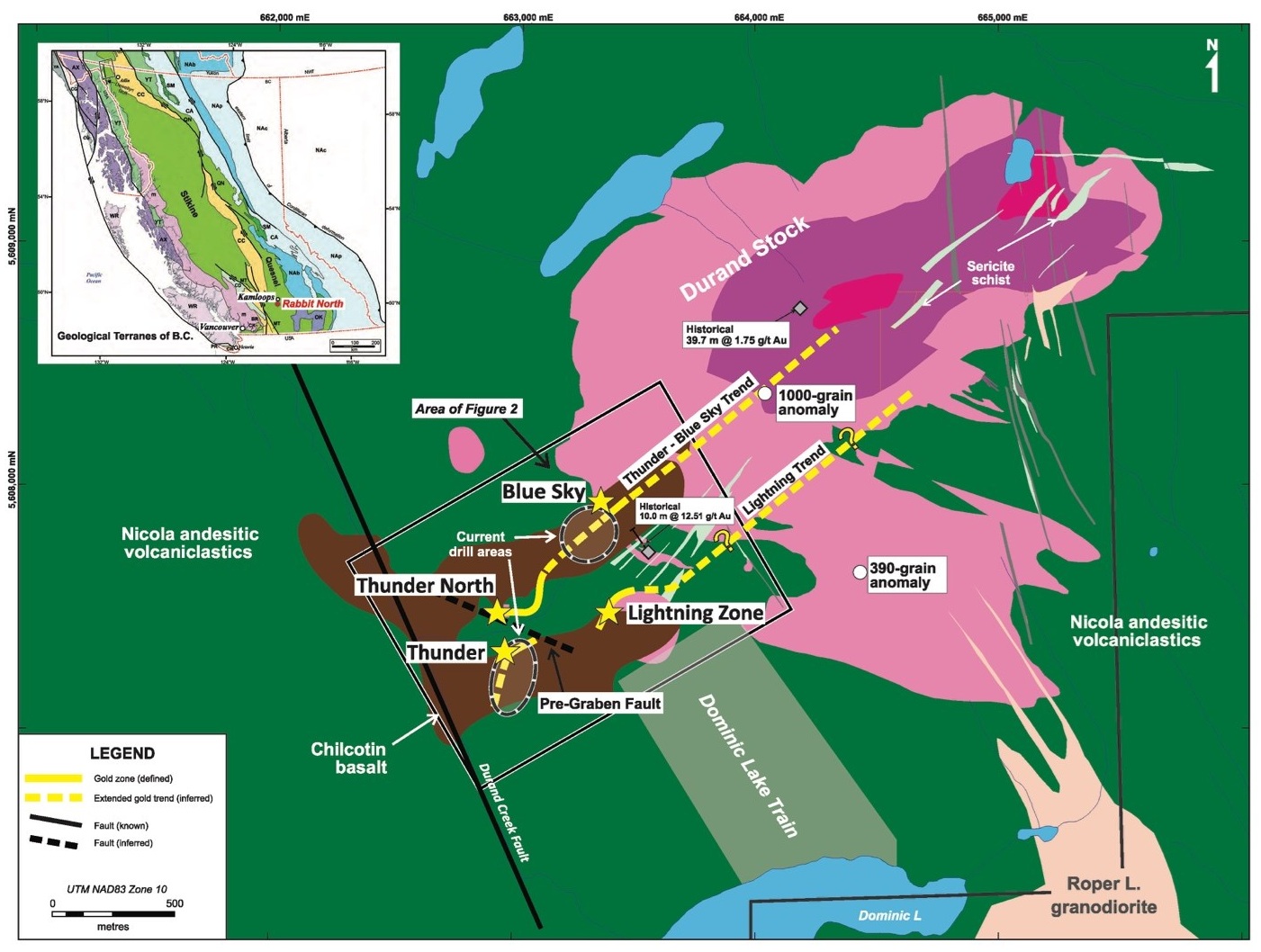
Figure 1 – Location of the Rabbit North property showing the geology of the central part and the major shear structures controlling Tower's gold discoveries. These shear zones are roughly coincident with more recent graben fault valleys that have been infilled by Chilcotin basalt flows. The yellow stars mark the locations of the main Au intersections in the initial discovery holes on the gold zones. Areas targeted in the current drill program are highlighted.
To view an enhanced version of this graphic, please visit:
https://images.newsfilecorp.com/files/5023/319130_twr-figure1.jpg
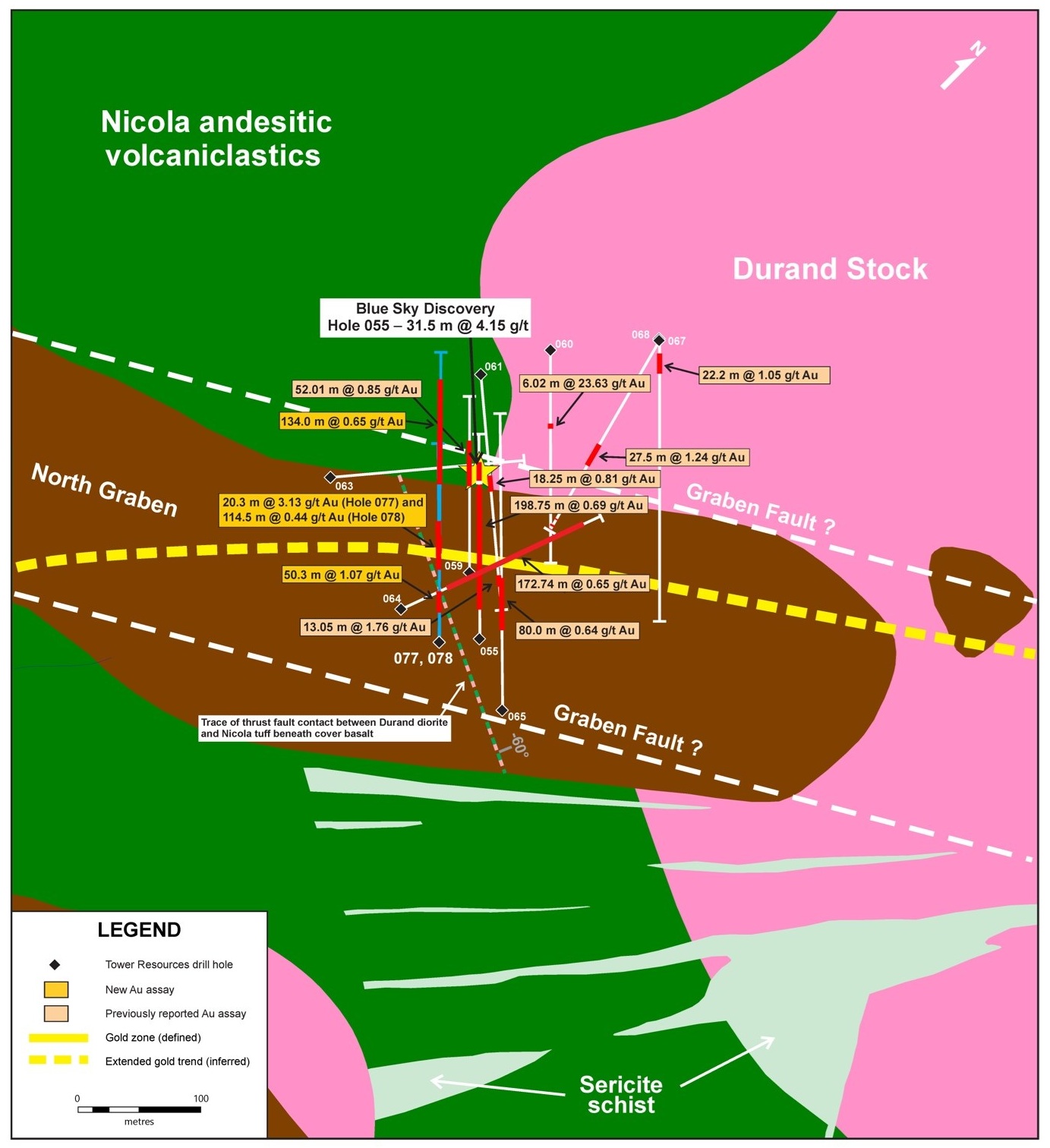
Figure 2 – Locations of Holes 077 and 078 relative to the Blue Sky gold zone. See Fig. 1 for bedrock lithologies and expanded legend.
To view an enhanced version of this graphic, please visit:
https://images.newsfilecorp.com/files/5023/319130_twr-figure2.jpg
Both holes were relatively long, reaching 362.0 and 468.0 m respectively (see Table 1), partly because the Blue Sky Zone is this area is covered by up to 70 m of much younger (~5 Ma vs 145 Ma) Chilcotin basalt + oxide-cemented alluvial gravel + saprolite and partly because the neighbouring mineralized section in the discovery hole was unusually thick, comprising 198.75 m of 0.69 g/t Au followed closely down-hole by 31.5 m of 4.15 g/t Au (see December 23, 2024 press release).
| Total Depth (m) | Mineralized Interval(s) | Average Au Grade (g/t) | |||||||||
| Hole No. | Easting (m) | Northing (m) | Azimuth (°) | Dip (°) | Mineralized Zone(s) | From (m) | To (m) | Length (m) | Au x m | ||
| RN-25-077 | 663412 | 5607826 | 315.38 | 49.4 | 362.00 | Upper Blue Sky | 111.30 | 131.60 | 20.30 | 3.13 | 64 |
| including | 123.60 | 131.60 | 8.00 | 7.16 | 57 | ||||||
| Lower Blue Sky | 197.50 | 328.50 | 134.00 | 0.65 | 87 | ||||||
| and including | 311.00 | 312.50 | 1.50 | 16.70 | 25 | ||||||
| RN-25-078 | 663412 | 5607827 | 314.44 | -69.9 | 468.00 | Upper Blue Sky | 70.00 | 120.30 | 50.30 | 1.07 | 48 |
| including | 83.30 | 86.90 | 3.60 | 4.15 | 15 | ||||||
| and including | 110.30 | 120.30 | 10.00 | 2.29 | 23 | ||||||
| Lower Blue Sky | 171.00 | 285.50 | 114.50 | 0.44 | 50 | ||||||
| and including | 242.80 | 244.20 | 1.40 | 7.13 | 10 | ||||||
Table 1 – Significant orogenic Au intercepts from Rabbit North Holes 077 and 078. Only zones with gold grade (in g/t) x core width (in metres) greater than 10 are shown. Gold values are uncut. Samples with Au grades greater than 15 g/t are shown individually. True widths have not been determined. See Figure 2 for hole locations.
As shown in section in Figure 3, both Holes 077 and 078 intersected a thin wedge of Durand diorite immediately below the cover basalt-saprolite, followed down-hole by the first of two mineralized domains – Upper and Lower – hosted by the thick Nicola tuffs that surround and are co-magmatic with the ~215 Ma Durand Stock.
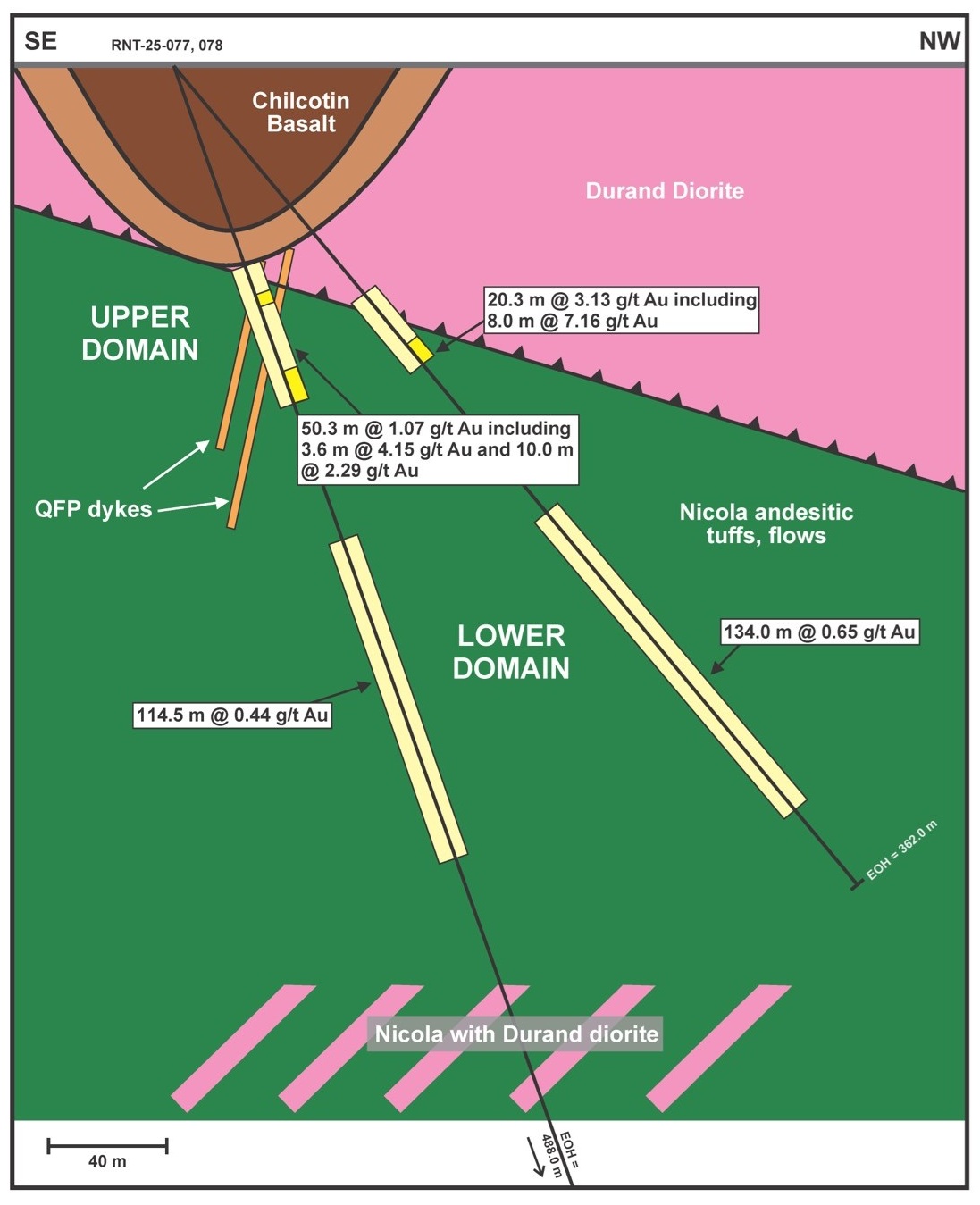
Figure 3 – Section of the Blue Sky Zone through Holes 077 and 078, looking southwest.
To view an enhanced version of this graphic, please visit:
https://images.newsfilecorp.com/files/5023/319130_twr-figure3.jpg
The diorite overlying the Upper Domain was unmineralized except for the bottom few metres in Hole 077 (see Fig. 3). However, a hole previously drilled east-northeast across the same section (No. 064 in Figure 2) encountered much thicker diorite beneath the cover rocks, including a 172.74 m mineralized section directly below the saprolite that averaged 0.65 g/t Au (see Fig. 2).
Oddly, the diorite overlies the volcanics that it intrudes, and dips shallowly to the northeast toward the Durand Stock (see Fig. 3). This suggests that diorite/tuff contact, which is now obscured by supergene oxidation, is a thrust fault, with the diorite thrust upward and outward from the Durand Stock onto the tuff. Its pre-basalt erosional limit is ~100 m southwest of the stock (see Fig. 2).
The Upper Domain, immediately below the diorite, is of a higher grade than the Lower Domain but is not as thick. The Hole 077 intersection is 20.3 m long down-hole and averages 3.13 g/t Au, including 8.0 m of 7.16 g/t Au at the base of the section (see Fig. 3 and Table 1). The Hole 078 intersection is 50.3 m long and averages 1.07 g/t Au, including 3.6 m of 4.15 g/t Au near the top and 10.0 m of 2.29 g/t Au at the bottom.
The Lower Domain is located ~50 m vertically below the Upper Domain (see Fig. 3). The Hole 077 intersection is 134.0 m long and averages 0.65 g/t Au, mirroring the results previously obtained 50 m to the east from parallel Holes 055 and 065 (198.75 m @ 0.69 g/t Au and 80.0 m @ 0.64 g/t Au, respectively), and also from cross-cutting Hole 064 (172.74 m @ 0.65 g/t Au).
Gold peaks >1 g/t, but mostly <2 g/t and only rarely above 5 g/t, were obtained from roughly every tenth sample in the thick intersections of the Lower Domain. In the above four holes, the "background" Au content of the samples between these peaks is unusually high, averaging 0.2-0.3 g/t. This additional mineralization smooths out the overall Au grade. The Hole 078 intersection was also long at 114.5 m but its overall Au grade was slightly lower at 0.44 g/t, possibly indicating proximity to the edge of the gold zone (see Fig. 2).
Configuration of the Gold Domains
Viewed in a section through Holes 077 and 078 (see Fig. 3), both the Upper and Lower Domains of the Blue Sky Zone appear to be sub-horizontal whereas the mineralization was previously thought to dip steeply southeast in the same manner as the Thunder North Zone (see March 18, 2026 press release).
In the original discovery hole, No. 055, the two gold domains are only 15 m apart. Curiously, their order is reversed, with the thick low-grade zone lying above the high-grade zone which in turn overlies rather than underlies barren Durand diorite. This reversal suggests the presence between the Holes 077-078 and discovery-area drill sections of a tight, northwest striking fold with a subhorizontal axis. The presence of such a fold is not unexpected because late tectonic horizontal compression and shear deformation are complementary processes critical to the formation of orogenic gold deposits. Hence, the apparent sub-horizontal aspect of the Upper and Lower gold domains in the Holes 077-078 section (see Fig. 3) could simply be an artefact of the section being parallel to the fold limbs.
Favourable Economic Attributes of the Blue Sky Zone
Whether the unusually thick Au mineralization in the Blue Sky area is due to the mineralization being deposited sub-horizontally, e.g. if it associated with the low-angle thrust fault that caps the Upper Domain, or subsequently thickened by folding, the thickness attribute, in combination with the proximity of the mineralization to surface, enhances prospects for economic development by open pit methods.
The vertical thickness of the basalt-saprolite cover, plus any unmineralized diorite, is only 60-70 m and the maximum separation between the Upper and Lower Domains is only 50 m. In addition, the unusually high, 0.2-0.3 g/t Au "background" in the lowest grade sections of the thick Lower Domain causes the overall Au grade of this domain to be relatively consistent and predictable.
Next Steps
Due to the essentially horizontal aspect of the Blue Sky Zone and the great thickness and consistent Au grade of its Lower Domain, the gold resources of the zone can probably best be established from vertical holes drilled in a grid pattern. Some holes should extend well below 250 m, the approximate base of the delineated portion of the Lower Domain, to test for possible additional mineralized domains at depth. Angle drilling can continue to be used to explore the presumed northeastern strike extension of the gold trend across the Durand Stock toward the exceptionally strong, 1001-grain gold anomaly identified previously identified in the till (see November 3, 2025 press release).
The favourable corridor has only minimal basalt cover, and earlier this month the Company performed detailed geological mapping and till boulder prospecting along it. Several highly oxidized boulders with resistate quartz veins and/or residual siliceous patches were found, including some having a discernible quartz-feldspar protolith. These features suggest proximity to a recessively saprolitized shear zone compatible with the Blue Sky structure. Assays are pending.
Methods and Qualified Person
The drill core was logged at Tower's leased, fully equipped core facility near Kamloops under the direction Matthew Husslage, P.Geo. Mr. Husslage has managed or co-managed all of Tower's Rabbit North diamond drilling programs since the discovery of the Lightning Zone in December 2021.
Split samples of the core, generally 1.0 or 1.5 m in length, were delivered directly to Activation Laboratories (ActLabs) in Kamloops, BC, a laboratory certified as ISO/IEC 17025 Accredited (Lab 790) by the Standards Council of Canada. QA/QC samples including blanks and standards were inserted regularly into the sample sequence at a ratio of approximately 1:20.
The samples were analyzed for Au by fire assay and ICP-OES and for Ag and 36 additional elements by ICP-OES using a four-acid, near-total digestion. Any over-limit (>5 g/t) Au analyses were repeated using the same fire assay procedure but with a gravimetric rather than ICP finish.
The technical content of this news release has been reviewed and approved by Stuart Averill, P.Geo., a director of the Company and a Qualified Person as defined by National Instrument 43-101.
About Tower Resources
Tower is a Canadian based mineral exploration company focused on the discovery and advancement of economic mineral projects in the Americas. The Company's key exploration assets, all in B.C., are the Rabbit North orogenic gold and porphyry copper-gold project located between the New Afton copper-gold and Highland Valley copper mines in the Kamloops mining district, the Nechako porphyry-associated gold-silver project near Artemis' Blackwater project and the More Creek epithermal gold project on the critical "red line" structural zone connecting the mineral deposits of the Golden Triangle.
On behalf of the Board of Directors
Tower Resources Ltd.
Joe Dhami, President and CEO
(778) 996-4730
www.towerresources.ca
Reader Advisory
This news release may contain statements which constitute "forward-looking information", including statements regarding the plans, intentions, beliefs and current expectations of the Company, its directors, or its officers with respect to the future business activities of the Company. The words "may", "would", "could", "will", "intend", "plan", "anticipate", "believe", "estimate", "expect" and similar expressions, as they relate to the Company, or its management, are intended to identify such forward-looking statements. Investors are cautioned that any such forward-looking statements are not guarantees of future business activities and involve risks and uncertainties, and that the Company's future business activities may differ materially from those in the forward-looking statements as a result of various factors, including, but not limited to, fluctuations in market prices, successes of the operations of the Company, continued availability of capital and financing and general economic, market or business conditions. There can be no assurances that such information will prove accurate and, therefore, readers are advised to rely on their own evaluation of such uncertainties. The Company does not assume any obligation to update any forward-looking information except as required under the applicable securities laws.
Neither TSX Venture Exchange nor its Regulation Services Provider (as that term is defined in policies of the TSX Venture Exchange) accepts responsibility for the adequacy or accuracy of this release.
To view the source version of this press release, please visit https://www.newsfilecorp.com/release/319130
Source: Tower Resources Ltd.