
| 688 m continuous REE-Ga interval (SL26-35), starting 4.6 m downhole | ~43% higher grade than the Indicated resource across four 75-324 m intervals | 13 of 13 2026 holes carried gallium over their full assayed length | 3 critical minerals in one deposit: rare earths, gallium, niobium |
HIGHLIGHTS
- Drilling done, two resource estimates next. All assays from the 13-hole, 5,445 metre ("m") winter program are now reported and will be used in an inaugural gallium resource estimate and an updated rare earth resource estimate, both targeted for Q4 2026.
- Hundreds of metres of continuous mineralization. Drill hole SL26-35 intersected 688.4m grading 0.81% TREO and 68.1 g/t Ga2O3, beginning just 4.6m down the hole. SL26-29 returned 324.0m of 1.00% TREO and 70.1 g/t Ga2O3, and SL26-30 returned 236.1m of 1.00% TREO, starting 5.4m down the hole.
- Long intervals above the current resource grade. Four 2026 intervals of 75m to 324m grade 1.00% TREO or better, ~43% higher than the 0.70% TREO average grade of the current Indicated resource (10kg of rare earth oxides per tonne versus 7kg).
- High grades and gallium in every hole. SL26-29 returned 7.54% TREO and 282.7 g/t Ga2O3 over 2.95m, the highest-grade interval of the 2026 program (more than 10x the current resource). Gallium was present over the full assayed length of every 2026 hole reported.
- Gallium in every hole. Gallium was present over the full assayed length of every 2026 hole. China controls 99% of global primary gallium production (USGS, 2026).
- Niobium emerges as a potential additional critical metal. A compilation of 39 holes found niobium intervals longer than 2.0m in 13 of 39 holes, including 0.16% Nb2O5 over 41.8m, including 0.46% Nb2O5 over 2.0m in SL12-12, and 0.11% Nb2O5 over 58.2m in SL11-01, in the same interval as 1.53% TREO and 104.8 g/t Ga2O3. Niobium is not in the current resource estimate, no niobium metallurgical testing has been completed, and these grades are below those of mines where niobium is the primary product.
Toronto, Ontario--(Newsfile Corp. - October 6, 2026) - Volta Metals Ltd. (CSE: VLTA) (OTCQB: VOLMF) (FSE: D0W) ("Volta" or the "Company") announces that all assay results from its 2026 winter drill program at the Springer Rare Earth Element deposit (the "Property"), near Sturgeon Falls, Ontario, have been reported, and that a compilation of drill data identifies niobium as a potential critical metal. Springer is ranked among the 10 largest rare earth deposits in North America (S&P Global Market Intelligence, 2025).
"This program did what we needed it to do. Every hole carried gallium, several stayed in rare earth mineralization for hundreds of metres, and our best long intervals grade well above our current resource. Those results now go straight into two resource estimates this quarter, including what would be the first gallium resource at Springer. Niobium is an unexpected addition. It is early, and we have not done any niobium metallurgy, but the potential for three critical minerals in one deposit beside the Trans-Canada Highway and existing infrastructure is worth understanding properly," said Kerem Usenmez, President and CEO of Volta.
WHY THIS MATTERS: THREE CRITICAL ELEMENTS IN ONE DEPOSIT
| Mineral | Main uses | Where supply comes from | Best Springer result |
| Rare earths (mainly Pr and Nd) | Permanent magnets for EVs, wind turbines, robotics and defence systems. | China dominates rare earth refining and magnet production. | 324.0m of 1.00% TREO (SL26-29). |
| Gallium | Semiconductors, LEDs, 5G, radar and defence electronics. | China: 99% of primary production (USGS, 2026). | 282.7 g/t Ga2O3 over 2.95m (SL26-29); present in every 2026 hole. |
| Niobium | Stronger, lighter steel for pipelines, vehicles and structures; aerospace superalloys. | Brazil: about 93% of mine production. U.S. is 100% import-reliant (USGS, 2026). | 0.16% Nb2O5 over 41.8m, including 0.46% over 2.0m (SL12-12). |
All three are designated critical minerals in Canada, the United States, and the European Union. Gallium and niobium are not included in the current Springer mineral resource estimate.
Gallium and niobium are not included in the current Springer mineral resource estimate.
| READING THE NUMBERS TREO (total rare earth oxides) is the standard measure of rare earth content. 1.00% TREO = 10 kg of rare earth oxides per tonne of rock. g/t = grams per tonne; 10,000 g/t = 1%. For context, the current Springer Indicated resource averages 0.70% TREO across 56.6 million tonnes. All intervals in this release are downhole core lengths; true thickness is unknown. |
WHAT'S NEXT: TWO RESOURCE ESTIMATES TARGETED FOR Q4 2026
- Initial gallium resource estimate. In progress. This would be the first gallium resource declared for the Property.
- Updated rare earth resource estimate, incorporating the 2026 infill and expansion drilling.
Both estimates will be prepared in accordance with National Instrument 43-101 and CIM Definition Standards. Separately, Volta will assess whether the niobium data warrants dedicated analytical, mineralogical and metallurgical work. No decision has been made, and niobium is not currently contemplated in either resource estimate.
DETAILS
2026 Drill Program Complete
From January to April 2026, Volta completed 13 drill holes totalling 5,445m (SL26-27 to SL26-39) at Springer (Figure 1). The program had two goals: upgrade the current mineral resource estimate through infill drilling and expand the known rare earth and gallium mineralization. All assays have now been received from the Saskatchewan Research Council ("SRC") and reported. Three key findings:
- Rare earth mineralization is continuous across the deposit, with the highest grades concentrated in the central portion of the Springer deposit.
- Gallium is widespread throughout the deposit, occurring over the full assayed length of every 2026 drill hole, across multiple rock types and independent of rare earth grade.
- Niobium represents a potential third critical mineral, with the strongest mineralization concentrated in the central portion of the deposit and additional zones identified to the north and south.
Table 1 summarizes the most significant rare earth, gallium and niobium intercepts reported at Springer to date, including both the widest mineralized intervals and selected higher-grade intervals. Collar locations for all drill holes mentioned in this release are provided in Table 3.
Where Niobium Occurs at Springer
Volta compiled niobium assays covering the 2011, 2012, 2025 and 2026 programs (Table 2 and Figure 4). Elevated niobium is widespread, with 23 of the 39 drill holes containing primarily narrow intervals of less than 2.0m. More substantial intervals grading approximately 1,000 g/t Nb2O5 (0.1%) or higher occur in 13 of the 39 drill holes and are associated with two distinct geological settings:
- Carbonatite-rich zones in the centre of the deposit, where elevated niobium occurs together with high rare earth and gallium mineralization. SL25-24, for example, returned 924 g/t Nb2O5, 1.98% TREO and 116 g/t Ga2O3 over 14.5m (158.0m to 172.5m) (Figure 2).
- Red syenite zones in the northern and southern portions of the deposit, generally containing little or no carbonatite, where elevated niobium occurs with more moderate rare earth and gallium grades. SL25-25 returned 1,106 g/t Nb2O5, 0.34% TREO and 42.7 g/t Ga2O3 over 9.0m (393.0m to 402.0m) (Figure 3).
Table 1. Best REE-Ga intercepts to date, Springer deposit
| Drill hole | From (m) | To (m) | Width (m) | Ga2O3 (g/t) | TREO (%) | HREO % of TREO | Nb2O5 (g/t) |
| SL11-01 | 145.9 | 204.1 | 58.2 | 104.8 | 1.53 | 4.7 | 1,117 |
| SL25-23 | 59.6 | 191.5 | 131.9 | 81.2 | 1.38 | 2.7 | 544 |
| SL25-24 | 158.0 | 172.5 | 14.5 | 116.0 | 1.98 | 3.1 | 924 |
| SL26-28 | 124.5 | 199.5 | 75.0 | 76.6 | 1.02 | 7.1 | 340 |
| SL26-29 | 96.0 | 420.0 | 324.0 | 70.1 | 1.00 | 5.0 | 302 |
| SL26-29 | 249.0 | 304.5 | 55.5 | 100.3 | 1.80 | 3.8 | 259 |
| SL26-29 | 249.0 | 251.95 | 2.95 | 282.7 | 7.54 | 1.9 | 272 |
| SL26-30 | 5.4 | 241.5 | 236.1 | 71.9 | 1.00 | 8.2 | 457 |
| SL26-30 | 114.2 | 141.0 | 26.8 | 104.6 | 1.95 | 8.8 | 498 |
| SL26-30 | 121.5 | 132.0 | 10.5 | 106.2 | 2.00 | 11.3 | 528 |
| SL26-30 | 142.5 | 165.0 | 22.5 | 86.2 | 1.28 | 5.4 | 1,150 |
| SL26-35 | 4.6 | 693.0 | 688.4 | 68.1 | 0.81 | 4.8 | 254 |
| SL26-35 | 366.0 | 576.0 | 210.0 | 79.0 | 1.01 | 3.4 | 256 |
Compiled from Volta news releases dated January 26, February 11, June 8, June 15, August 10, September 3, September 15, and September 21, 2026, and from Table 2 of this release. SL11-01 was drilled in 2011. Intervals are downhole core lengths; true thickness is unknown. Shorter intervals may sit within wider intervals from the same hole. HREO % of TREO and Nb2O5 values not previously reported are length-weighted averages over the same intervals, calculated from the Company's assay database. HREO (%) = Eu2O3 + Gd2O3 + Tb4O7 + Dy2O3 + Ho2O3 + Er2O3 + Tm2O3 + Yb2O3 + Lu2O3 + Y2O3. Ga2O3 (g/t) is calculated from assayed Ga ppm using the factor 1.3442, and Nb2O5 (g/t) from assayed Nb ppm using the factor 1.4305. Gallium and niobium are not included in the current mineral resource estimate.
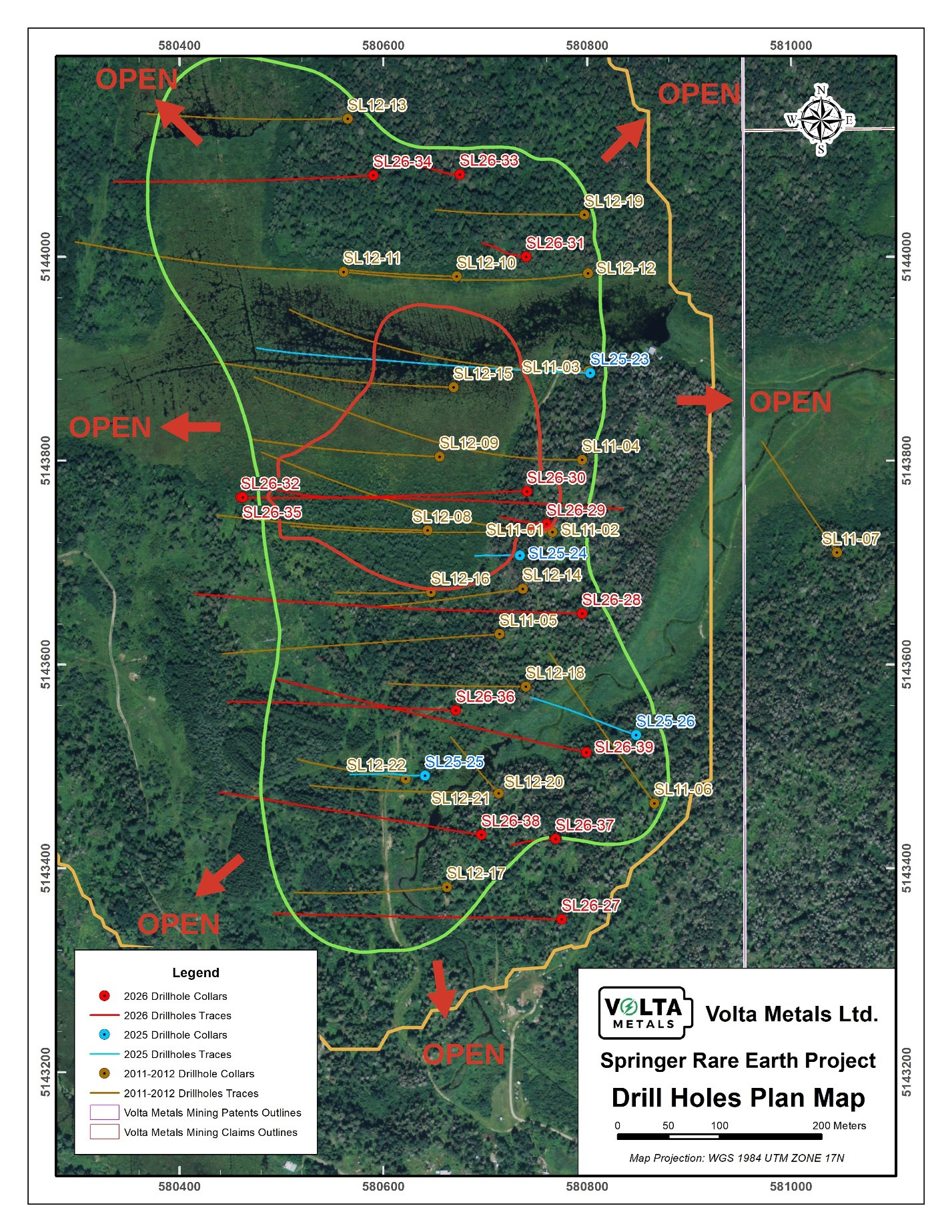
Figure 1. Plan map of all drill holes at the Springer deposit, Sturgeon Falls, northeastern Ontario.
To view an enhanced version of this graphic, please visit:
https://images.newsfilecorp.com/files/9598/317479_4a56cf34d44588df_001full.jpg
Rare earth and gallium grades at Springer are highest in zones where dolomite carbonatite is abundant. Niobium occurs within these carbonatite-rich zones but is also present in "syenite" containing little or no carbonatite, where rare earth and gallium grades are generally lower. This broader distribution suggests that niobium mineralization may extend beyond Springer's carbonatite-rich core.
Grade context. Most of the significant niobium intervals are summarized in Table 2. These grades are generally below those of deposits mined primarily for niobium. No niobium-specific metallurgical test work has been completed, and the mineralogical host of the niobium has not yet been determined. Based on the grades identified to date, Volta does not currently consider niobium a potential primary commodity at Springer. Whether it could ultimately contribute value as a by-product remains to be determined through additional geological, mineralogical and metallurgical work.
Why Niobium Matters
Niobium is a designated critical mineral in Canada, the United States, and the European Union. Global supply is highly concentrated: Brazil produced approximately 93% of the world's niobium in 2025 and Canada approximately 5%, while the United States relies on imports for 100% of its needs (USGS Mineral Commodity Summaries, 2026).
Most niobium is used as ferroniobium in high-strength steel, where relatively small additions can increase strength while reducing the amount of steel required. These steels are widely used in pipelines, vehicles, buildings and other infrastructure. Niobium is also used in high-performance superalloys for applications including jet engines and power generation.
Current Resource Estimate
On February 23, 2026, Volta reported an updated Mineral Resource Estimate ("MRE") for the Springer deposit, effective December 31, 2025, prepared by SLR Consulting (Canada) Ltd. The MRE comprises:
- Indicated: 56.6 Mt at 0.70% TREO, including a near-surface high-grade core of 11.5 Mt at 1.10% TREO.
- Inferred: 119.5 Mt at 0.58% TREO, including a near-surface high-grade core of 3.0 Mt at 1.16% TREO.
Resources are reported within an optimized open pit shell above a C$43/t net metal revenue cut-off. Praseodymium and neodymium, the key magnet metals, account for about 90% of total net metal value. The MRE placed Springer among the 10 largest rare earth deposits in North America based on the S&P Global Market Intelligence database (2025). Mineralization remains open in all directions. Gallium and niobium are not included in the current MRE. An NI 43-101 Technical Report supporting the MRE was filed on SEDAR+ on April 9, 2026. Mineral resources are not mineral reserves and do not have demonstrated economic viability.
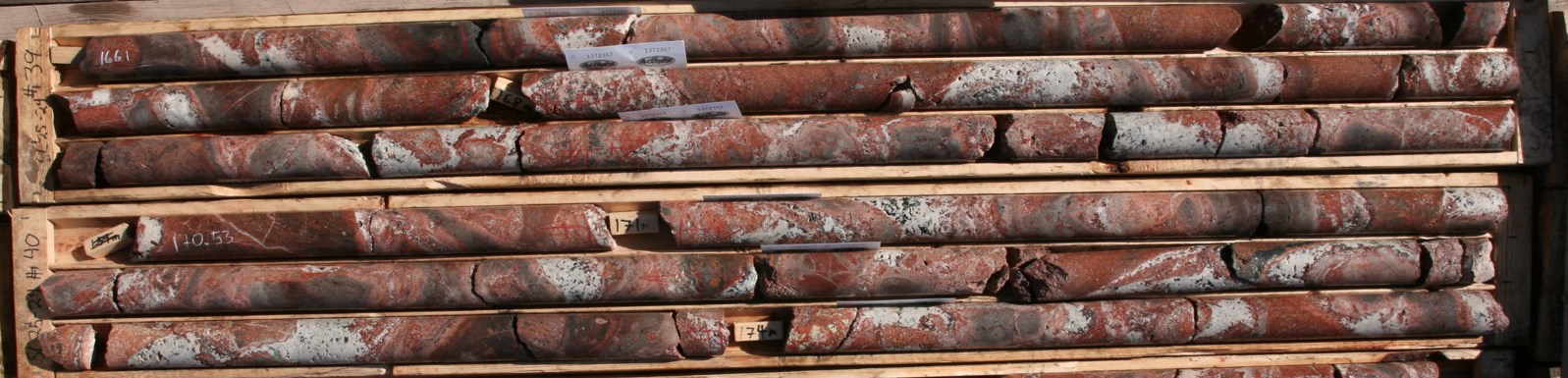
Figure 2. Red syenite with abundant white carbonatite. SL25-24, 166.1 to 174.4 m, boxes 39 to 40.
To view an enhanced version of this graphic, please visit:
https://images.newsfilecorp.com/files/9598/317479_4a56cf34d44588df_002full.jpg
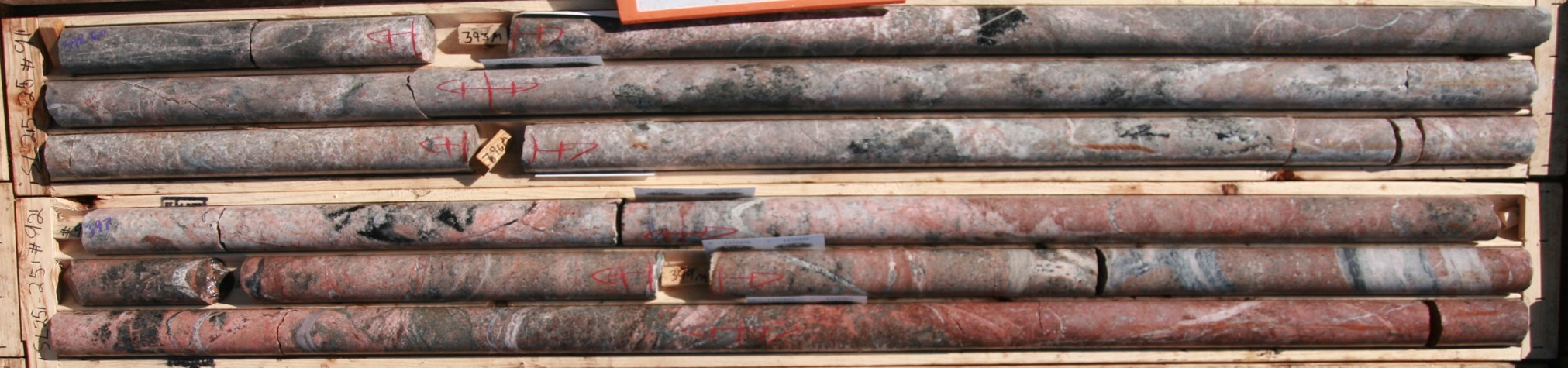
Figure 3. Syenite with little or no carbonatite. SL25-25, 392.6 to 401.35 m, boxes 91 to 92.
To view an enhanced version of this graphic, please visit:
https://images.newsfilecorp.com/files/9598/317479_4a56cf34d44588df_003full.jpg
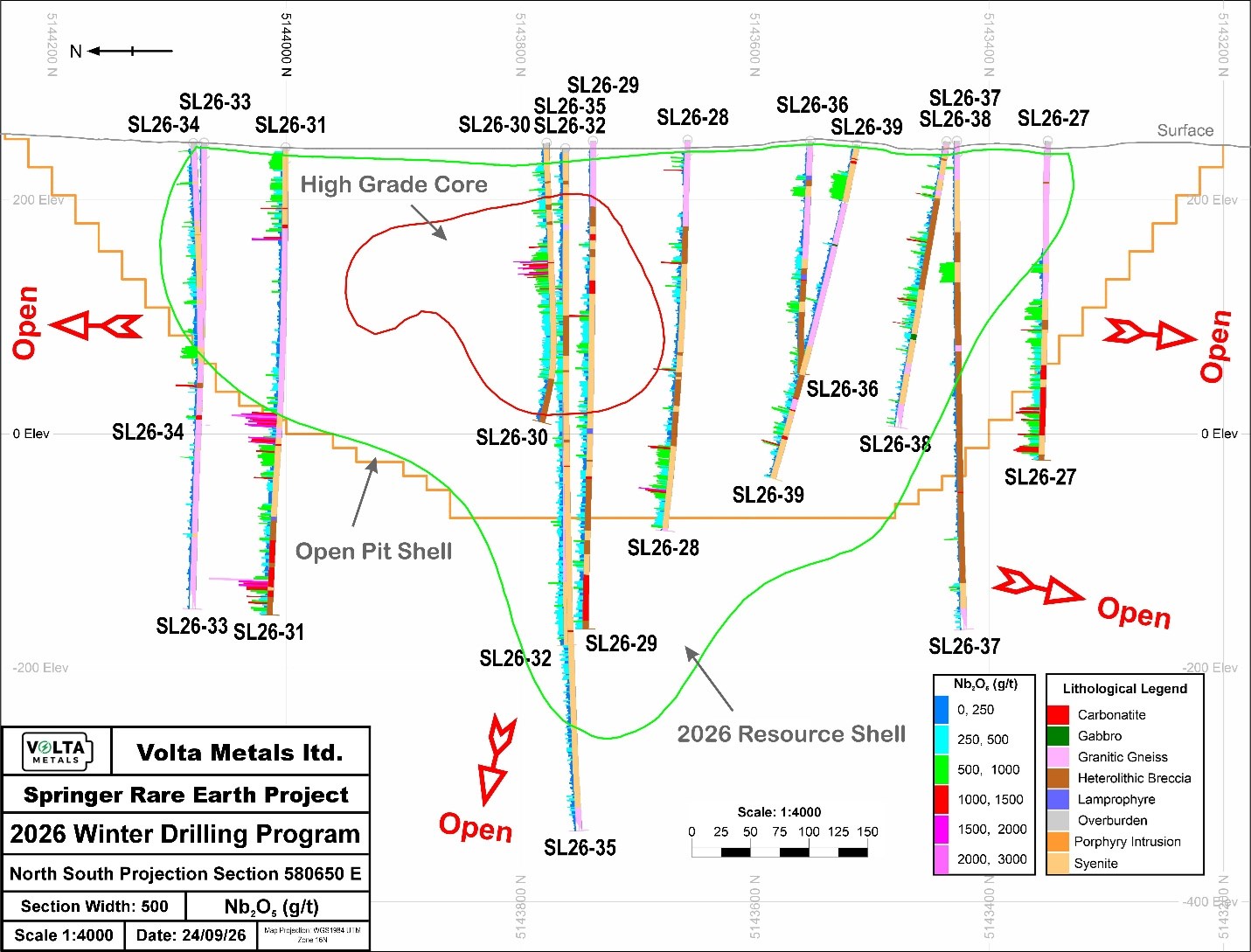
Figure 4. Niobium distribution within the Springer deposit in N-S long section, 500m wide
To view an enhanced version of this graphic, please visit:
https://images.newsfilecorp.com/files/9598/317479_4a56cf34d44588df_004full.jpg
Table 2. Selected niobium intervals, Springer deposit (2011 to 2026 drilling)
| Drill hole | From (m) | To (m) | Length (m) | Ga2O3 (g/t)* | Nb2O5 (g/t)** | TREO (%)*** |
| SL11-01 | 145.9 | 204.1 | 58.2 | 104.84 | 1,116.76 | 1.526 |
| SL11-03 | 50.4 | 62.4 | 12.0 | 54.22 | 1,074.48 | 1.221 |
| SL11-03 | 108.9 | 123.3 | 14.4 | 78.58 | 1,173.54 | 1.176 |
| incl. SL11-03 | 117.9 | 119.4 | 1.5 | 68.55 | 2,580.00 | 0.765 |
| SL11-03 | 187.6 | 197.17 | 9.57 | 65.84 | 1,034.08 | 1.851 |
| SL12-12 | 109.2 | 151.0 | 41.8 | 50.49 | 1,630.53 | 0.344 |
| incl. SL12-12 | 141.0 | 143.0 | 2.0 | 60.49 | 4,580.00 | 0.552 |
| incl. SL12-12 | 145.0 | 151.0 | 6.0 | 51.98 | 3,133.33 | 0.376 |
| SL12-15 | 144.0 | 166.0 | 22.0 | 53.65 | 1,350.13 | 0.500 |
| SL25-23 | 193.5 | 204.0 | 10.5 | 45.44 | 1,075.67 | 0.567 |
| SL25-23 | 226.5 | 252.0 | 25.5 | 41.46 | 1,035.60 | 0.607 |
| SL25-24 | 158.0 | 172.5 | 14.5 | 116.03 | 923.96 | 1.984 |
| SL25-25 | 383.0 | 389.7 | 6.7 | 35.19 | 1,143.18 | 0.491 |
| SL25-25 | 393.0 | 402.0 | 9.0 | 42.70 | 1,105.78 | 0.340 |
| SL25-26 | 241.5 | 255.0 | 13.5 | 38.53 | 1,035.36 | 0.611 |
| SL26-27 | 375.0 | 385.9 | 10.9 | 39.57 | 1,124.78 | 0.355 |
| SL26-30 | 142.5 | 165.0 | 22.5 | 86.18 | 1,150.30 | 1.280 |
| SL26-31 | 228.2 | 240.65 | 12.45 | 54.75 | 1,657.42 | 0.212 |
| incl. SL26-31 | 231.2 | 232.7 | 1.5 | 60.35 | 2,503.38 | 0.259 |
| SL26-31 | 370.5 | 382.5 | 12.0 | 38.05 | 1,502.22 | 0.539 |
| incl. SL26-31 | 372.0 | 373.5 | 1.5 | 14.79 | 3,247.24 | 0.281 |
Intervals are downhole core lengths; true thickness is unknown. "Incl." rows are contained within the interval directly above.
* Ga2O3 (g/t) is calculated from assayed gallium (Ga) ppm using the stoichiometric factor 1.3442.
** Nb2O5 (g/t) is calculated from assayed niobium (Nb) ppm using the stoichiometric factor 1.4305. Nb2O5 (%) = Nb2O5 (g/t) ÷ 10,000.
*** TREO (%) = La2O3 + CeO2 + Pr6O11 + Nd2O3 + Sm2O3 + Eu2O3 + Gd2O3 + Tb4O7 + Dy2O3 + Ho2O3 + Er2O3 + Tm2O3 + Yb2O3 + Lu2O3 + Y2O3.
Drill Hole Collar Locations
Table 3. Collar locations for drill holes mentioned in this release (UTM NAD 83, Zone 17)
| Drill hole | Easting (m) | Northing (m) | Elevation (m) | Azimuth (°) | Dip (°) | Length (m) |
| SL11-01 | 580769.00 | 5143729.46 | 248.96 | 270 | -45 | 413.3 |
| SL11-03 | 580801.00 | 5143888.00 | 244.90 | 270 | -45 | 419.3 |
| SL12-12 | 580801.23 | 5143983.62 | 243.41 | 270 | -45 | 345.0 |
| SL12-15 | 580669.02 | 5143872.11 | 244.30 | 270 | -45 | 331.0 |
| SL25-23 | 580803.43 | 5143889.97 | 244.83 | 270 | -45 | 453.0 |
| SL25-24 | 580731.75 | 5143706.25 | 247.94 | 270 | -85 | 465.0 |
| SL25-25 | 580636.72 | 5143491.64 | 247.65 | 268 | -80 | 423.0 |
| SL25-26 | 580848.04 | 5143527.65 | 249.09 | 290 | -70 | 297.0 |
| SL26-27 | 580776.30 | 5143349.66 | 250.04 | 272 | -45 | 393.0 |
| SL26-28 | 580809.22 | 5143657.31 | 251.00 | 270 | -45 | 507.0 |
| SL26-29 | 580760.00 | 5143738.00 | 250.40 | 270 | -85 | 420.0 |
| SL26-30 | 580741.07 | 5143777.97 | 248.47 | 267 | -45 | 351.0 |
| SL26-31 | 580744.95 | 5144000.56 | 244.45 | 270 | -85 | 402.0 |
| SL26-35 | 580456.64 | 5143761.66 | 243.86 | 90 | -60 | 693.0 |
Azimuth and dip are collar orientations. No downhole directional survey was completed.
CAUTIONARY STATEMENTS
The Company cautions that the timing of both mineral resource estimates depends on the completion of supporting metallurgical and analytical work, and on the availability of the Company's independent consultants. There is no assurance that either estimate will be completed within the anticipated timeframe, that a gallium mineral resource will be defined at all, or that any updated rare earth mineral resource estimate will be larger or higher grade than the current MRE. Mineral resources are not mineral reserves and do not have demonstrated economic viability.
The Company further cautions that niobium is not included in the current Springer mineral resource estimate, that no metallurgical test work has been completed demonstrating that niobium can be recovered from Springer mineralization, and that the niobium grades reported in this release are below grades typical of deposits mined principally for niobium. There is no assurance that niobium will be included in any future mineral resource estimate for the Property, or that niobium mineralization at Springer has any economic value.
QA/QC Protocol, 2025 to 2026
All drilling was completed by a diamond drill rig producing NQ-size core. Volta applied a strict QA/QC protocol to all core samples from the Springer property, inserting high- and low-concentration certified rare earth element and gallium standards, blanks and core duplicates to validate the accuracy and precision of the assay results. Core was cut in half with a rock saw under the supervision of a professional geologist. One half was placed in sturdy plastic bags and zip-tied shut; the other half was returned to the core box, which is stored on the Property. Samples were shipped by Manitoulin Transport from Volta's core shack in Sturgeon Falls to SRC's facility in Saskatoon, Saskatchewan.
Samples were analyzed at SRC by lithium metaborate fusion followed by ICP-MS. SRC holds ISO/IEC 17025:2017 accreditation from the Standards Council of Canada. SRC inserted Natural Resources Canada syenite standard SY-5 into the sample stream every 20 samples. SY-5 passed within two standard deviations for the rare earth elements (La to Lu) and Ga. All internal standards and duplicates, and all external blanks, standards and core duplicates, passed a quality control review by the Qualified Person.
QA/QC Protocol, 2011 to 2012
The 2011 to 2012 drilling was carried out for Rare Earth Metals Inc. by Cartwright Drilling Inc. Not all intervals of the drill core were sampled. Half of the core was sampled for geochemical analysis and the other half returned to the core box (Ontario assessment report AFRO#2.53511). Care was taken to ensure that neither half of the core was biased with respect to the nature and mineral content of the sample. Standard reference samples from Canmet and OREAS (146 and Oka-2) and blanks (OREAS 22c and 23a) were each inserted every 20th sample. The sample interval and methodology are consistent with industry standards.
Samples were packaged in "rice" bags sealed with recorded security tags, taken from camp to North Bay by Rare Earth Metals Inc. employees, and delivered by Manitoulin Transport to Activation Laboratories Ltd. ("Actlabs") in Thunder Bay, Ontario for preparation, then forwarded to Actlabs in Ancaster, Ontario for analysis. Samples were prepared by lithium metaborate/tetraborate fusion and analyzed for major oxides by ICP-OES and a suite of 43 trace elements by ICP-MS. Actlabs further tests accuracy and precision through the systematic inclusion of reference and duplicate samples. Actlabs is ISO 17025 (Lab 266) and NELAP (Lab E87979) accredited for specific registered tests.
Quality control of the standards, blanks and duplicates was completed by Rare Earth Metals Inc. and reviewed by Tetra Tech Wardrop and is documented in Rare Earth Metals Inc.'s NI 43-101 Technical Report dated May 4, 2012. The Qualified Person (Dr. Selway) believes the sample preparation, security, and analytical procedures are adequate to characterize the rare earth element mineralization in the 2011 to 2012 drill holes.
Qualified Person
The technical content of this news release has been reviewed and approved by Dr. Julie Selway, P.Geo., VP Exploration, and a Qualified Person ("QP") as defined in National Instrument 43-101, Standards of Disclosure for Mineral Projects.
ABOUT VOLTA METALS LTD.
Volta Metals Ltd. (CSE: VLTA) (FSE: D0W) (OTCQB: VOLMF) is a critical mineral exploration company focused on rare earths, gallium, lithium, cesium and tantalum in Ontario, one of the world's most prolific emerging hard-rock critical mineral districts. Volta owns, has optioned and is exploring a portfolio of rare earth, gallium, lithium, cesium and tantalum projects in the province.
Volta's flagship is the 4,879-hectare Springer REE Deposit, on the traditional territory of the Nipissing First Nation in Sturgeon Falls, about 70 km east of Sudbury, Ontario. The project has direct access via the Trans-Canada Highway and Highway 64, with paved roads, on-site power lines fed from the Crystal Falls hydroelectric dam, a natural gas pipeline and Canadian National Railway service, all within 8 km of the deposit.
To learn more about Volta and its Springer and Aki projects, visit www.voltametals.ca.
ON BEHALF OF THE BOARD
For further information, contact:
Kerem Usenmez, President & CEO
Tel: 416.919.9060 | Email: info@voltametals.ca | Website: www.voltametals.ca
Neither the CSE nor the Canadian Investment Regulatory Organization (CIRO) accepts responsibility for the adequacy or accuracy of this release.
Forward-Looking Statements
This news release contains forward-looking statements relating to exploration activities, plans, strategies and other statements that are not historical facts. Forward-looking statements are often identified by terms such as "will", "may", "should", "anticipate", "expects", "targeting" and similar expressions. All statements other than statements of historical fact included in this news release are forward-looking statements that involve risks and uncertainties. Forward-looking information in this news release includes, but is not limited to, the Company's stated intention and timing to complete an initial gallium mineral resource estimate and an updated rare earth mineral resource estimate for the Springer deposit in the fourth quarter of 2026; statements regarding the potential extent and grade of the gallium, rare earth and niobium mineralization; the geological interpretation of the Springer REE deposit as a vertically extensive carbonatite system; the Company's intention to assess whether niobium warrants further analytical, mineralogical and metallurgical work; the potential for niobium to be included in any future mineral resource estimate; and the potential for the 2026 drilling program to support future resource estimation. There can be no assurance that such statements will prove to be accurate, and actual results and future events could differ materially from those anticipated. Important factors that could cause actual results to differ materially from the Company's expectations include the risks detailed from time to time in the filings made by the Company with securities regulators; future prices of and demand for rare earth elements, gallium and niobium; changes to export control or trade measures affecting gallium supply; the absence to date of metallurgical test work demonstrating that gallium can be economically recovered from the Springer mineralization; the absence to date of metallurgical test work demonstrating that niobium can be recovered from the Springer mineralization; laboratory results that differ from visual or geological observations; and delays in, or the inability of the Company to obtain, any approvals, permits and authorizations required to carry out its business plans. Readers are cautioned not to place undue reliance on any forward-looking statements. Forward-looking statements in this news release are made as of the date of this news release, and the Company disclaims any intention or obligation to update or revise them, whether as a result of new information, future events or otherwise, other than as required by law.
To view the source version of this press release, please visit https://www.newsfilecorp.com/release/317479
Source: Volta Metals Ltd.