
Vancouver, British Columbia--(Newsfile Corp. - July 16, 2026) - Aquitaine Metals Corp. (the "Company" or "Aquitaine") today announced an update on its ongoing exploration program at the Limousin Gold and Critical Metals Project ("Limousin" or the "Project") in Nouvelle-Aquitaine, France.
The Company has discovered widespread tungsten mineralization alongside significant gold mineralization at Moulin de Cheni ("Moulin de Cheni" or "Cheni"), located six kilometres west of its primary drill location at Laurieras. Four drill holes have been recently completed totalling 1,262 metres and have intersected a mineralized system contained within a major regional structural corridor that is interpreted to extend up to 20 kilometres.
Highlights
- Approximately 1,262 metres of drilling has been completed in four diamond drill holes at the new Cheni target as part of Aquitaine's Phase 1 drill program.
- Drilling has intersected structurally controlled gold and tungsten mineralization occurring within quartz stockworks and breccias hosted within granite and extending well below the limits of historic mining.
- Results from the first 2 of 4 drill holes adjacent to the north-eastern edge of the Moulin de Cheni historical mine have intersected visible gold and scheelite (tungsten mineralization) within stockwork and breccia-hosted mineralized zones. This mineralization is similar to the first 17 drill holes at the neighbouring Laurieras structure that were reported on October 6, 2025 and February 19, 2025, where wide mineralized envelopes surround high-grade veins.
- Significant results include 16.54 grams per tonne ("g/t") gold over 24.00 metres, starting at 47.50 metres downhole, including a high-grade core of 136.88 g/t gold over 2.00 metres (drill hole CMA044B).
- Within this interval, tungsten-rich mineralization is also present over a significant width, assaying 0.11 % WO3 and 12.27 g/t gold over 9.70 metres.
- Other significant gold intercepts are provided in Table 1 and include:
- A broad interval of 2.13 g/t gold over 63.00 metres starting at 75 metres downhole, which included sub-intervals of 3.66 g/t gold over 5.50 metres, 7.70 g/t gold over 2.50 metres and 17.82 g/t gold over 4.45 metres (drill hole CMA044B).
- A broad interval of 1.82 g/t gold over 28.00 metres starting at 199 metres downhole, which included 6.96 g/t gold over 6.45 metres (drill hole CMA044).
- Widespread tungsten mineralization has been identified for the first time at the Limousin Project, as tungsten was not a target of historical exploration and historical samples were not assayed for tungsten. The new discovery of tungsten mineralization strengthens the strategic importance of the Limousin project for France and the broader European Union. The best tungsten intercepts include:
- 0.95 % WO3 and 4.88 g/t gold over 0.50 metres within a broad interval averaging 0.21 % WO3 and 1.55 g/t gold over 3.00 metres (drill hole CMA044).
- 0.37 % WO3 and 1.34 g/t gold over 2.00 metres within a broad interval averaging 0.18 % WO3 and 1.60 g/t gold over 6.00 metres (drill hole CMA044B).
The Moulin de Cheni structure, and its proximal secondary structures, host more than 100 ancient gallic open pit gold mines (in French: "aurières"), and historic underground production is estimated at approximately 300,000 ounces at an average grade of 15 g/t to 20 g/t gold over various phases of mining during the twentieth century. The most recent mining operations were undertaken by COGEMA, ending in 2002. Aquitaine's initial drilling targets mineralization intersected down to approximately 110 metres below historic workings of what COGEMA called the "South Vein", extending the mineralized system to depths of approximately 230 metres below surface, which remains open to extension in all directions.
The Cheni mineralized structural system has been drilled over more than 6 kilometres of strike length, and regional mapping, soil geochemistry and Lidar interpretation suggest the fault is more than 20 kilometres in length, highlighting significant district-scale exploration potential.
Chris Taylor, CEO of Aquitaine, commented, "The Moulin de Cheni prospect is rapidly emerging as one of the most compelling exploration targets within the Limousin district. High-grade visible gold and tungsten mineralization have been intersected well below COGEMA's historical workings, reinforcing our belief that Moulin de Cheni represents a much larger mineralized system than previously recognized."
Mr. Taylor continued:
"What makes Moulin de Cheni particularly interesting is the apparent overprinting of two mineralizing systems-gold and tungsten-along the same structural corridors. This suggests repeated hydrothermal activity focused along long-lived structures, potentially creating zones of enhanced grade concentration that remain largely untested at depth and along strike. The presence of tungsten also strengthens the strategic importance of the Limousin Project as Europe seeks to secure domestic sources of critical and strategic raw materials."
Drilling Confirms Significant Structural Controls
Aquitaine's drill program at Cheni is testing two principal mineralized structures, referred to as the North and South Structures, separated by a complex grey quartz stockwork zone that hosts both gold and tungsten mineralization.
Drilling has confirmed that gold mineralization occurs within stockwork-style quartz veining and brecciation, with tungsten mineralization defined by scheelite that is observed as disseminations, veins and breccia clasts. In drill hole CMA044, visible gold and scheelite were observed within quartz veins which cross cut the Moulin de Cheni leucogranite, providing further evidence of a multistage hydrothermal mineralizing system. The two holes reported herein were both drilled from the same platform. CMA044 was drilled towards 160 degrees at a dip of -45 degrees and drill hole CMA044B was drilled at 165 degrees at a dip of -60 degrees. Hole CMA044 intersected the first anticipated vein from 45 to 71.5 metres downhole and the second anticipated vein from 199 to 227 metres downhole. The drill hole was terminated at a final depth of 308.5 metres. Drill hole CMA044B intersected the first of two anticipated veins from 49.3 to 71.5 metres downhole, and a second from 252.3 to 266 metres downhole. The final downhole depth was 354.5 metres. Many mineralized veins and stockworks were also intersected outside the two main veins known historically, which indicate a much larger mineralized envelope than previously recognized. Two more holes, CMA044C and CMA044D were also drilled from this platform, with assays pending.
The Company's geological model suggests that mineralization may be influenced by the interaction of several granite plutons, with enhanced grade concentration occurring along major fault intersections and structural dilation zones.
Table 1: Moulin de Cheni gold results.
| Hole ID | From (m) | To (m) | Width* (m) | Gold (g/t) | Silver (g/t) | WO3 (%) | Area | |
| CMA044 | 45.00 | 78.00 | 33.00 | 1.21 | 0.53 | 0.02 | Moulin de Cheni target | |
| including | 55.50 | 56.55 | 1.05 | 4.00 | 1.19 | 0.46 | ||
| including | 68.00 | 74.00 | 6.00 | 4.35 | 0.65 | < 0.01 | ||
| and | 82.00 | 108.00 | 26.00 | 0.54 | 0.53 | < 0.01 | ||
| including | 90.00 | 91.50 | 1.50 | 2.42 | 2.02 | < 0.01 | ||
| including | 94.00 | 97.00 | 3.00 | 2.06 | 0.36 | < 0.01 | ||
| and | 179.00 | 191.00 | 12.00 | 1.80 | 0.49 | < 0.01 | ||
| including | 183.00 | 184.00 | 1.00 | 19.20 | 2.48 | < 0.01 | ||
| and | 199.00 | 227.00 | 28.00 | 1.82 | 0.47 | 0.01 | ||
| including | 208.55 | 215.00 | 6.45 | 6.96 | 0.82 | 0.04 | ||
| CMA044B | 47.50 | 71.50 | 24.00 | 16.54 | 0.97 | 0.06 | ||
| including | 49.30 | 59.00 | 9.70 | 12.27 | 0.91 | 0.11 | ||
| including | 65.00 | 67.00 | 2.00 | 136.88 | 4.52 | 0.05 | ||
| and | 75.00 | 138.00 | 63.00 | 2.13 | 0.75 | < 0.01 | ||
| including | 78.50 | 84.00 | 5.50 | 3.66 | 0.70 | < 0.01 | ||
| including | 91.00 | 93.50 | 2.50 | 7.70 | 0.75 | 0.01 | ||
| including | 107.00 | 109.00 | 2.00 | 1.22 | 0.88 | < 0.01 | ||
| including | 119.00 | 120.00 | 1.00 | 3.36 | 0.47 | < 0.01 | ||
| including | 133.05 | 137.50 | 4.45 | 17.82 | 1.21 | < 0.01 | ||
| and | 151.50 | 163.30 | 11.80 | 1.24 | 0.29 | < 0.01 | ||
| including | 160.40 | 162.80 | 2.40 | 5.48 | 0.59 | 0.02 |
Table 2: Moulin de Cheni tungsten results.
| Hole ID | From (m) | To (m) | Width* (m) | WO3 (%) | Gold (g/t) | Area | |
| CMA044 | 54.50 | 57.50 | 3.00 | 0.21 | 1.55 | Moulin de Cheni target | |
| including | 54.50 | 56.00 | 1.50 | 0.36 | 1.79 | ||
| including high grade | 55.50 | 56.00 | 0.50 | 0.95 | 4.88 | ||
| and | 212.50 | 213.00 | 0.50 | 0.17 | 0.69 | ||
| CMA044B | 53.00 | 59.00 | 6.00 | 0.18 | 1.60 | ||
| including | 53.00 | 55.00 | 2.00 | 0.37 | 1.34 | ||
| including high grade | 53.85 | 54.40 | 0.55 | 0.49 | 0.76 | ||
| including high grade | 54.40 | 55.00 | 0.60 | 0.63 | 0.49 | ||
| including | 58.50 | 59.00 | 0.50 | 0.33 | 1.15 | ||
| and | 259.00 | 260.00 | 1.00 | 0.35 | 0.10 | ||
| including high grade | 259.50 | 260.00 | 0.50 | 0.55 | 0.06 |
*Interval widths are downhole depths. For most of the drill holes, true widths of mineralization are estimated to be approximately 65-95% of the downhole interval based on preliminary results, structural observations and historical data. All are diamond drill holes. Vein structures vary in strike between 60 to 85 degrees and dip between 45 to 75 degrees to the northwest. All drill holes intersect both high grade and bulk tonnage domains and often intersect multiple domains within the same drill hole.
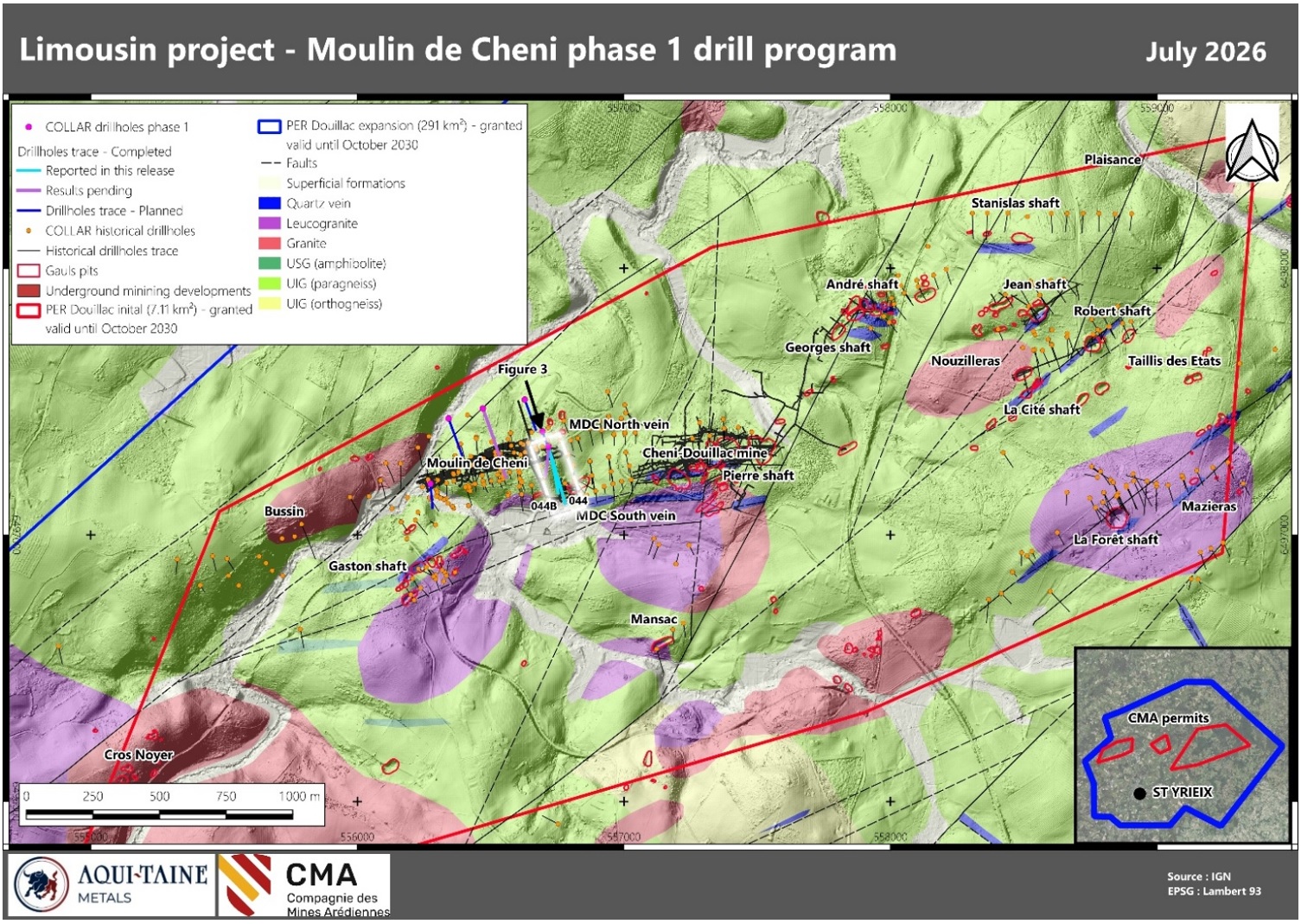
Figure 1: Progress map of the Phase 1 drill program on the Moulin de Cheni fault structure. Gallic-era mining operations are shown in red outline.
To view an enhanced version of this graphic, please visit:
https://images.newsfilecorp.com/files/11279/305309_aquitaine1en.jpg
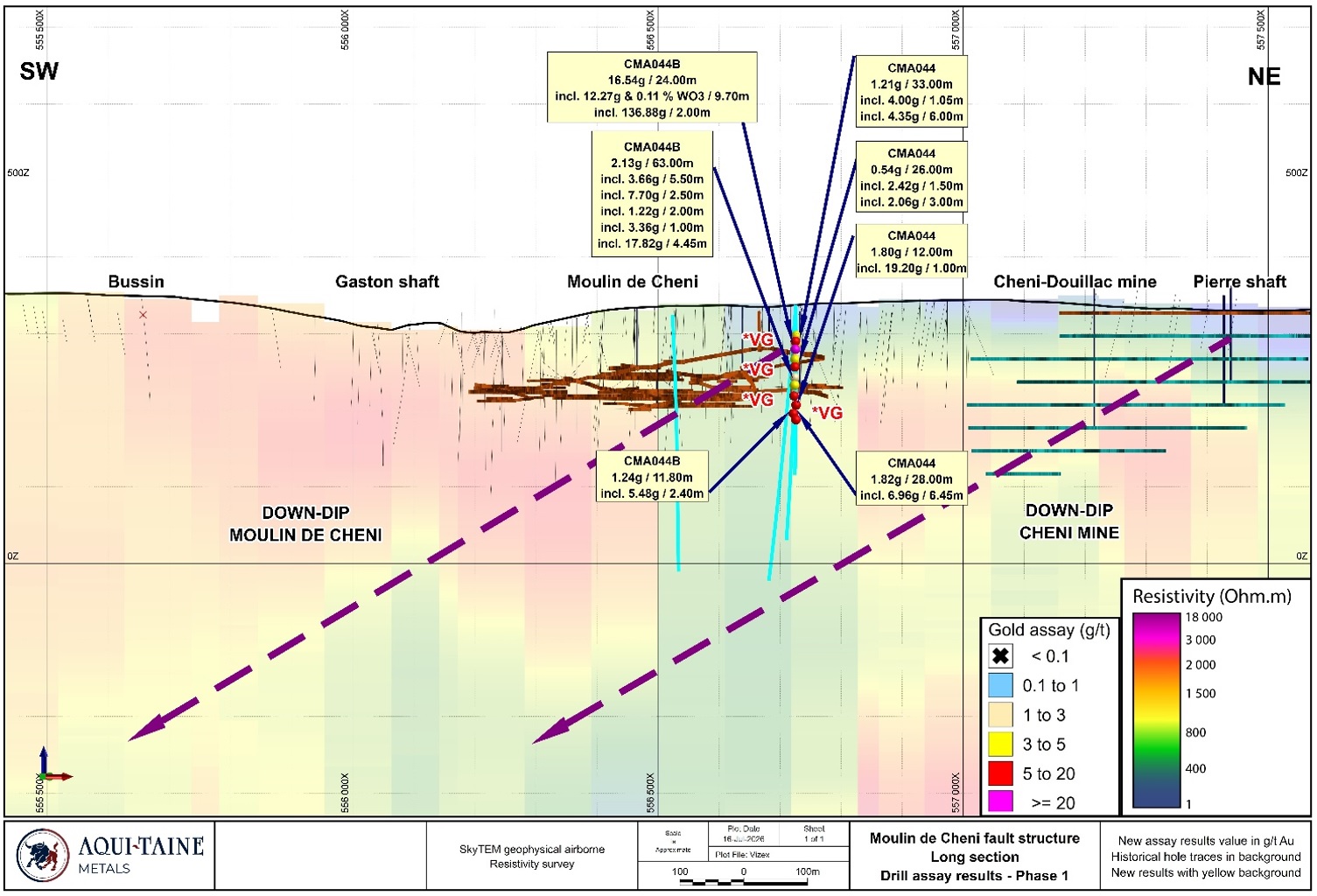
Figure 2: SW-NE long section showing the progress of the Phase 1 drill program on the Moulin de Cheni structure.
To view an enhanced version of this graphic, please visit:
https://images.newsfilecorp.com/files/11279/305309_aquitaine2en.jpg
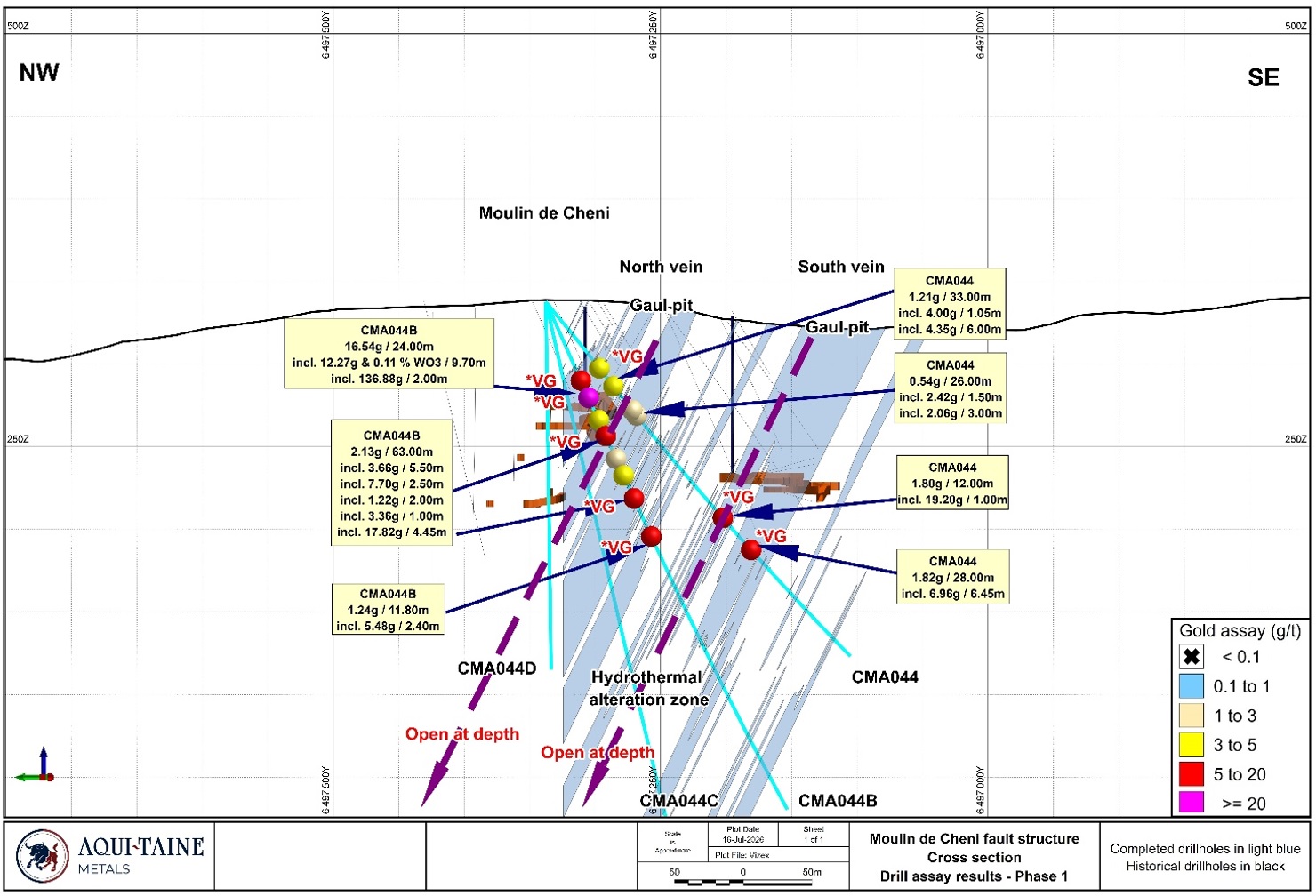
Figure 3: Cross section of the fan CMA044-044B at Moulin de Cheni prospect. Hydrothermal alteration zone outline shown in blue. Historical workings shown in red.
To view an enhanced version of this graphic, please visit:
https://images.newsfilecorp.com/files/11279/305309_aquitaine3en.jpg
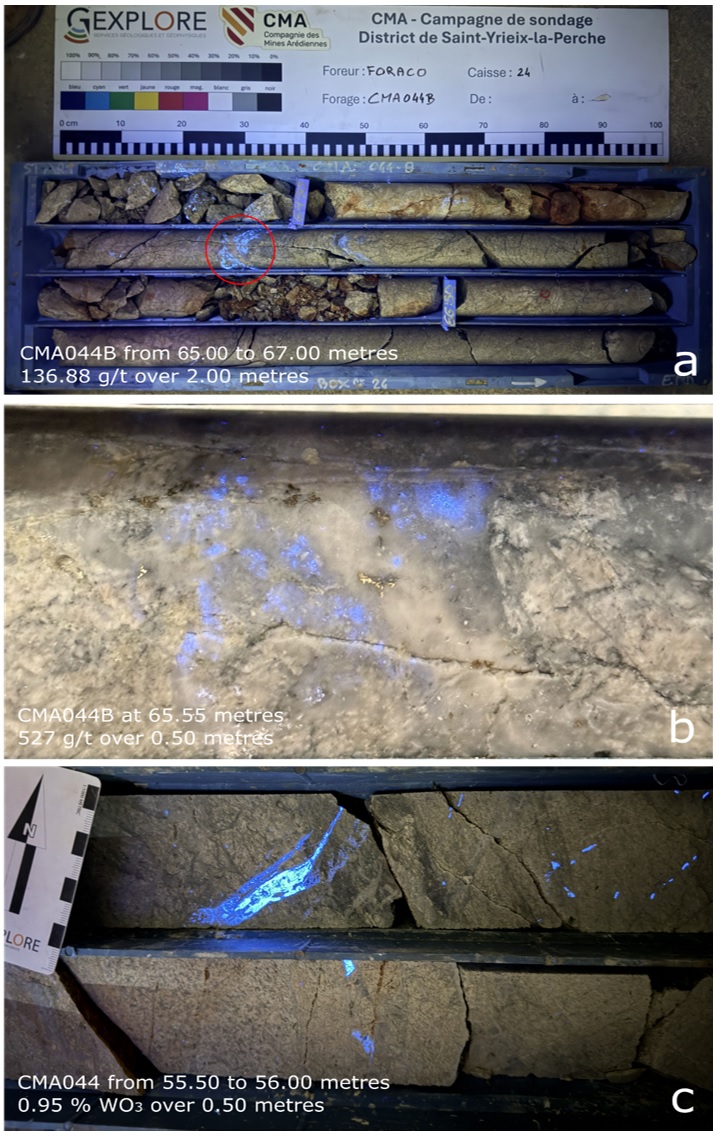
Figure 4: Drill core sample images from Phase 1 drill campaign at Moulin de Cheni. a) Drill core interval from 65.00 to 67.00 metres showing the blue light reflecting scheelite and visible gold (136.88 g/t over 2.00 metres) within the red circle. b) Close up photo of HQ core from drill hole CMA044B at 65.55m depth demonstrating visible gold and scheelite occupying a shared structure (527 g/t over 0.50 metres). c) Drill core interval from 55.50 to 56.00 metres showing a high grade scheelite interval in a quartz vein with 0.95 % WO3 over 0.50 metres.
To view an enhanced version of this graphic, please visit:
https://images.newsfilecorp.com/files/11279/305309_aquitaine4en.jpg
Interpretation of Multiple Metallogenic Events
Preliminary macroscopic observations of the mineralization show that scheelite appears to be emplaced earlier than the gold mineralization. Both are found in quartz veins which crosscut the leucogranite of Moulin de Cheni. Scheelite crystals are generally coarse and brecciated by later quartz generations which contain visible gold and disseminated sulphides.
Aquitaine's technical team believes the gold and tungsten mineralization observed at Moulin de Cheni reflect two distinct mineralizing events that utilized the same structural architecture for mineral deposition during the collapse of the Variscan chain approximately 300 million years ago.
This interpretation suggests repeated fluid flow through long-lived structures, with separate mineralizing episodes potentially contributing to enhanced metal endowment within the system. Understanding the timing and controls of these events remains an important focus of ongoing geological and mineralogical studies.
Table 3: Limousin project drill hole locations.
| Hole ID | Easting (m) | Northing (m) | Elevation (m) | Azimuth (°) | Dip (°) | Depth (m) |
| CMA044 | 556716,532 | 6497330,934 | 337,77 | 162,25 | -46,42 | 308,50 |
| CMA044B | 556716,532 | 6497330,934 | 337,77 | 164,81 | -61,96 | 354,50 |
*The coordinate reference system is Lambert 93 (EPSG 2154).
Strategic Importance of Tungsten
Tungsten is classified as both a Critical Raw Material and a Strategic Raw Material under the Critical Raw Materials Act adopted by the European Union. Tungsten is essential for defense systems, aerospace technologies, semiconductors, energy infrastructure, and advanced industrial tooling due to its exceptional hardness, density, and heat resistance.
The European Union has identified tungsten as a priority metal because of its high economic importance and elevated supply risk, with global production concentrated in a limited number of jurisdictions. The discovery of tungsten mineralization at Moulin de Cheni in significant grades therefore materially enhances the strategic importance of the Limousin Project.
Aquitaine believes the discovery of coexistence of gold and tungsten mineralization within the Limousin district positions the Project as a potentially important source of both precious, critical and strategic metals for European industry.
About the Limousin Project
The Limousin Project is located in the historic Limousin Mining District in the Region of Nouvelle-Aquitaine, southwest France, approximately 40 kilometres south of the city of Limoges. The project consists of 330 square kilometres of exploration licenses and includes 23 past-producing gold mines that operated during the 20th and 21st centuries, as well as more than 900 ancient Gallic high-grade gold mining sites occurring along regional-scale fault structures that extend for 200 kilometres of strike length.
Historical operations in the district were most recently conducted by COGEMA, a French mining company that produced approximately one million ounces of gold between 1988 and 2002. Underground production averaged grades of 12 to 15 grams per tonne gold at a cutoff of 12 grams per tonne in underground workings, with mining widths ranging from 3 to 10 metres, while open-pit production averaged 7 to 8 grams per tonne gold at a cutoff grade of 6 grams per tonne.
Aquitaine's technical team has identified a number of critical and strategic accessory minerals that accompany the gold mineralization across the Limousin district, including silver, antimony, tungsten, lead, copper, zinc and is systematically analysing all the samples for 49 elements.
The Cheni target, discussed in this release, is located approximately six kilometres west of the Laurieras deposit where most of Aquitaine's drilling has occurred during its Phase 1 drill program. The Cheni and Laurieras targets and represent two of several high-priority targets being evaluated as part of Aquitaine's district-scale exploration strategy.
About Aquitaine Metals Corp.
Aquitaine Metals Corp. is a Vancouver-based gold and strategic metals exploration company focused on reviving world-class mining projects in France. Through its wholly owned French subsidiary, Compagnie des Mines Arédiennes (CMA), the Company is advancing the Limousin project in Nouvelle-Aquitaine, where a Phase 1 diamond drill program is underway to confirm historical datasets and test extensions of high-grade gold and critical metals ore zones.
Aquitaine and CMA are committed to sustainable exploration with a long-term vision that demonstrates responsible stewardship of the land, operational excellence and accountability.
Records of work activities, permitting timelines and environmental monitoring progress are available at CMA's website at: https://www.minesarediennes.fr/.
Aquitaine Metals Corp. is a proud member of Discovery Group: https://discoverygroup.ca/.
Quality Assurance and Control
All drilling recovers PQ and HQ core to increase the sample size. For deep holes, the core size may be reduced to NQ at depth.
Drill core is logged and sampled in a secure core storage facility located in Saint-Yrieix-la-Perche, France. A geologist examines the drill core and marks out the intervals to be sampled and the cutting line. Sample lengths are mostly 0.50 meter in mineralized or hydrothermally altered zones and 1.00 meter outside. Samples are adjusted to respect lithological and/or mineralogical contacts and isolate narrow (<1.0m) veins or other structures that may yield higher grades. Technicians saw the core in half along the defined cutting line using an automatic diamond saw or a hand splitter for intersections with incompetent core. One-half of the core is kept as a witness sample and the other half is submitted for analysis. Individual sample bags are sealed and placed into rice bags, which are then sealed and marked with the contents.
Preparation and analytical work for drill samples is being carried out at the independent ALS Laboratories in Sevilla (Spain) and Loughrea (Ireland), a commercial certified laboratory under ISO/IEC 17025:2017.
Samples are transported by Fedex from CMA's core storage facility located in Saint-Yrieix-la-Perche to ALS lab in Sevilla, Spain, for sample preparation. Samples are logged in the tracking system, weighed, dried, crushed to 90% passing 2.00 mm screen, riffle split (1,000 g) and pulverized to 85% passing 75 µm. A quartz wash is systematically applied between every sample to reduce or eliminate any contamination during crushing and milling. Prepared samples are then transported to ALS lab in Loughrea, Ireland, by ALS for analysis. All samples are analyzed using a 50 g fire assay (50 g aliquot) with an Atomic Absorption (Au-AA26) finish and multi-element four acid digest ICP-AES/ICP-MS method (ME-MS61). For samples that return assay values over 5.0 g/t gold, another cut is taken from the original pulp (50 g sample) and fire assayed with a gravimetric finish (Au-GRA22). For samples with visible gold or which return assay values over 10 g/t gold, another cut is taken from the original pulp (1 kg sample) and assayed using a metallic screening fire assay (Au-SCR24). Certified gold and multi-element reference standards, blanks and field duplicates are routinely inserted into the sample sequence, as part of CMA quality control/quality assurance program (QAQC). A secure chain of custody is maintained in transporting and storing of all samples. No QAQC issues were noted with the results reported herein.
Drill program design, Quality Assurance/Quality Control, and interpretation of results are performed by qualified persons employing a rigorous Quality Assurance/Quality Control program consistent with industry best practices. Standards and blanks account for a minimum of 10% of the samples in addition to the laboratory's internal quality assurance programs.
Quality Control data are evaluated on receipt from the laboratories for failures. Appropriate action is taken if assay results for standards and blanks fall outside allowed tolerances. All results stated have passed CMA quality control protocols.
Mineralized Interval Calculations
Significant intervals reported in this news release are calculated as downhole length-weighted intercepts. A stoichiometric conversion factor of 1.261 is applied to calculate WO3 grade values from W elemental grade assays.
For gold, main reported intervals are calculated at a 0.1 g/t gold cut-off grade with up to 2 metres of internal waste for delineating mineralized zones, average composite gold grade no less than 0.5 g/t, and gold grade*thickness no less than 2 g/t*m.
Included high-grade intervals are calculated a 1 g/t gold cut-off grade with up to 2 metres of internal waste, average composite gold grade no less than 1 g/t, and gold grade*thickness no less than 2 g/t*m.
For tungsten, main reported intervals are calculated at a 0.05 % WO3 cut-off grade with up to 2 metres of internal waste for delineating mineralized zones, average composite gold grade no less than 0.1 % WO3, and tungsten grade*thickness no less than 0.1 %*m.
Included high-grade intervals are calculated a 0.05 % WO3 cut-off grade with up to 2 metres of internal waste, average composite tungsten grade no less than 0.3 % WO3, and tungsten grade*thickness no less than 0.3 %*m.
Individual very high-grade assays (> 0.49 % WO3) are also reported for information.
Table 3 contains a list of all Moulin de Cheni holes reported in this release. For most of the drill holes, true widths are estimated to be 65-95% of the downhole widths. Vein structures vary in strike between 60 to 80 degrees and dip between 45 to 75 degrees to the northwest.
Qualified Person and NI 43-101 Disclosure
Mr. Andrew Wilkins, PGeo is the Responsible Officer for Lithos Geological and is the Qualified Person as defined by National Instrument 43-101 responsible for the accuracy of technical information contained in this news release. Lithos Geological Inc. has a permit to practice number 1004267 with the Association of Professional Engineers and Geoscientists of British Columbia.
Investor Inquiries
| Chris Taylor CEO and Director Tel. (778) 357-3501 Email. ctaylor@aquitainemetals.com | Denver Harris VP Corporate Development Tel. (604) 603-5484 Email. dharris@aquitainemetals.com |
Note on Historical Data
All information related to COGEMA's historical mining and exploration activities is believed to be accurate but has not yet been verified by a Qualified Person according to the standards of National Instrument 43-101. Verification sampling and drilling are being undertaken at historical mine sites where exposures are available and included in the current ongoing Phase 1 drill program which started in February. Other historical production data is taken from public records, publications such as Bouchot et al., 2005, and past verification work by COGEMA. It is considered generally reliable for exploration purposes but cannot be verified. Information related to ancient gold production including estimates of historical production grades and total gold produced is taken from archaeological publications, particularly Cauuet et al., 2018, and Baron et al., 2019. Gallic gold mining sites are readily apparent on airborne LIDAR data, from which Aquitaine and CMA's geologists have reproduced locations and outlines of sites verified and interpreted by archaeologists, and by Aquitaine's field crews and past explorers at COGEMA.
Cautionary Statement Regarding Forward-Looking Information
This press release contains "forward-looking information" within the meaning of applicable Canadian securities legislation. Forward-looking information includes, without limitation, statements regarding the use of proceeds from the Company's recently completed financings and the future or prospects of the Company. Generally, forward-looking information can be identified by the use of forward-looking terminology such as "plans", "expects" or "does not expect ", "is expected ", "budget", "scheduled", "estimates", "forecasts", "intends", "anticipates" or "does not anticipate", or "believes", or variations of such words and phrases or state that certain actions, events or results "may", "could", "would", "might" or "will be taken", "occur" or "be achieved". Forward-looking statements are necessarily based upon a number of assumptions that, while considered reasonable by management, are inherently subject to business, market, and economic risks, uncertainties, and contingencies that may cause actual results, performance, or achievements to be materially different from those expressed or implied by forward-looking statements. Although the Company has attempted to identify important factors that could cause actual results to differ materially from those contained in forward-looking information, other factors may cause results not to be as anticipated, estimated, or intended. There can be no assurance that such information will prove to be accurate, as actual results and future events could differ materially from those anticipated in such statements. Accordingly, readers should not place undue reliance on forward-looking information. Other factors which could materially affect such forward-looking information are described in the risk factors in the Company's most recent annual management discussion and analysis. The Company does not undertake to update any forward-looking information except in accordance with applicable securities laws.
To view the source version of this press release, please visit https://www.newsfilecorp.com/release/305309
Source: Aquitaine Metals Corp.