
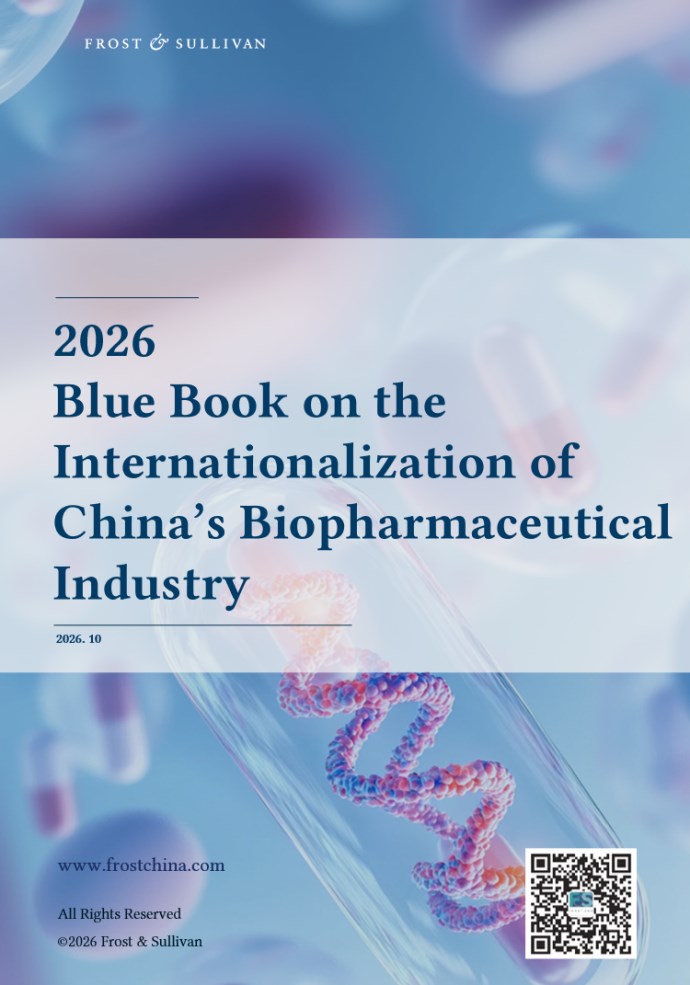
Shanghai, China--(Newsfile Corp. - October 29, 2026) - Frost & Sullivan today released the 2026 Blue Book on the Internationalization of China's Biopharmaceutical Industry, a comprehensive assessment of how Chinese drugmakers are expanding their global footprint. The report traces the industry's progression from supplying active pharmaceutical ingredients (APIs) and intermediates, through exporting generics and biosimilars, to licensing and launching innovative medicines worldwide. With competition intensifying at home and funding conditions shifting, global expansion has become a strategic priority for Chinese companies, widening their addressable markets and allowing them to capture more of the value of their assets. The Blue Book also examines emerging collaboration models, cross-border deal activity, and the opportunities and risks ahead. The full report is available at: https://hub.frost.com/chinas-biopharmaceutical-industry-on-the-global-stage-pathways-progress-and-competitive-position/.
APIs and intermediates: from cost leadership to capability
China remains a cornerstone of the global supply of APIs and intermediates, underpinned by mature industrial infrastructure, cost competitiveness, and manufacturing scale. The segment is now undergoing a structural shift. Traditional bulk products face pricing pressure and volatile overseas demand, while higher-value categories, peptide hormones in particular, have become new sources of growth. Manufacturers are moving into specialty APIs, critical intermediates, and CDMO services, and some are integrating vertically from intermediates through APIs to finished dosage forms. As global supply chains are reconfigured, competitive advantage is shifting from cost toward quality systems, regulatory track record, technical expertise, and long-standing customer relationships.
Generics and biosimilars: competing on complexity
Generics and biosimilars offer a second route to international markets. Worldwide, healthcare cost containment, aging populations, and patent expiries on blockbuster drugs continue to drive demand for lower-cost alternatives. Chinese generic manufacturers are concentrating on complex formulations, hard-to-make dosage forms, and first-generic opportunities, where higher technical barriers limit competition and support differentiation. Biosimilar developers, meanwhile, are strengthening their capabilities in analytical similarity, CMC, quality management, and international regulatory filings, and are reaching overseas markets through out-licensing, regional partnerships, and commercialization agreements. Together, these moves are helping Chinese companies turn their R&D and manufacturing strengths into global commercial returns.
Innovative medicines: multiple routes to global markets
Chinese innovators are pursuing an increasingly varied set of strategies to reach global markets, including independent global development, out-licensing, co-development, cross-border M&A, and the NewCo model. The right choice depends on how differentiated an asset is, what overseas clinical data it requires, and the company's financial and commercial resources. Going it alone suits highly competitive assets backed by sustained investment, and a growing number of companies now design multiregional trials and build global regulatory requirements into their programs from the outset. Overseas approvals of China-developed medicines have shown that these products can compete in major markets. Licensing and partnerships, by contrast, can accelerate overseas development and reduce financial risk, while NewCo and co-development structures let companies draw on outside resources while retaining an economic stake.
Deal activity accelerates
Cross-border business development (BD) and out-licensing have become a primary engine of this expansion. Between 2021 and 2025, the number of China's biopharmaceutical BD transactions more than doubled, from 159 to 328, while total disclosed deal value rose from approximately US$11.1 billion to US$143.1 billion. In the first half of 2026, cross-border transactions outnumbered domestic ones for the first time, underscoring China's expanding role in global drug innovation. Deal structures are maturing as well, moving from single-asset licenses toward long-term strategic partnerships that span multiple assets and proprietary technology platforms.
By modality, small molecules and monoclonal antibodies still account for a substantial share of deal activity, while antibody-drug conjugates (ADCs) and bispecific antibodies have emerged as particularly valuable segments. Multinational drugmakers are showing growing interest in differentiated mechanisms, novel molecular designs, and proprietary platforms, and are placing greater weight on technological differentiation and clinical potential.
Chinese bispecific antibodies are moving into global markets at a faster pace, with overseas partnerships increasingly struck at earlier stages of development. Licensees now scrutinize target combinations, molecular engineering, and platform capabilities alongside clinical performance. ADCs, for their part, have become one of the most established categories of Chinese out-licensing. Approximately 75% of Chinese ADC out-licensing deals have involved assets between the preclinical stage and Phase I, and pipelines are expanding beyond validated targets toward more diverse and novel designs.
Newer modalities are broadening the scope of collaboration further. Bispecific ADCs are attracting rising interest, although growing technological convergence means developers will need to differentiate more sharply. In peptides, global partnerships are centering on differentiated GLP-1-based therapies, particularly multi-target agonists, while regional deals aim to capture local market opportunities. In cell therapy, cross-border activity is extending beyond conventional CAR-T products to in vivo CAR-T, allogeneic CAR-T, stem cell technologies, and related platforms. Taken together, these trends point to an increasingly diverse Chinese pipeline with growing global relevance.
M&A and NewCo structures
Beyond conventional licensing, cross-border M&A and NewCo structures are opening additional routes to global markets and to realizing asset value. Acquisitions give Chinese companies a path to liquidity and access to global resources, while giving international buyers access to differentiated assets and technology platforms. Under the NewCo model, a company transfers the overseas rights to an asset into a newly formed entity funded by outside investors, sharing development risk while retaining a stake in future upside. NewCo activity has risen sharply since 2024, with 31 transactions recorded through the first half of 2026. The long-term value of these structures, however, will ultimately depend on clinical results, financing conditions, regulatory progress, and commercial execution.
Challenges and outlook
Significant challenges remain. Global supply chains are being restructured, regulatory requirements continue to evolve, valuations of innovative assets are increasingly polarized, and many companies still lack mature global operating capabilities. To stay competitive internationally, Chinese companies will need to keep strengthening their quality systems, regulatory expertise, supply chain management, and overseas commercial infrastructure.
Looking ahead, continued industrial upgrading and differentiated innovation are expected to sustain this momentum. Backed by advances in high-end manufacturing and innovative R&D, China's biopharmaceutical industry is shifting from exporting products to delivering innovative assets, technology platforms, and integrated capabilities to the world.
The Blue Book also profiles selected Chinese biopharmaceutical companies with established international strategies, including ABclonal, Gene Key Life, HUALAN, Shibeikang, and VelaVigo, highlighting their work in R&D innovation, global supply chain integration, overseas market expansion, and international collaboration.
Key Topics Covered
Background of China's Biopharmaceutical Internationalization
APIs and Intermediates
Generic Drugs and Biosimilars
Innovative Pharmaceuticals
Key Challenges and Opportunities for China's Biopharmaceutical Internationalization
About Frost & Sullivan
Frost & Sullivan, the Growth Partnership Company, works in collaboration with clients to leverage visionary innovation that addresses the global challenges and related growth opportunities that will make or break today's market participants. For more than 65 years, Frost & Sullivan has been supporting the Global 1000, emerging businesses, the public sector, and investors in developing growth strategies.
Media Contact
Contact: Qian Li
Company Name: Frost & Sullivan
Website: https://www.frostchina.com
Email: PR@frostchina.com
To view the source version of this press release, please visit https://www.newsfilecorp.com/release/321537
Source: Hmedium