
Highlights
- 2026 exploration program commenced at the Pambula Gold Project
- Initial results from 110 soil samples returned assays of up to 24.6 g/t Au, including 7.4 g/t Au and 3.35 g/t Au, with five samples exceeding 1.0 g/t Au
- Geological mapping, ground checking and systematic soil sampling are underway
- High resolution LiDAR survey commissioned to refine structural interpretation and identify historic workings
Vancouver, British Columbia--(Newsfile Corp. - June 10, 2026) - Crossroads Gold Corp. (TSXV: CRG) (OTCQB: CRGCF) (FSE: FI1) (the "Company" or "Crossroads") is pleased to announce the commencement of its maiden 2026 field exploration program (the "Program") at the Pambula Gold Project (the "Project") in southeastern New South Wales, Australia (Figure 1). The Company also reports initial assay results from recent soil sampling completed at Pambula.
Mr. Rex Motton, CEO & Director of Crossroads, commented, "We are very encouraged by the strong start to our 2026 exploration program at Pambula, where initial high-grade gold-in-soil results, including assays of up to 24 g/t Au and 7 g/t Au, are already highlighting the project's significant potential. These results are particularly meaningful because they point to multiple mineralised structures, supported by mapping that is identifying a broader network of historical workings across the project area. When considered alongside the geological setting, historical production and current geochemical evidence, we believe Pambula has the potential to host a large, low-sulphidation epithermal gold system, with indications that we may be within the upper part of a preserved high-grade 'bonanza' zone."
Next Steps in Exploration
Pambula remains significantly underexplored, with historical work limited in scope. The Company is advancing a modern, systematic exploration program designed to refine and prioritise high-quality drill targets across the Pambula Goldfield. Current exploration activities include:
- Ongoing geological mapping to better define mineralised structures and historical workings;
- Systematic soil sampling to extend and refine gold-in-soil anomalies;
- A commissioned LiDAR survey to improve structural interpretation and target definition;
- Integration of historical drilling data with new mapping and geochemical results.
Select historical drill highlights being used to support target generation include:
- 4 m @ 11.82 g/t Au from 21 m depth in PH-P1
- 5 m @ 7.20 g/t Au from 99 m depth in DDH-P7
- 6 m @ 5.13 g/t Au from 33 m depth in PRC13
- 2 m @ 33.05 g/t Au from 26 m depth in PRC32
These results, together with the newly identified gold-in-soil anomalies and mapped historical workings, provide a strong technical basis for advancing toward high-quality drill targets and assessing the potential for multiple high-grade ore shoots across the Pambula Goldfield. Seven of the 32 historical drill holes intersected old workings, including hole PRC13 listed above.
The historical drilling results have not been independently verified by Crossroads Gold but are considered relevant for exploration targeting purposes.
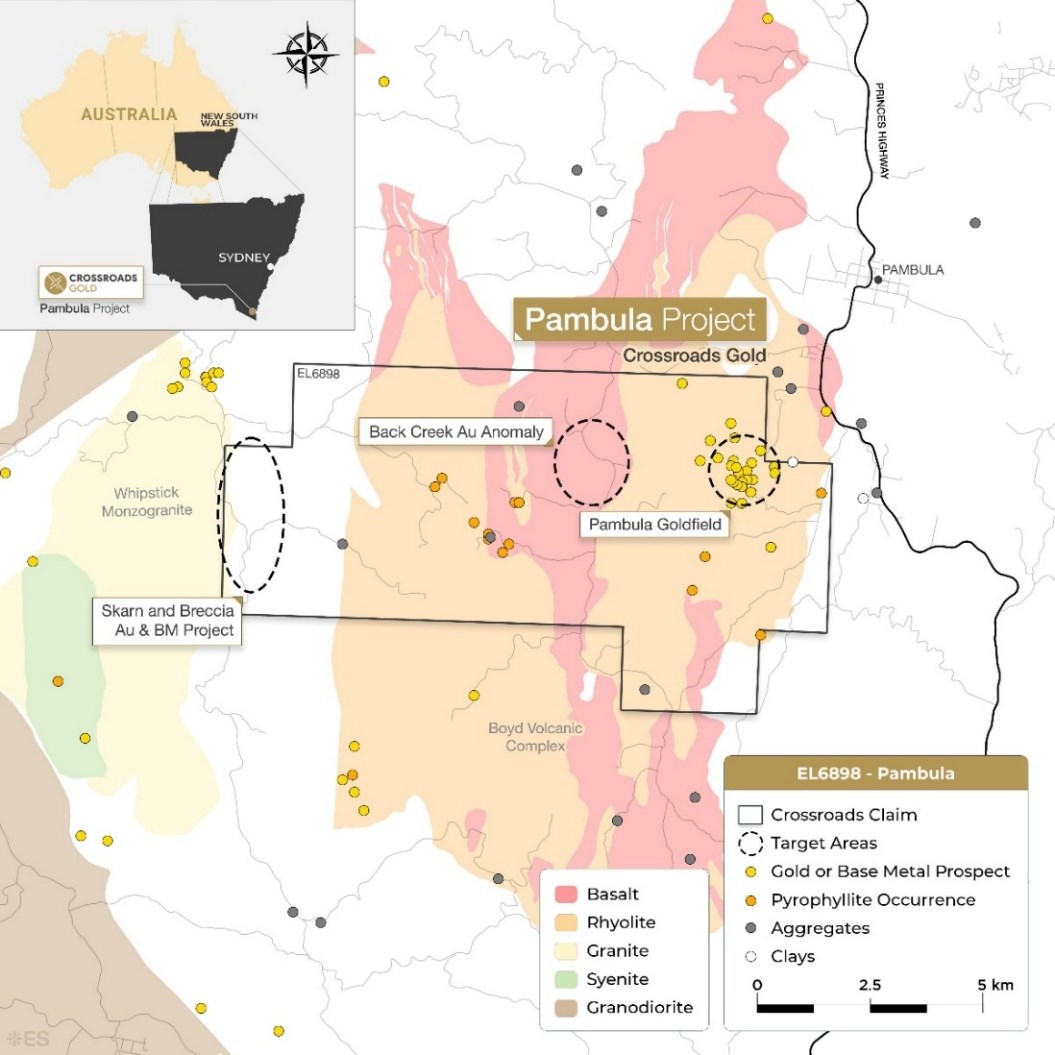
Figure 1 - Pambula Project Location Map
To view an enhanced version of this graphic, please visit:
https://images.newsfilecorp.com/files/12063/300839_0e1004fb44e29aa5_002full.jpg
Initial Soil Geochemistry Results
| SAMPLE ID | EAST GDA94 | NORTH GDA94 | AU_PPB | AUR_PPB | Location |
| 106449 | 753023.08 | 5904681.05 | 1460.00 | 1610.00 | Pilot Fissure Foot Wall - Victory area |
| 106453 | 753537.85 | 5904366.75 | 406.00 | 434.00 | Eastern Fissure - PRC32 area |
| 106456 | 753558.48 | 5904445.21 | 398.00 | 365.00 | Eastern Fissure - PRC32 area |
| PBS02 | 753537.00 | 5904405.00 | 981.00 | 893.00 | Eastern Fissure - PRC32 area |
| PBS07 | 753556.00 | 5905040.00 | 524.00 | 483.00 | Killaloe-Eastern Link Zone |
| PBS21 | 753238.00 | 5904831.00 | 24600.00 | 21500.00 | Hidden Treasure Fissure |
| PBS28 | 753080.00 | 5904667.00 | 1210.00 | 1200.00 | Pilot Fissure Hanging Wall - Victory area |
| PBS47 | 753079.00 | 5904739.00 | 7400.00 | 7930.00 | Pilot Fissure Hanging Wall - Harrison's |
| PBS54 | 753462.00 | 5905037.00 | 744.00 | 821.00 | Killaloe Fissure |
| PBS62 | 753097.00 | 5905037.00 | 3350.00 | 3700.00 | Pilot Fissure Hanging Wall - Gahan area |
| PBS70 | 753118.00 | 5905109.00 | 302.00 | 333.00 | Pilot Fissure Hanging Wall - Gahan North |
Table 1 - Highlighted Soil Geochemistry from Pambula Goldfield
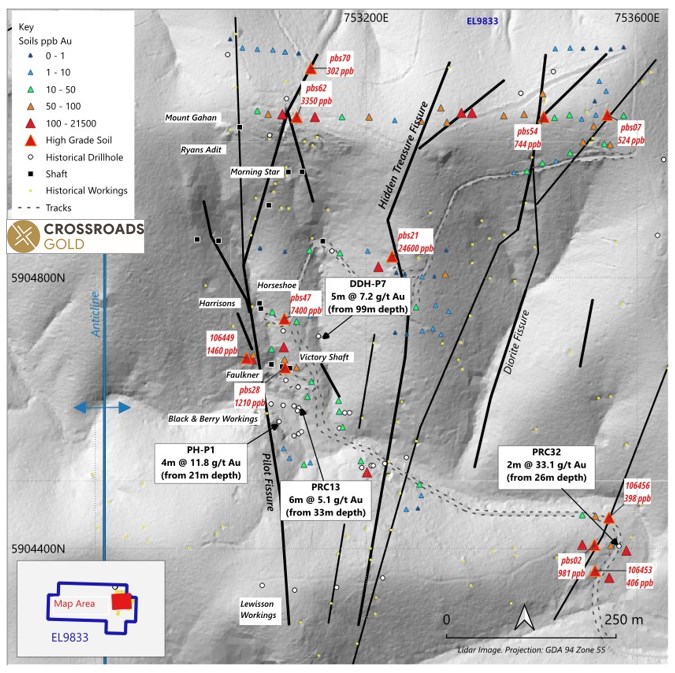
Figure 2 - Pambula Goldfield gold in soil map on old LiDAR topography
To view an enhanced version of this graphic, please visit:
https://images.newsfilecorp.com/files/12063/300839_0e1004fb44e29aa5_003full.jpg
LiDAR Survey Commissioned
The Company has commissioned a high-resolution LiDAR survey, which is expected to:
- Reveal previously unmapped historic workings;
- Improve structural interpretation;
- Support more accurate targeting and drill planning.
Pambula Project Overview
The Program at Pambula is focused on systematic exploration and target generation, including geological mapping, prospecting, soil sampling and geochemical surveys. The Company has completed an initial soil sampling campaign comprising 110 samples, all of which have now been assayed for gold. A further 130 samples were submitted for gold assay within the past week.
The Program may continue to grow as additional historic gold workings are identified. Importantly, historical soil sampling across the Pambula Goldfield was limited in scope and did not include gold assays, instead focusing on only a small number of elements such as mercury, zinc and lead. The Company's current work represents the first systematic effort to evaluate Pambula using modern gold geochemistry alongside a broader base metals suite.
Previous scout drilling conducted by Homestake Australia P/L in the mid-1980s identified significant gold mineralisation, and the Company intends to follow up this work as soon as possible. Most drilling focused on the Pilot Fissure, although a single drill hole on the Eastern Fissure also returned a significant result (hole PRC32).
Pambula Goldfield Geology & Mining History
The Pambula Goldfield is in the eastern part of the exploration licence ("EL") at Pambula and is hosted within a sequence of evolved, high-silica, calc-alkaline rhyolites and associated felsic volcaniclastics of the BVC. It is interpreted as a low-sulphidation epithermal system of volcanic-arc felsic affinity. Gold mineralisation occurs within altered Upper Devonian felsic volcanics containing chalcedonic silica, pyrophyllite, muscovite, albite, chlorite, and disseminated pyrite-features characteristic of low hydrothermal alteration and epithermal gold systems.
Historical Mining and Fissure Systems
The main part of the Pambula Goldfield contains four recognised fissures, or fault zones, that host the primary gold mineralisation. These structures were mined in the late 1890s and early 1900s and produced more than 40,000 ounces of gold from high-grade ore. The westernmost structure, the Pilot Fissure, accounted for most of the goldfield's production from the Gahan, Falkner, Victory and other mines. High-grade ore shoots comprising veins and breccias within the Pilot Fissure reached widths of up to 7.3 metres (1). To the east lie the Hidden Treasure, Diorite-Killaloe and Eastern Fissures. Secondary cross-cutting mineralised faults link these major structures, and many of these linking faults were also mined for high-grade vein and breccia shoots.
Structural Interpretation
Geological mapping and structural analysis at the Pambula Gold Project indicate that gold mineralisation is associated with a fault-controlled epithermal vein system developed within a volcanic arc to rift-margin volcanic pile. Mineralisation is hosted within a network of steep to moderately dipping quartz-carbonate-sulphide veins and breccias localised along major fault corridors, subsidiary linking structures, and reactivated basement fabrics. These structures include reverse faults, oblique ramps and steep transfer faults, which together form a complex, multi-phase deformation architecture favourable for fluid focusing and vein development.
Analogue Goldfield Comparisons
The geological setting and structural style observed at Pambula share similarities with several well-documented epithermal goldfields hosted in volcanic piles, including the Hauraki Goldfield in New Zealand, the Cracow and Mount Coolon districts in Queensland, and the Nerrigundah-Gulaga region of southern New South Wales. The structural architecture of the Pambula vein system also shows parallels with the Victoria veins of the Lepanto district in the Philippines, where steep, long-lived fault zones and linking structures exert primary control on vein emplacement within a volcanic arc environment.
These analogue systems demonstrate that epithermal mineralisation in volcanic piles is commonly focused along reactivated structural corridors, fault intersections and zones of local dilation created during alternating compressional and extensional stress regimes. The Company cautions that mineralisation in these analogue districts is not necessarily indicative of mineralisation on the Company's property.
Target Generation & Geological Interpretation
Previous interpretations of the system are considered simplistic, and ongoing work is developing a more detailed understanding of the structural geology and controls on mineralisation. Early fieldwork is focused on:
- Identifying and refining key structural controls on mineralisation
- Defining the principal features of the goldfield
- Generating and prioritising drill-ready targets
- Advancing and refining targets identified through historical work
Geochemistry Methodology
Whole-soil samples were collected from a nominal depth of 30 cm beneath the humic layer in relatively thin, skeletal soils overlying rhyolitic bedrock. Initial portable X-ray fluorescence ("XRF") analysis of 233 samples identified an As-Pb-Zn-Ba elemental association, a signature typical of a low-sulphidation epithermal ("LSE") gold system developed in rhyolite. Mineralisation identified to date highlights numerous prospective areas. The central part of the Pambula Goldfield, covering approximately 2 km2, will require further detailed soil sampling to establish a complete grid-based dataset. This work is ongoing.
Qualified Person
The scientific and technical information in this news release was reviewed and approved by Mr. Neil (Rex) Motton, who is a "Qualified Person" as defined in National Instrument ("NI") 43-101 - Standards of Disclosure for Mineral Projects. Mr. Motton is the CEO and a Director of the Company and, accordingly, is not considered independent of the Company under NI 43-101. Mr. Motton has visited the Pambula Gold Project discussed in this disclosure.
QA / QC Statement
All soil samples collected from the Pambula Project were obtained as whole-soil samples from the B-horizon where possible. Samples were air-dried prior to dispatch to Onsite Laboratories in Bendigo, Victoria, Australia. At the laboratory, samples were dried, crushed, and pulverised to industry standards to ensure homogeneity prior to analysis.
The Company implemented a comprehensive Quality Assurance ("QA") / Quality Control ("QC") program that included the routine insertion of certified reference materials (standards), blank samples, and field duplicates at regular intervals within the sample stream. These QA/QC samples were inserted at a rate appropriate for early-stage geochemical programs and were used to monitor analytical accuracy, precision, and potential contamination. Laboratory internal QA/QC protocols, including repeats, blanks, and standards, were also monitored as part of the quality control process.
No material QA/QC issues were identified during the review of analytical results. The Company considers the sample preparation, analytical methods, and QA/QC procedures to be appropriate for soil geochemical surveys conducted at this stage of exploration.
Sources & References:
(1) Willis, J.L., 1970 Mining History of Gold deposits of the Far South Coast, New South Wales. Bulletin 24, Department of Mines. Geol. Survey NSW.
About Crossroads Gold
Crossroads Gold is a Canadian gold exploration company backed by the Fiore Group and focused on high-potential gold projects in southeastern Australia, one of the world's premier gold-producing jurisdictions. The Company's objective is to deliver new gold discoveries in a Tier-1 jurisdiction while generating long-term value for shareholders. Its portfolio includes the Pambula Gold Project, the Steiglitz Gold Project, the Pheasant Creek Project and the Club Terrace Project.
Crossroads is led by an experienced management and technical team with deep Australian and global discovery expertise. The Company benefits from excellent infrastructure, year-round access and a stable regulatory framework, supporting a systematic exploration and drilling approach aimed at unlocking meaningful gold discoveries. Crossroads is committed to responsible resource development, proactive and transparent communication, and inclusive engagement with regional communities, Indigenous organisations and other stakeholders. It also seeks to create long-term economic opportunities in the communities in which it operates.
On behalf of the Board of Directors of Crossroads,
Mr. Neil (Rex) Motton
CEO & Director
Crossroads Gold Corp.
T: +1 778 949 3691
Email: investors@crossroadsgold.com
www.crossroadsgold.com
Neither the TSX Venture Exchange nor its Regulation Services Provider (as that term is defined in the policies of the TSX Venture Exchange) accepts responsibility for the adequacy or accuracy of this release.
Certain statements and information contained herein, including all statements that are not historical facts, constitute "forward-looking statements" and "forward-looking information" within the meaning of applicable securities laws. Such forward-looking statements and information include, but are not limited to, statements regarding: the Company's exploration activities and plans at the Pambula Gold Project; the continuation and expansion of geological mapping, prospecting, soil sampling and geochemical survey programs; the receipt, timing and interpretation of assay results; the identification, generation, prioritization and advancement of exploration targets; the completion and interpretation of LiDAR surveys and structural geological studies; the potential size, continuity, extent, preservation, prospectivity and geological characteristics of mineralized systems at the Pambula Gold Project; comparisons to analogue epithermal gold systems; the potential for additional discoveries, ore shoots, mineralized structures or extensions of known mineralization; the commencement, scope, timing and results of future exploration or drilling programs; the receipt of regulatory approvals and permits; and the Company's ability to advance its projects and create long-term value for shareholders.
Forward-looking statements and information are based on a number of assumptions, including, among other things, assumptions that exploration activities will proceed as planned, that assay results and geological interpretations will support the Company's exploration objectives, that required permits and approvals will be obtained on acceptable timelines, that contractors and service providers will perform as expected, that market conditions will remain supportive, and that general business and economic conditions will not materially change. Although the Company considers these assumptions to be reasonable based on information currently available, they may prove to be incorrect.
Forward-looking statements and information are subject to known and unknown risks, uncertainties and other factors that may cause actual results, performance or achievements to differ materially from those expressed or implied by such statements. Such risks and uncertainties include, without limitation: risks associated with mineral exploration and development; the speculative nature of exploration activities; uncertainty in geological interpretations and sampling results; the possibility that future exploration results may not confirm historical results or current interpretations; risks relating to permitting, environmental regulation and community relations; operational and technical risks; fluctuations in gold prices, commodity markets and foreign exchange rates; changes in capital market conditions; the availability of financing, labour, equipment and contractors; and other risks detailed from time to time in the Company's public disclosure documents.
Readers are cautioned not to place undue reliance on forward-looking statements and information. Forward-looking statements and information are made as of the date of this news release, and the Company undertakes no obligation to update or revise such statements or information, except as required by applicable securities laws.

To view the source version of this press release, please visit https://www.newsfilecorp.com/release/300839
Source: Crossroads Gold Corp.