
Vancouver, British Columbia--(Newsfile Corp. - March 17, 2026) - West Point Gold Corp. (TSXV: WPG) (OTCQB: WPGCF) (FSE: LRA0) ("West Point Gold" or the "Company") is pleased to announce the intersection of shallow gold mineralization at the Black Dyke target located four kilometres ("km") west of the Tyro Main Zone, at the Company's Gold Chain Project in Arizona. The initial six reverse circulation ("RC") drill holes at Black Dyke, suggest it is a highly prospective area where additional resources could be defined at the Gold Chain Project. Recent drilling results from the Black Dyke prospect have further prioritized the target for follow-up drilling in early 2026. To date, 10,255m of the ongoing 15,000m drill program at the Gold Chain project have been completed. Results are pending for 24 holes representing 5,361m from the Tyro Main Zone, South Tyro, Sheep Trail, and Bull 8 targets.
Highlights:
Black Dyke hosts a shallow-dipping body of quartz veinlets and breccia ranging in estimated thickness between 7.6 and 36.6m over a strike length of at least 200m and from surface to approximately 250m down-dip
The zone remains open along strike to the west and down-dip to the southwest
Alteration and textures observed in near surface drill results suggest the presence of a potentially deeper gold system associated with this shallow mineralization.
4 km west of Tyro, Black Dyke now represents a second area for potential resource development; follow-up drilling is planned to expand the limits of the shallow oxidized gold mineralization
"Black Dyke is now a potential second resource development area at Gold Chain, which is a meaningful milestone for the project. Shallow, oxidized gold from the surface, with the zone open in multiple directions, gives us a well-defined path to expand this target. Equally compelling is that West Point Gold found this by applying modern methods to a historically underexplored prospect, and the Company is taking that same approach across the property. With results pending from multiple step-out targets, it appears that the potential of the Gold Chain Project is still being defined," stated Derek Macpherson, President and CEO.
Table 1: Drill Results
| Holes | From (m) | To (m) | Width (m) | Grade (g/t Au) |
| GC25-095 | 0 | 36.6 | 36.6 | 1.04 |
| GC25-097 | 4.6 | 15.2 | 10.6 | 0.80 |
| GC26-098 | 21.3 | 42.7 | 21.3 | 0.92 |
| GC26-099 | 62.5 | 70.1 | 7.6 | 1.56 |
| GC26-100 | No Significant Intercepts | |||
| GC26-101 | 114.3 | 126.5 | 12.2 | 1.09 |
| Note: All widths shown are downhole; true widths are greater than 80% of downhole widths. | ||||
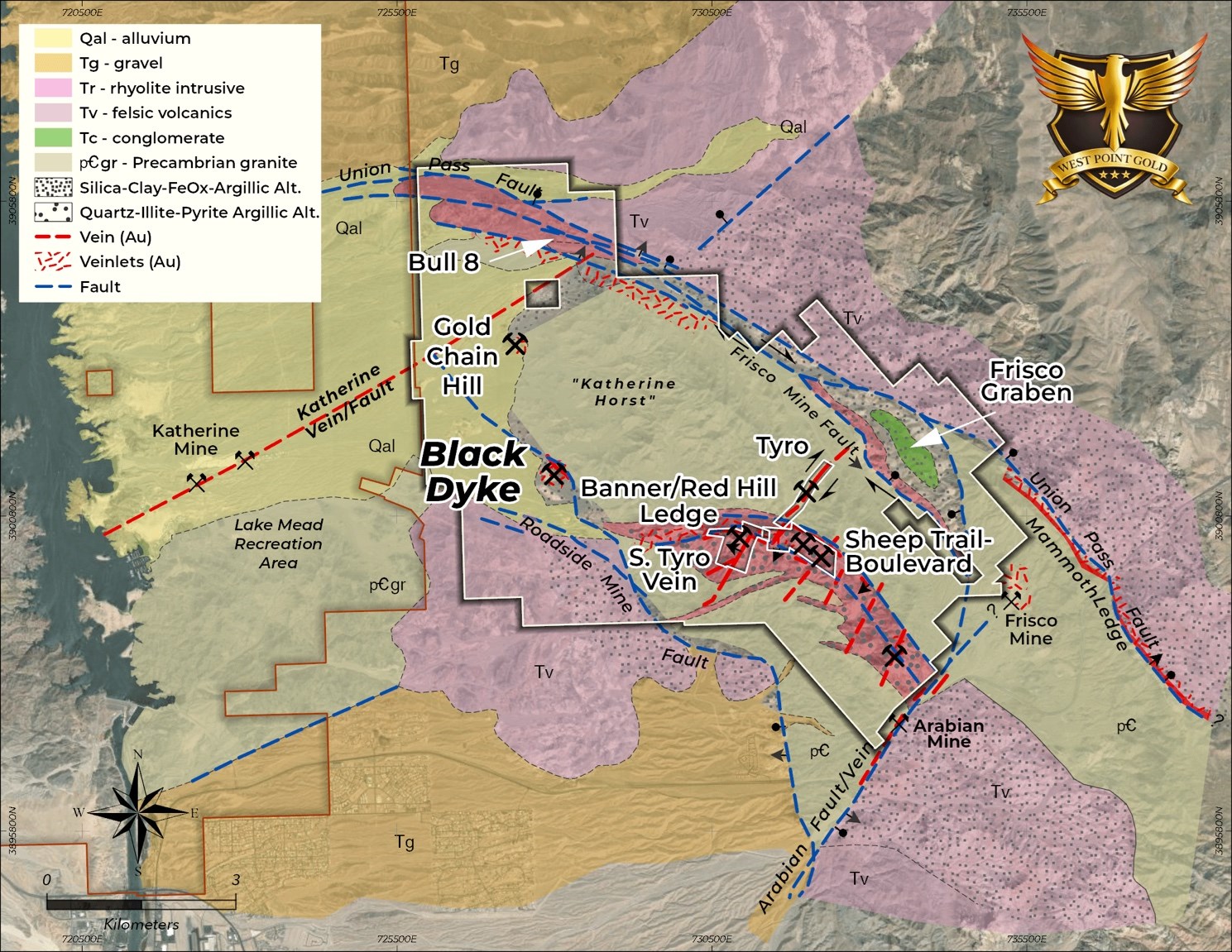
Figure 1: Plan view of the Gold Chain project showing geology, historical mines and/or current prospects. Note the location of the Black Dyke prospect.
To view an enhanced version of this graphic, please visit:
https://images.newsfilecorp.com/files/5717/288736_52ddce7b745e29ae_002full.jpg
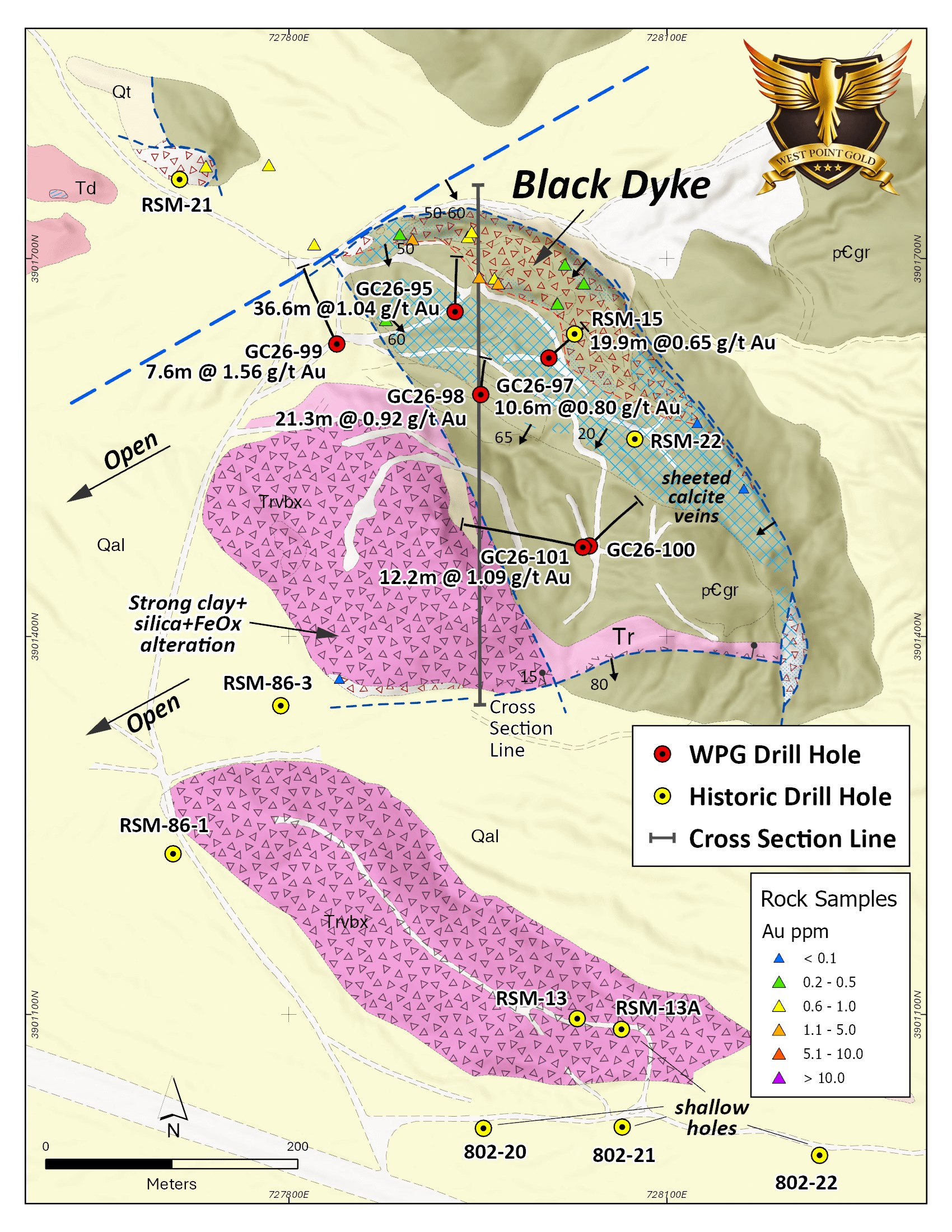
Figure 2. Geologic map of the Black Dyke prospect showing drill holes and surface samples.
To view an enhanced version of this graphic, please visit:
https://images.newsfilecorp.com/files/5717/288736_52ddce7b745e29ae_003full.jpg
Drilling Summary
Holes GC26-95 and GC26-97 through GC26-101 (Table 1) confirm the presence of gold in the subsurface over meaningful grades and widths. The mineralized zone is part of the historical Black Dyke structure and confirms the presence of gold identified in previous exploration efforts. Figure 3 provides a preliminary view of this newly drilled zone and reveals that the gold-bearing holes cut the surface breccia a short distance, up to 250m, down-dip. Given that other NE-trending structures in the district have served as gold-bearing conduits, such as Tyro, Figure 2 suggests that a similar relationship exists at Black Dyke. A short distance into the hanging wall, volcanic rocks deposited upon the Precambrian granite are strongly altered (kaolinite-silica-iron oxide) and brecciated (Figure 3).
The geologic section provided in Figure 3 reveals a sub-horizontal 'blanket' of quartz-calcite breccia and veins at shallow depths. Hole GC26-95 contains 36.6m of 1.04 g/t Au and GC26-98 intersected 21.3m of 0.92 g/t Au. It appears that the holes closest to the intersection of the 'Black Dyke' breccia and the suspected NE-trending structure are thicker and point to the importance of this structural intersection. The southward continuation of this mineralized zone is likely and supported by the projection of mineralized, regional structures (Roadside Mine fault) and hydrothermal alteration in the overlying volcanics (Figure 1).
West Point Gold plans to return to the area to expand the gold zone by drilling to depth and laterally. The gold-bearing vein occurs as fragments in a calcite-cemented breccia. It is anticipated that these fragments emanated from a discrete vein or breccia body at depth.
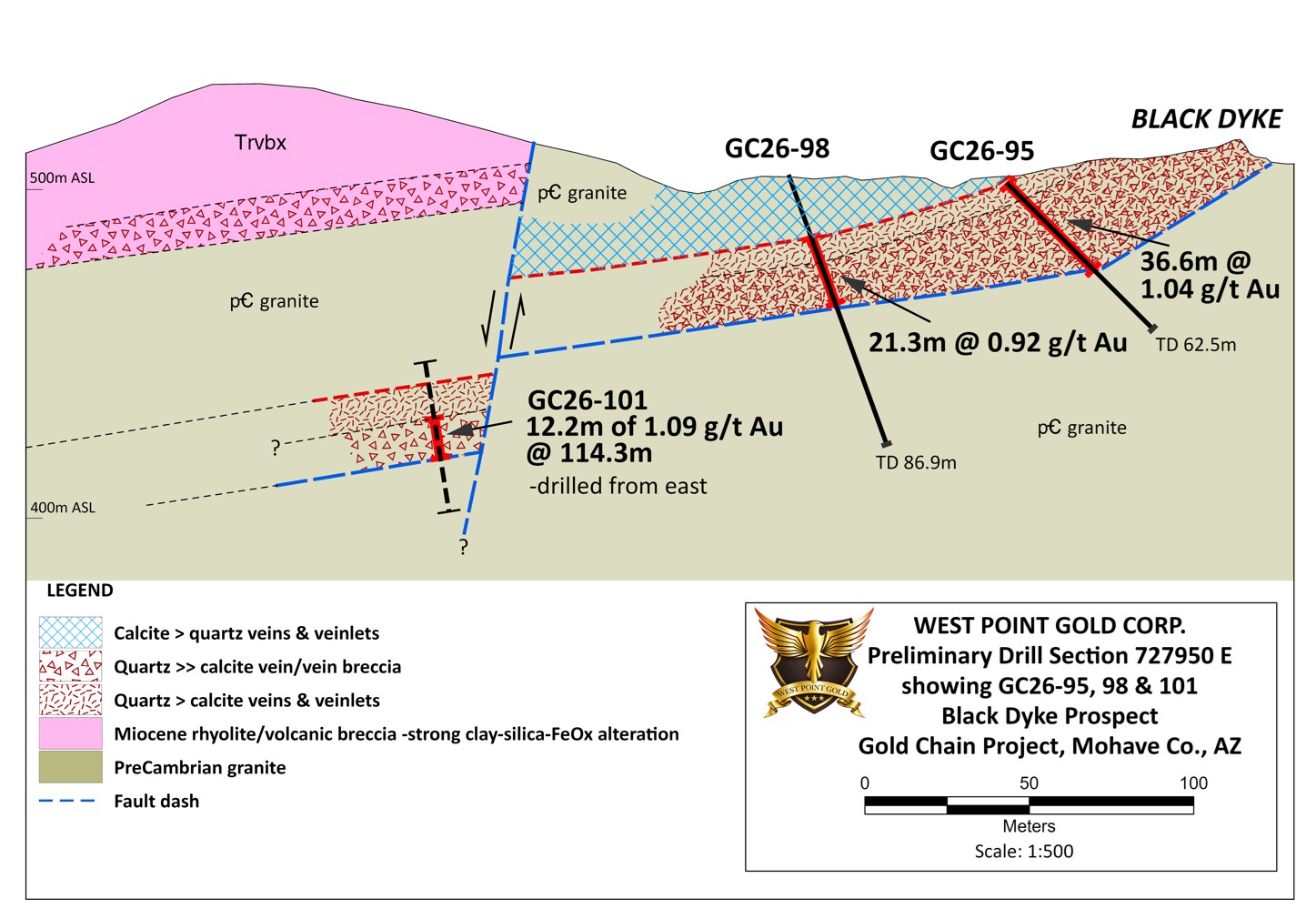
Figure 3. Geologic section along Holes GC26-95, -98 and -101 revealing shallow gold mineralization above the water table (oxidized) extending beneath strongly altered and brecciated volcanics. Fault offsets are postulated, and irregularities in the breccia may, instead, reflect fault refractions or bends.
To view an enhanced version of this graphic, please visit:
https://images.newsfilecorp.com/files/5717/288736_52ddce7b745e29ae_004full.jpg
Project Geology
The northern limit of the Black Dyke prospect is defined by a northwest-trending low-lying ridge composed of coarsely crystalline calcite cementing up to 80+% chalcedony vein and vein (hydrothermal) breccia (Figure 4). The calcite is commonly banded and can be correlated to other calcite veins across the Gold Chain project, which are considered to have been deposited late in the gold system's history and after the gold events.
Historical reports and mapping suggested a southward dip between 30 and 60 degrees. Drilling now indicates a shallow, southerly dip of less than 30 degrees. The western and eastern limits of the low-angle breccia are defined by north- to northeast-trending faults (Figure 2). In the surface exposures both the footwall ("FW") and hangingwall ("HW") rocks are composed of Precambrian granite. The FW contact is sharp with weak propylitic alteration in the underlying Precambrian rocks. The HW is strongly replaced by chlorite and invaded by abundant low-angle calcite veins (<1m) and veinlets. Surface weathering, which extends down to the footwall contact, is evidenced by strong iron and manganese oxides in the gold-bearing zones. Gold mineralization in these initial holes is associated with quartz-chalcedony-calcite veinlets, vein and vein breccia.
This entire south-dipping package passes beneath intensely altered (kaolinite-silica-iron oxides) Miocene dikes and volcanic breccias and tuffs. These rocks comprise distinct low-lying hills surrounded by alluvial deposits composed of gravel and sand. It is suspected that this high-level alteration is related to the gold events operative at Black Dyke.
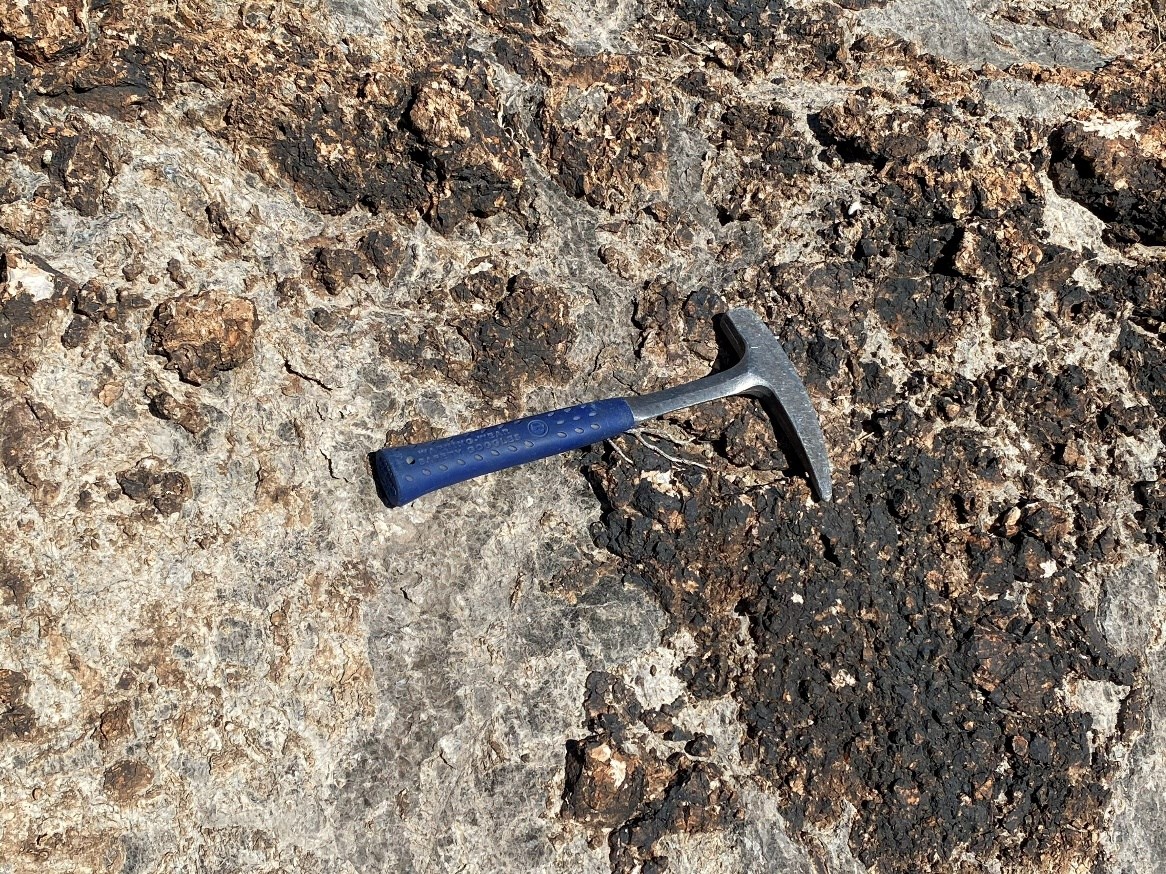
Figure 4. Photograph of the Black Dyke 'vein breccia' showing the dark 'desert varnish' patina on quartz vein and vein breccia hosted in white-gray, massive to banded coarsely crystalline late-stage calcite.
To view an enhanced version of this graphic, please visit:
https://images.newsfilecorp.com/files/5717/288736_52ddce7b745e29ae_005full.jpg
Project History
The Black Dyke mine, which consists of a backfilled shaft, several small pits and dumps, and extensive roads, is located 4.8km east of the Katherine mine and 4.0km west of the Tyro Main Zone. The Katherine vein, like the Tyro vein (West Point Gold), trends northeast and consists of a broad zone of sub-parallel quartz-chalcedony-adularia-calcite veins and veinlets developed along ancestral shears and Miocene rhyolite dikes. Shortly after the discovery of the Katherine vein in 1900, prospectors discovered a broad, easterly trending gold-bearing ridge referred to as a "dyke". It was later described as a vein breccia, up to 30 meters wide, composed of broken chalcedony vein and breccia cemented by a massive to banded, coarsely crystalline gray calcite with elevated manganese (Figure 4). Weathering of the siliceous vein fragments resulted in a dark patina (desert varnish) and, hence, the Black Dyke (dike).
There is no reported gold production from the Black Dyke mine although a two-compartment shaft was open in 1940 which was sunk to 150 feet (45.7m) in the hanging wall of the south-dipping breccia complex. Several hundred feet of drifting was conducted from the bottom of the shaft with much of it reported to be in mineralized rock. Historical assays reveal low gold grades over broad widths up to 30m. Intermittent exploration and development activities continued up through the 1930s but without recorded production.
In the 1980s, several RC/rotary drilling campaigns were conducted with up to 12 holes drilled across the prospect (see Figure 2). One hole, RSM15, drilled 20m of 0.65 g/t Au at 41m. Although the historical (pre-2020) database is considered incomplete, the holes plotted in Figure 2 appear to have been too shallow. Aside from these few holes, there does not appear to have been additional exploration until West Point Gold optioned the property in 2019.
Table 2: Drill hole locations and descriptions
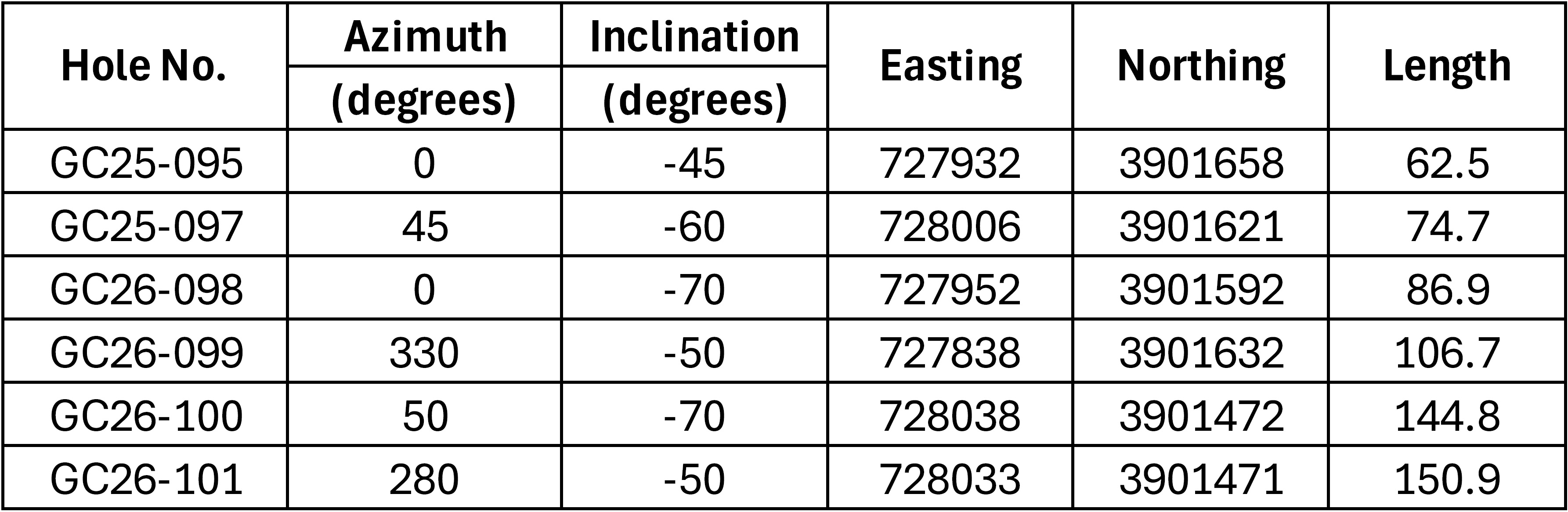
To view an enhanced version of this graphic, please visit:
https://images.newsfilecorp.com/files/5717/288736_52ddce7b745e29ae_0006full.jpg
Qualified Person
Robert Johansing, M.Sc. Econ. Geol., P. Geo., the Company's Vice President, Exploration, is a qualified person ("QP") as defined by NI 43-101 and has reviewed and approved the technical content of this press release. Mr. Johansing has also been responsible for overseeing all phases of the drilling program, including logging, labelling, bagging and transport from the project to American Assay Laboratories of Sparks, Nevada. Drillholes have a diameter of about 10cm, and samples have an approximate weight of 5 to 10kg. Samples were then dried, crushed and split, and pulp samples were prepared for analysis. Gold was determined by fire assay with an ICP finish, and over-limit samples were determined by fire assay and gravimetric finish. Silver plus 15 other elements were determined by Aqua Regia ICP-AES (IM-2A16), and over-limit samples were determined by fire assay and gravimetric finish. Both certified standards and blanks were inserted on site along with duplicates, standards and blanks inserted by American Assay. The results summarized above have been carefully reviewed with reference to the QA/QC results. Standard sample chain of custody procedures were employed during drilling and sampling campaigns until delivery to the analytical facility.
About West Point Gold Corp.
West Point Gold is an exploration and development company focused on unlocking value across four strategically located projects along the prolific Walker Lane Trend in Nevada and Arizona, USA, providing shareholders with exposure to multiple discovery opportunities across one of North America's most productive gold regions. The Company's near-term priority is advancing its flagship Gold Chain Project in Arizona.
For further information regarding this press release, please contact:
Aaron Paterson, Corporate Communications Manager
Phone: +1 (778) 358-6173
Email: info@westpointgold.com
Stay Connected with Us:
LinkedIn: linkedin.com/company/west-point-gold
X (Twitter): @westpointgoldUS
Facebook: facebook.com/Westpointgold/
Website: westpointgold.com/
FORWARD-LOOKING STATEMENTS:
Certain statements contained in this press release constitute forward-looking information. These statements relate to future events or future performance. Forward-looking statements in this press release include statements with respect to Black Dyke representing a second area for potential resource development, that follow-up drilling is planned to expand the limits of the shallow oxidized gold mineralization, that near surface drill results suggest the presence of a potentially deeper gold system associated with this shallow mineralization and include estimates and statements that describe the Company's future plans, objectives or goals, including words to the effect that the Company or management expects a stated condition or result to occur. The use of any of the words "could", "intend", "expect", "believe", "will", "projected", "estimated" and similar expressions and statements relating to matters that are not historical facts are intended to identify forward-looking information and are based on the Company's current belief or assumptions as to the outcome and timing of such future events including, among others, assumptions about future prices of gold, silver, and other metal prices, currency exchange rates and interest rates, favourable operating conditions, political stability, obtaining government approvals and financing on time, obtaining renewals for existing licenses and permits and obtaining required licenses and permits, labour stability, stability in market conditions, availability of equipment, availability of drill rigs, and anticipated costs and expenditures. The Company cautions that all forward-looking statements are inherently uncertain, and that actual performance may be affected by a number of material factors, many of which are beyond the Company's control. Such factors include, among other things: risks and uncertainties relating to West Point Gold's ability to complete any payments or expenditures required under the Company's various option agreements for its projects; and other risks and uncertainties relating to the actual results of current exploration activities, the uncertainties related to resources estimates; the uncertainty of estimates and projections in relation to production, costs and expenses; risks relating to grade and continuity of mineral deposits; the uncertainties involved in interpreting drill results and other exploration data; the potential for delays in exploration or development activities; uncertainty related to the geology, grade and continuity of mineral deposits; the possibility that future exploration, development or mining results may vary from those expected; statements about expected results of operations, royalties, cash flows, financial position may not be consistent with the Company's expectations due to accidents, equipment breakdowns, title and permitting matters, labour disputes or other unanticipated difficulties with or interruptions in operations, fluctuating metal prices, unanticipated costs and expenses, uncertainties relating to the availability and costs of financing needed in the future and regulatory restrictions, including environmental regulatory restrictions. The possibility that future exploration, development or mining results will not be consistent with adjacent properties and the Company's expectations; operational risks and hazards inherent with the business of mining (including environmental accidents and hazards, industrial accidents, equipment breakdown, unusual or unexpected geological or structural formations, cave-ins, flooding and severe weather); metal price fluctuations; environmental and regulatory requirements; availability of permits, failure to convert estimated mineral resources to reserves; the inability to complete a feasibility study which recommends a production decision; the preliminary nature of metallurgical test results; fluctuating gold prices; possibility of equipment breakdowns and delays, exploration cost overruns, availability of capital and financing, general economic, political risks, market or business conditions, regulatory changes, timeliness of government or regulatory approvals and other risks involved in the mineral exploration and development industry, and those risks set out in the filings on SEDAR made by the Company with securities regulators. Although the Company believes that the assumptions and factors used in preparing the forward-looking information in this corporate press release are reasonable, undue reliance should not be placed on such information, which only applies as of the date of this news release, and no assurance can be given that such events will occur in the disclosed time frames or at all. The Company expressly disclaims any intention or obligation to update or revise any forward-looking statements whether as a result of new information, future events or otherwise, other than as required by applicable securities legislation.
Neither the TSX Venture Exchange nor its Regulation Services Provider (as that term is defined in the policies of the TSX Venture Exchange) accepts responsibility for the adequacy or accuracy of this release.

To view the source version of this press release, please visit https://www.newsfilecorp.com/release/288736
Source: West Point Gold Corp.