
Vancouver, British Columbia--(Newsfile Corp. - February 24, 2026) - Great Pacific Gold Corp. (TSXV: GPAC) (OTCQX: GPGCF) (FSE: 0B3) ("Great Pacific Gold," "GPAC," or the "Company") announces that a second diamond drill rig has arrived on site at its flagship Wild Dog Project ("Wild Dog" or the "Project"), located on the island of New Britain, East New Britain Province, Papua New Guinea ("PNG"), and has commenced drilling on the Kasie Ridge epithermal gold-copper target.
Kasie Ridge represents the largest preserved advanced argillic alteration system identified to date on the Wild Dog Project. The prospect forms part of the broader Nengmutka hydrothermal system and lies northeast of the central Wild Dog corridor. It is interpreted as a structurally controlled lithocap developed above, or adjacent to, a potential high-sulphidation epithermal or porphyry system at depth. The scale, intensity and mineralogical maturity of the alteration footprint are consistent with the upper levels of robust magmatic-hydrothermal systems recognized in major high-sulphidation and porphyry districts globally.
This marks the first drilling ever undertaken at Kasie Ridge.
Key Kasie Ridge Target Highlights:
- Extensive advanced argillic alteration footprint extending approximately 1.5-2.0 km in strike and several hundred metres in width
- Alteration assemblage includes pyrophyllite, dickite, kaolinite, alunite, diaspore and zunyite, consistent with high-temperature, acidic hydrothermal conditions
- Coincident magnetic anomaly interpreted as hydrothermal modification of a shallow magnetic source
- MobileMT and resistivity inversions define conductive clay-rich zones with localized deeper resistive features interpreted as potential silica-rich or structurally focused zones
- Structural interpretation highlights multiple NNW-NW trending lineaments converging beneath the ridge
- First drill program to test the system beneath the alteration cap underway with Rig 2
"Kasie Ridge is a very technically compelling target on the Wild Dog project. The scale of advanced argillic alteration, the presence of high-temperature minerals such as zunyite and diaspore, and the convergence of structural corridors into a coincident magnetic feature all point toward a robust hydrothermal centre. Lithocap systems are inherently high-risk, but they are also where many major high-sulphidation and porphyry discoveries originate. This drill program is about applying disciplined mineral systems thinking to test whether we are positioned above something significant," stated Callum Spink, VP Exploration. "Drilling with Rig #1 is also progressing well with a second hole underway at the Kavasuki target. Having two rigs turning full time will allow us to increase the pace of our exploration in 2026, as planned."
Kasie Ridge Target Overview
Kasie Ridge is located on the northern end of the 15-km Wild Dog Structural Corridor (Figure 1) and approximately 4.5 km north of the Sinivit Target where drilling has delineated multiple high-grade shoots (Northern Sulphide shoot and the Southern Oxide shoot).
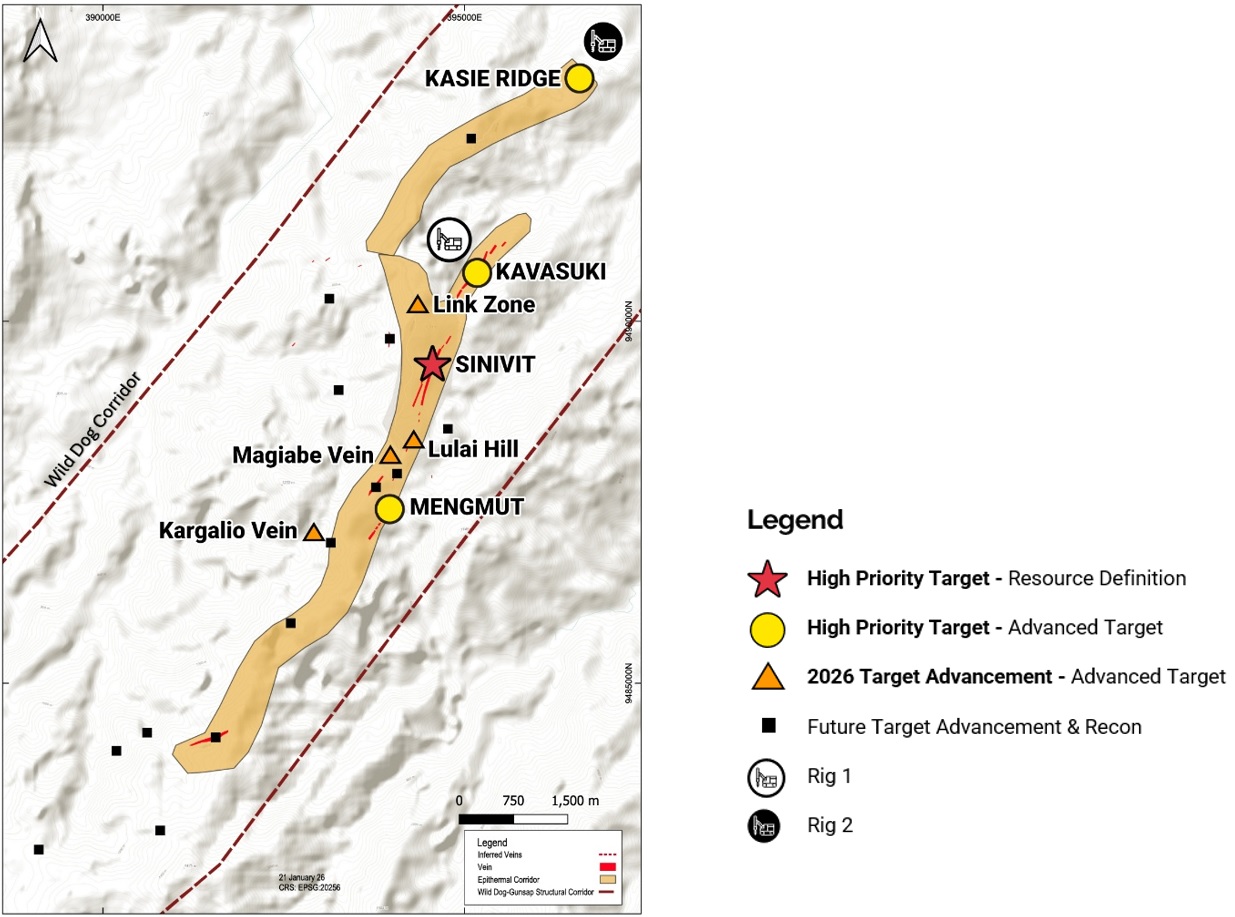
Figure 1: Wild Dog Structural Corridor pipeline of epithermal targets developed from historical and recent work on the Project and the location of Kasie Ridge target.
To view an enhanced version of this graphic, please visit:
https://images.newsfilecorp.com/files/11018/285021_gpac%20figure%201.jpg
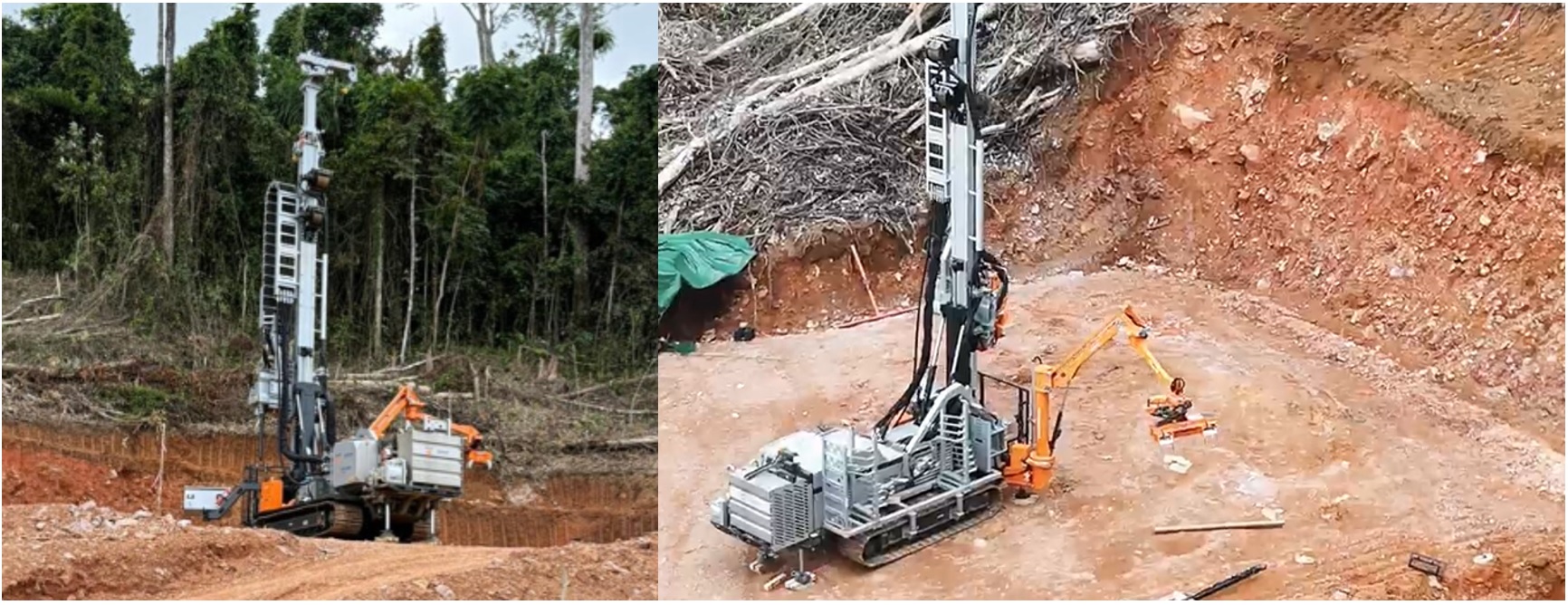
Photos: Newly arrived Rig 2 set up on the Kasie Ridge target.
To view an enhanced version of this graphic, please visit:
https://images.newsfilecorp.com/files/11018/285021_gpac%20photos.jpg
Kasie Ridge is defined by an extensive advanced argillic alteration footprint extending approximately 1.5-2.0 km along strike and several hundred metres in width. The alteration assemblage includes alunite, pyrophyllite, dickite, kaolinite, diaspore and importantly zunyite (Figure 2).
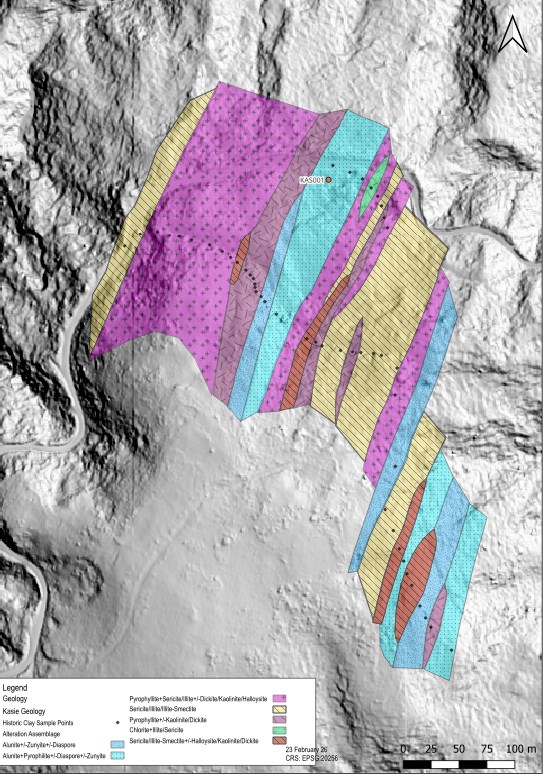
Figure 2: Alteration mineral assemblage map at Kasie Ridge highlighting advanced argillic zones including alunite, pyrophyllite, diaspore and zunyite.
To view an enhanced version of this graphic, please visit:
https://images.newsfilecorp.com/files/11018/285021_d7e212e034e5d85d_006full.jpg
The presence of zunyite and diaspore is particularly significant, as these minerals are commonly associated with higher-temperature, highly acidic hydrothermal conditions proximal to a heat source.
Lithocap systems of this scale are commonly developed above porphyry-epithermal systems and may be barren at surface while overlying potentially mineralized feeder structures at depth.
Modern datasets significantly enhance the geological interpretation at Kasie Ridge relative to historical reconnaissance work. These include:
- High-resolution LiDAR structural interpretation;
- Magnetic inversion modelling;
- MobileMT conductivity modelling, and
- 3D resistivity cross sections.
Magnetic data define a coincident magnetic feature beneath the ridge interpreted to potentially reflect hydrothermal modification of a shallow magnetic source. Resistivity inversions identify conductive clay-rich domains with localized deeper resistive features interpreted as potential silica-rich or structurally focused zones.
Structural interpretation highlights multiple NNW-NW trending lineaments converging beneath Kasie Ridge (Figure 3). This structural junction geometry is consistent with focused hydrothermal fluid pathways recognized in mineralized systems globally.
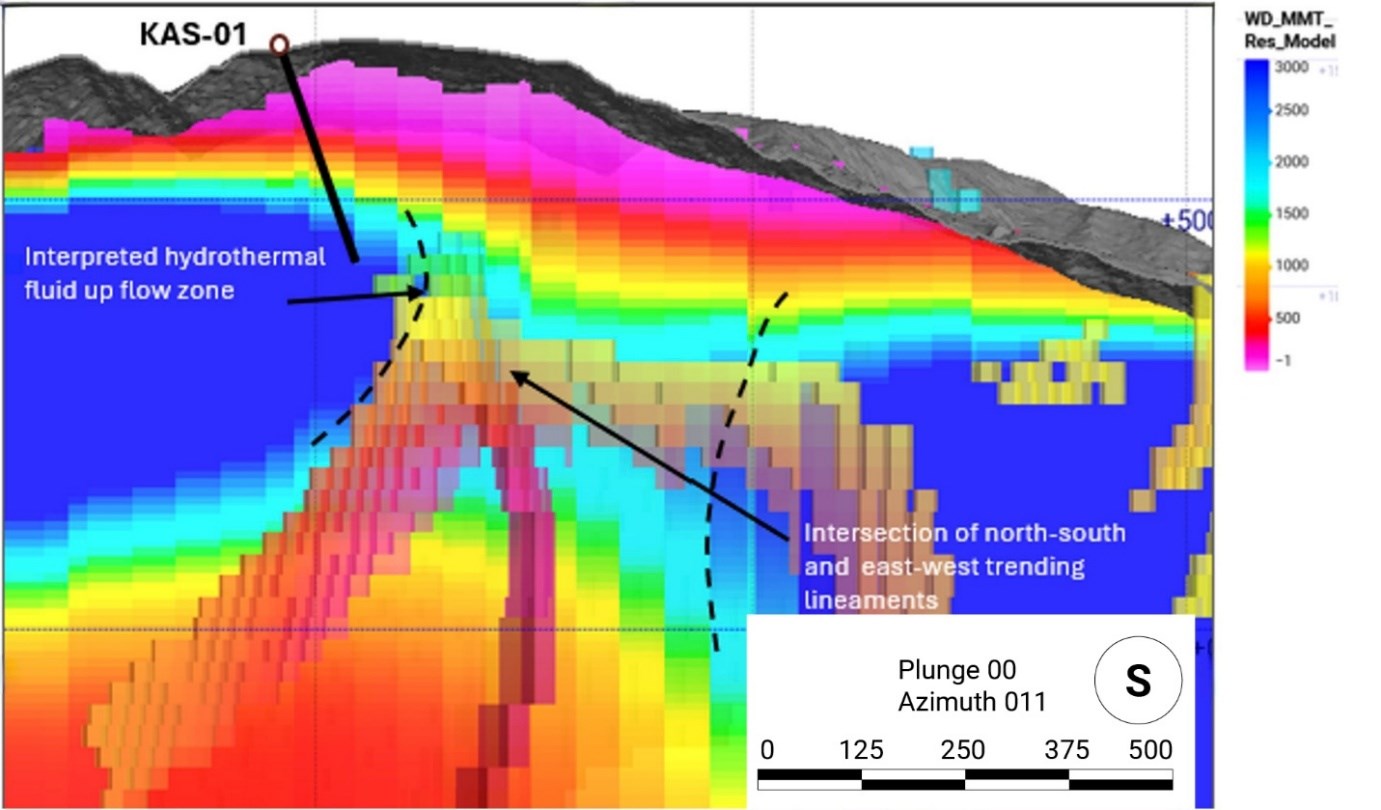
Figure 3: Section view looking East-North-East of drillhole KAS-01 overlain on the resistivity model at Kasie Ridge.
To view an enhanced version of this graphic, please visit:
https://images.newsfilecorp.com/files/11018/285021_d7e212e034e5d85d_007full.jpg
The Company's working interpretation considers Kasie Ridge to represent the preserved upper levels of a high-sulphidation epithermal system or lithocap developed above a potential porphyry source. In such systems:
- Advanced argillic alteration forms at shallow levels from acidic magmatic fluids;
- Vertical clay mineral zonation reflects temperature gradients toward feeder zones;
- Higher-temperature minerals (pyrophyllite, diaspore, zunyite) are commonly proximal to upflow conduits, and
- Mineralization may occur beneath or laterally offset from the alteration cap.
Importantly, alteration systems of this scale require sustained hydrothermal fluid flow and structural permeability, characteristics commonly associated with mineralized magmatic centres.
Lithocap systems and targets are inherently high-risk, as advanced argillic alteration may develop without associated economic mineralisation at depth; however, their scale and mineralogical zonation provide strong vectors toward potential concealed mineral systems.
Comparable geological settings include districts such as Lepanto (Philippines), Wafi-Golpu (Papua New Guinea), and Onto (Indonesia), where lithocap alteration masks deeper porphyry or high-sulphidation mineralization (comparisons are provided for geological context only and do not imply the presence of similar mineralization at Kasie Ridge).
The first drill hole, KAS-01, has been collared within the highest-temperature portion of the advanced argillic assemblage. The hole is designed to test the interpreted intersection of two conductive lineaments, evaluate the margin of a moderately conductive "upflow" zone defined by resistivity inversion modelling, and assess vertical alteration zonation and sulphide development at depth.
Results from KAS-01 will guide follow-up drilling and determine whether the prospect advances to more systematic testing.
Kasie Ridge represents a technically compelling, first-principles mineral systems test within the broader Wild Dog corridor.
On behalf of Great Pacific Gold:
Greg McCunn
Chief Executive Officer and Director
For further information, visit gpacgold.com or contact:
Investor Relations
Phone +1-778-262-2331
Email: info@gpacgold.com
Qualified Person
The technical content of this news release has been reviewed, verified and approved by Callum Spink, the Company's Vice President, Exploration, who is a member of the Australian Institute of Geoscientists, MAIG, and a Qualified Person as defined by National Instrument 43-101 Standards of Disclosure for Mineral Projects. Mr. Spink is responsible for the technical content of this news release. Mr. Spink is not independent of the Company.
About Great Pacific Gold
Great Pacific Gold's vision is to become the leading gold-copper development company in Papua New Guinea ("PNG"). The Company has a portfolio of exploration-stage projects in PNG, as follows:
Wild Dog Project: the Company's flagship project is located in the East New Britain Province of PNG. The project consists of a large-scale epithermal target, the Wild Dog structural corridor, stretching 15 km in strike length and potentially over 1,000 metres deep based on a recent MobileMT geophysics survey. The survey also highlighted the Magiabe porphyry target, adjacent to the epithermal target and potentially 1,000 metres in diameter and over 2,000 metres deep. Drilling of the epithermal structure on the Sinivit target has yielded high-grade results, including WDG-08 which intercepted 8.4 metres at 50 g/t AuEq from 154 metres. The current drilling program will extend into 2026 with second drill rig expecting to be operational in early February 2026.
Kesar Project: located in the Eastern Highlands Province of PNG and contiguous with the mine tenements of K92 Mining Inc. ("K92"), the Kesar Project is a greenfield exploration project with several high-priority targets in close proximity to the property boundary with K92. Multiple epithermal veins at Kesar are on strike and have the same orientation as key K92 deposits, such as Kora. Exploration work to date by the Company at the Kesar Project has shown that these veins have high grades of gold present in outcrop and very elevated gold in soil grades, coincident with aeromagnetic highs. The Company conducted a diamond drill program on key target areas at the Kesar Project from November 2024 to May 2025 and have developed a follow-up Phase 2 program for 2026.
Arau Project: also located in the Eastern Highlands Province of PNG, the Arau Project is south of and contiguous to the mine tenements of K92. Arau contains the highly prospective Mt. Victor exploration target with potential for a high sulphidation epithermal gold-base metal deposit. A Phase 1 Reverse Circulation drilling program was completed at Mt. Victor in August 2024, with encouraging results. The Arau Project includes the Elandora licence, which also contains various epithermal and copper-gold porphyry targets.
The Company also holds the Tinga Valley Project in PNG.
Forward-Looking Statements
Information set forth in this news release contains forward-looking statements that are based on assumptions as of the date of this news release. These statements reflect management's current estimates, beliefs, intentions and expectations. They are not guarantees of future performance. Great Pacific Gold cautions that all forward-looking statements are inherently uncertain and that actual performance may be affected by many material factors, most of which are beyond their respective control. Such factors include, among other things: risks and uncertainties relating to Great Pacific Gold's limited operating history, its exploration and development activities on its mineral properties and the need to comply with environmental and governmental regulations. Accordingly, actual and future events, conditions and results may differ materially from the estimates, beliefs, intentions and expectations expressed or implied in the forward-looking information. Except as required under applicable securities legislation, Great Pacific Gold does not undertake to publicly update or revise forward-looking information.
Mineralization at the properties held by K92 Mining Inc. and at the Wafi-Golpu deposit is not necessarily indicative of mineralization at the Wild Dog Project.
Neither TSX Venture Exchange nor its Regulation Services Provider (as that term is defined in the policies of the TSX Venture Exchange) accepts responsibility for the adequacy or accuracy of this release.
To view the source version of this press release, please visit https://www.newsfilecorp.com/release/285021
Source: Great Pacific Gold Corp.