
Vancouver, British Columbia--(Newsfile Corp. - January 23, 2026) - Tinka Resources Limited (TSXV: TK) (OTCQB: TKRFD) ("Tinka" or the "Company") is pleased to provide an update of the exploration activities at the Silvia gold-copper property in Peru.
Highlights of initial drilling at Silvia:
Initial 1,400 metre diamond drill program completed - A four-hole, 1,400 metre diamond drill program which commenced in late October 2025, was completed in early January 2026. The drill cores are being assayed for gold, copper and pathfinder elements at a commercial laboratory in Lima. Assays are awaited.
Visible copper mineralization - Copper in the form of chalcopyrite was observed in all holes. Visible chalcopyrite of potentially economic grade occurs over relatively narrow intervals up to a few metres in thickness, and is concentrated on or near the contacts between monzonite intrusive dikes and limestone associated with skarn alteration. Chalcopyrite is associated pyrite, magnetite and minor pyrrhotite. Molybdenite is also present in some intersections but typically not directly associated with visible chalcopyrite.
Copper increasing with depth - There are multiple intervals of copper mineralization, and there appears to be a tendency for the chalcopyrite mineralization to increase in intensity with depth, to be confirmed by the assay results.
Drill rig remains on site - The portable drill rig will remain on site for the wet season until the end of April at the earliest, or until a decision is made to continue the drilling program subject to results of an upcoming geophysical program.
Next steps - Assay results for the four-hole drill program are expected Q1 2026. A ground geophysical survey using induced polarization ("IP") and/or magnetotellurics ("MT") is planned for Q2 2026 targeting zones of greater sulphide concentrations.
Dr. Graham Carman, President and CEO of Tinka, stated: "The first drill program at Silvia has been completed at Silvia NW Area A, one of three targets at the Silvia gold-copper property. Four holes were drilled to depths of between 250 metres and 450 metres targeting gold - copper mineralization sampled at surface. Copper mineralization appears to be relatively narrow but we are encouraged by the confirmation of its presence in the subsurface. There are multiple intervals of visible copper sulphides in some of the holes, and there appears to be a tendency for copper abundance to increase with depth, to be confirmed by assays. We are planning a ground geophysical program to follow-up this drilling once access allows after the wet season. The geophysical surveys are intended to highlight areas of greater sulphide concentrations both laterally removed from Area A and at depth, including at Areas A and B."
Discussion of Observed Geology in the Drill Holes
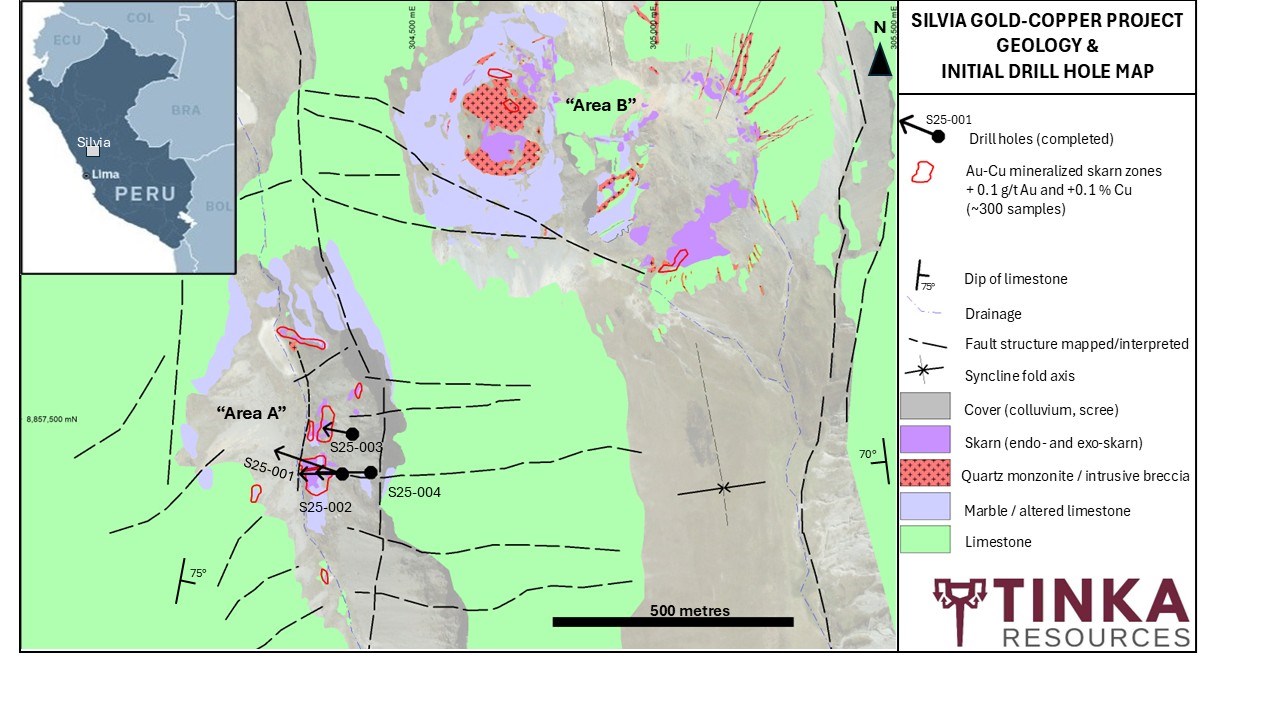
Four diamond drill holes were completed at Silvia NW Area A between late October 2025 and early January 2026. Three of the holes (S25-001, 002 and 004) were drilled on one section line with holes inclined to the west. A fourth hole (S25-003) was drilled on a separate section approximately 100 metres to the north (Figure 1).
A summary of the drill intercepts which have significant visible chalcopyrite is presented in Table 1. Details of the four drill holes including collar coordinates are summarized in Table 2.
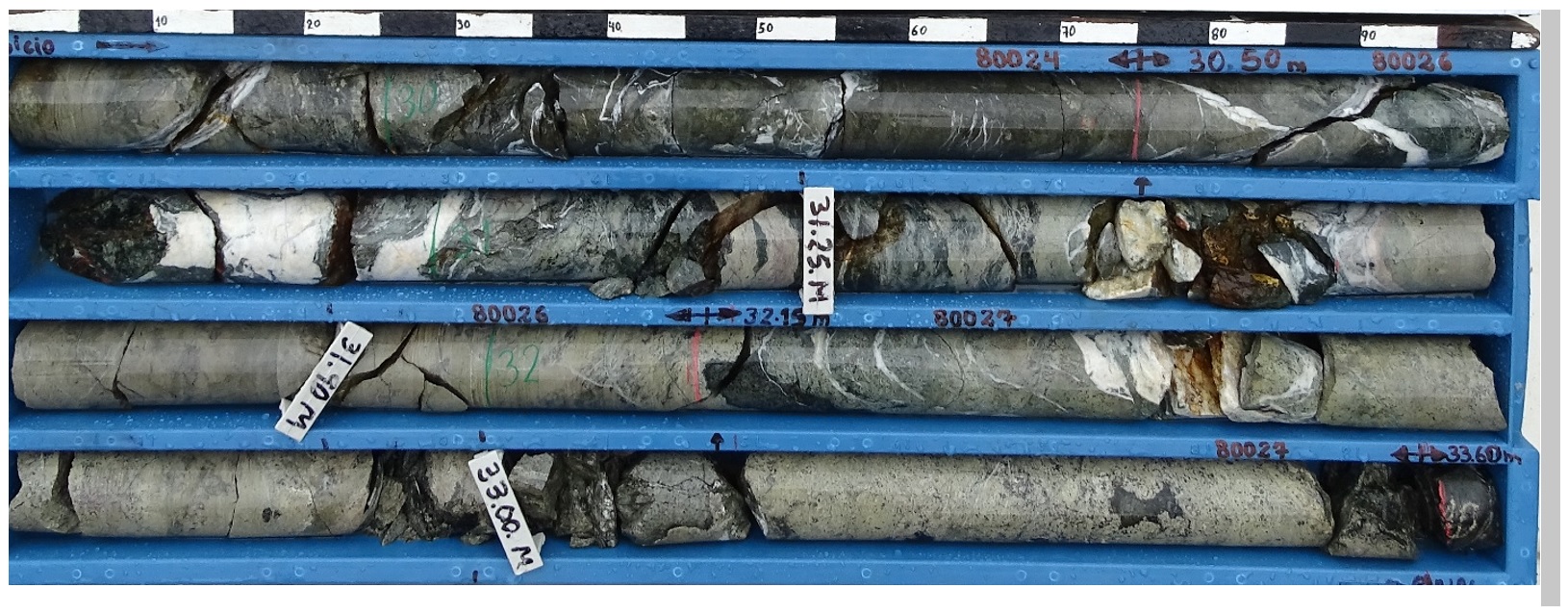
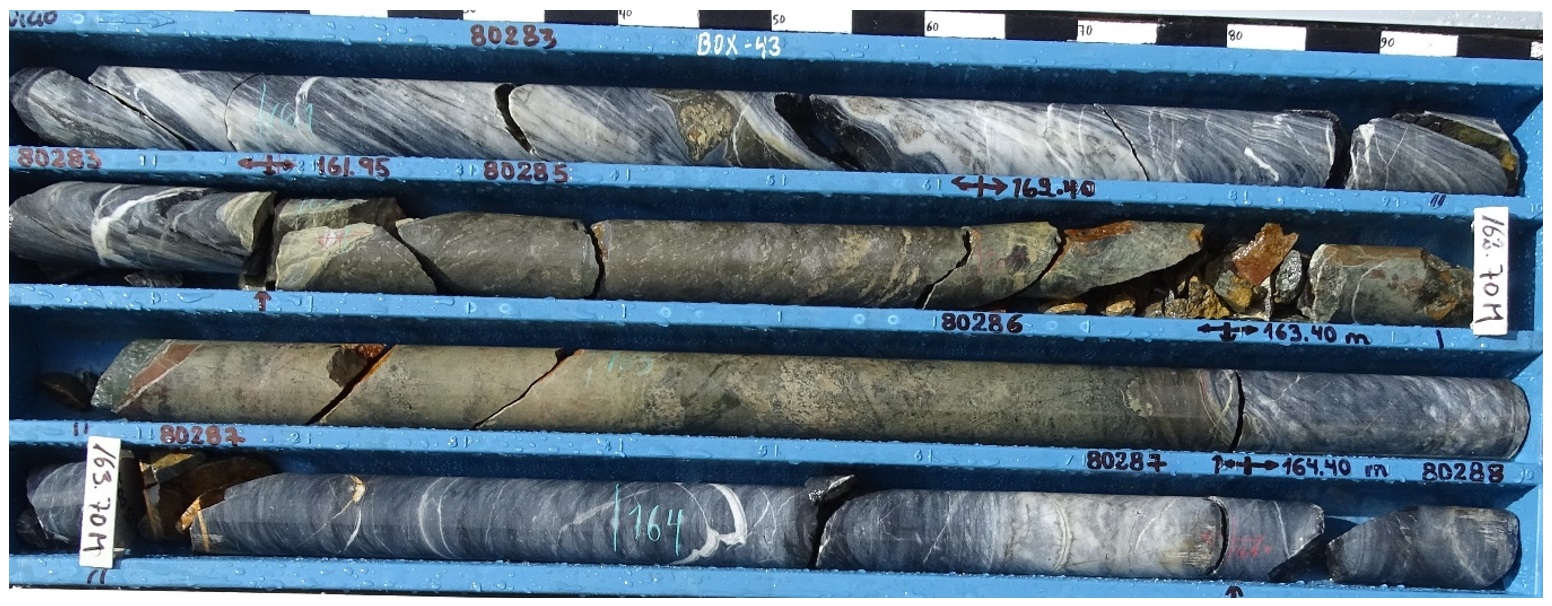
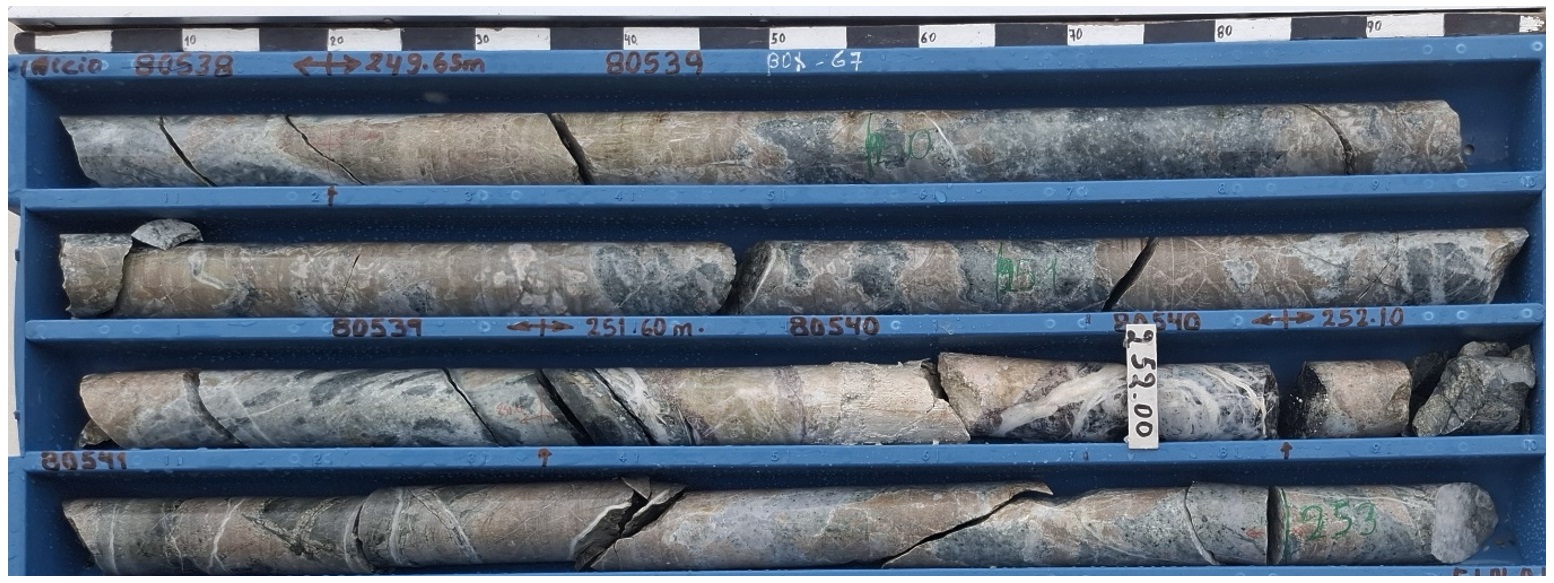
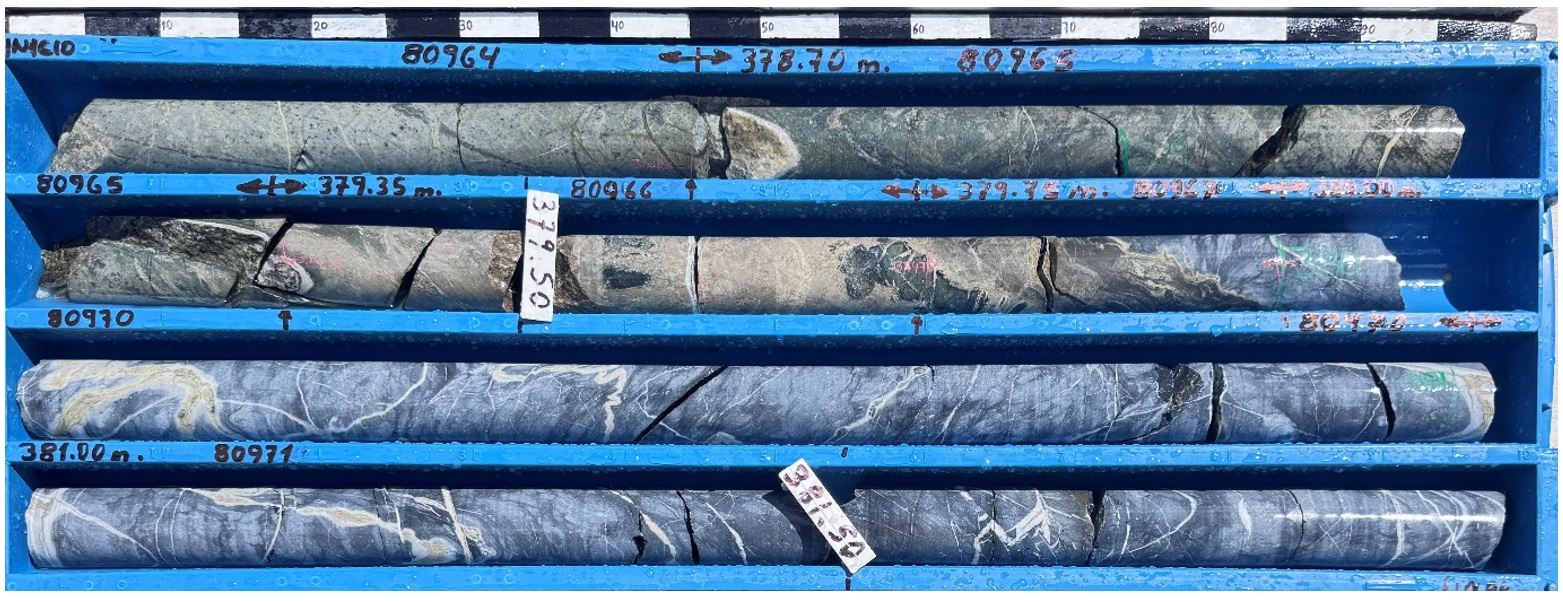
There is widespread and pervasive skarn alteration in the intrusive rocks (quartz monzonite) and limestone (Jumasha Formation) in the drill holes. Skarn typically consists of green and brown garnet with lesser pyroxene, vesuvianite and potassium feldspar ("prograde" alteration) which is overprinted by variable amounts of chlorite, quartz, amphibole, magnetite and carbonate ("retrograde" alteration) in veins and replacements. Exoskarn refers to skarn in limestone, whereas endoskarn refers to alteration in monzonite intrusions (mostly dikes). Sulphides including chalcopyrite, are typically associated with the retrograde alteration. On the edges of the skarn, marble and recrystallised limestone predominate. Typical drill core textures are displayed in Figure 2.
Table 1. Summary of geology in drill intercepts with visible chalcopyrite
| Drill hole | Depth from (m) | Depth to (m) | Approximate downhole thickness (m) | Sulphides | Summary description of geology |
| S25-001 | 18.4 | 22.4 | 4 | py, po, sph, cpy | Exoskarn with sulphide veins |
| 29.5 | 32.5 | 3 | py, po, sph, cpy | Exoskarn and endoskarn with sulphide | |
| 36 | 51 | 15 | mo | Weak disseminated mo in endoskarn | |
| S25-002 | 16 | 32 | 16 | py, cpy | Exoskarn with disseminated mt, py, cpy |
| 32 | 34 | 2 | py, cpy | Stronger sulphide with py, cpy | |
| 36 | 50 | 14 | mo | Weak disseminated mo in endoskarn | |
| 51 | 54 | 3 | py, cpy | Bands of mt, py, cpy in exoskarn | |
| 69 | 71 | 2 | py, cpy, po | Exoskarn with disseminated py, cpy | |
| 71 | 88 | 17 | mo | Weak disseminated mo in endoskarn | |
| 96 | 98 | 2 | py, cpy | Endo and exoskarn, sulphides with mt | |
| 152 | 154 | 2 | po, py, cpy, sph | Exoskarn associated with mt | |
| 159 | 163 | 4 | py, po, cpy | Exoskarn with mt and green garnets | |
| 169 | 172 | 3 | Py, po, cpy | Exo and endoskarn with mt, green garnets | |
| S25-003 | 62 | 82 | 20 | mo | Weak disseminated mo in endoskarn |
| 160 | 163 | 3 | py, po, cpy, sph | Sulphide vein in endoskarn with mt | |
| 208 | 211 | 3 | py, cpy | Sulphide veining in exoskarn with mt | |
| 395 | 396 | 1 | po, py, cpy | Exoskarn with garnets and mt | |
| 417 | 422 | 4 | py, sph, cpy | Endoskarn, disseminated sulphides | |
| S25-004 | 176 | 177 | 1 | po, py, sph, cpy | Sulphide vein in exoskarn |
| 186 | 194 | 8 | py, po, cpy | Sulphides in exo and endoskarn with mt | |
| 231 | 233 | 2 | py, cpy | Sulphide veins in exoskarn | |
| 238 | 255 | 17 | py, po, cpy | Sulphide veins in exoskarn with mt | |
| 366 | 371 | 5 | py, po, cpy | Sulphide veins in endoskarn | |
| 379 | 382 | 3 | py, po, cpy | Sulphide in exoskarn contact | |
| 385 | 386 | 1 | py, cpy | Sulphide vein with mt in exoskarn | |
| 400 | 401 | 1 | py, cpy | Sulphide vein with mt in exoskarn |
Note to Table 1: Mt = magnetite. Cpy = chalcopyrite. Py = pyrite. Po = pyrrhotite. Mo = molybdenite. Sph = sphalerite.
Table 2. Details of Drill holes completed at Silvia NW Area A
| Drill hole | Easting | Northing | Elevation | Azimuth (mag) | Dip | Total Depth (m) |
| S25-001 | 304354 | 8857384 | 4497 | 293 | -55 | 257.1 |
| S25-002 | 304355 | 8857383 | 4497 | 270 | -70 | 258.7 |
| S25-003 | 304379 | 8857468 | 4507 | 280 | -80 | 447.3 |
| S25-004 | 304417 | 8857388 | 4532 | 270 | -75 | 438.5 |
Note: Coordinates are in WGS84-18S datum
Figure 1. Geology map of Area A and B targets at Silvia NW with location of drill holes completed
To view an enhanced version of this graphic, please visit:
https://images.newsfilecorp.com/files/2197/281376_34d26d7754cfbaa3_007full.jpg
Figure 2. Drill core photos
- S25-001 (29.75 to 33.65 m): Limestone altered to garnet exoskarn (pale brown-green colour) and later sulphide (dark black) and carbonate veins (white).
To view an enhanced version of this graphic, please visit:
https://images.newsfilecorp.com/files/2197/281376_tinkafigure2a.jpg
- S25-002 (160.9 to 164.6 m): Limestone (light grey, banded) cut by sulphide - magnetite vein (dark brown). Sulphides include pyrite, chalcopyrite and minor pyrrhotite.
To view an enhanced version of this graphic, please visit:
https://images.newsfilecorp.com/files/2197/281376_tinkafigure2b.jpg
- S25-003 (249.45 to 253.25 m): Monzonite porphyry (grey) altered to garnet endoskarn (brown) and cut by late carbonate-chlorite veins (white)
To view an enhanced version of this graphic, please visit:
https://images.newsfilecorp.com/files/2197/281376_tinkafigure2c.jpg
- S25-004 (378.3 to 381.95 m): Limestone (light grey) cut by garnet skarn (brown) and in turn cut by sulphide-rich vein with retrograde skarn alteration (dark green to black)
To view an enhanced version of this graphic, please visit:
https://images.newsfilecorp.com/files/2197/281376_tinkafigure2d.jpg
| On behalf of the Board, "Graham Carman" Dr. Graham Carman, President & CEO | Further Information: www.tinkaresources.com Tim McNulty 1.604.290.8100 info@tinkaresources.com Stay up to date by subscribing for news alerts at Contact Tinka and by following Tinka on X, LinkedIn and Facebook. |
About Tinka Resources Limited
Tinka is an exploration and development company focused on base and precious metals projects in Peru. The Company's flagship property is the Ayawilca zinc-silver-tin project which has substantial mineral resources of zinc (with silver-lead credits), the Colquipucro silver deposit and the Tin Zone in separate areas. The nearby Silvia gold-copper project is the current focus of exploration drilling. The Company filed a NI 43-101 technical report on an updated PEA for the Ayawilca Project on April 15, 2024 (link to NI 43-101 report here). Dr. Graham Carman, Tinka's President and CEO, has reviewed, verified and approved the technical contents of this release. Dr. Carman is a Fellow of the Australasian Institute of Mining and Metallurgy, and is a Qualified Person as defined by National Instrument 43-101.
Forward-Looking Statements: Certain information in this news release contains forward-looking statements and forward-looking information within the meaning of applicable securities laws (collectively "forward-looking statements"). All statements, other than statements of historical fact, are forward-looking statements. Forward-looking statements are based on the beliefs and expectations of Tinka as well as assumptions made by and information currently available to Tinka's management. Such statements reflect the current risks, uncertainties and assumptions related to certain factors including, without limitations: timing of planned work programs and results varying from expectations; delay in obtaining results; changes in equity markets; uncertainties relating to the availability and costs of financing needed in the future; equipment failure; unexpected geological conditions; imprecision in resource estimates or metal recoveries; success of future development initiatives; competition and operating performance; environmental and safety risks; timing of geological reports; the preliminary nature of the Ayawilca Project PEA and the Company's ability to realize the results of the Ayawilca Project PEA; the political environment in which the Company operates continuing to support the development and operation of mining projects; risks related to negative publicity with respect to the Company or the mining industry in general; delays in obtaining or failure to obtain necessary permits and approvals from local authorities; community agreements and relations; and, other development and operating risks. Should any one or more of these risks or uncertainties materialize, or should any underlying assumptions prove incorrect, actual results may vary materially from those described herein. Although Tinka believes that assumptions inherent in the forward-looking statements are reasonable, forward-looking statements are not guarantees of future performance and accordingly undue reliance should not be put on such statements due to the inherent uncertainty therein. Except as may be required by applicable securities laws, Tinka disclaims any intent or obligation to update any forward-looking statement.
Neither the TSX Venture Exchange nor its Regulation Services Provider (as that term is defined in the policies of the TSX Venture Exchange) accepts responsibility for the adequacy or accuracy of this news release.

To view the source version of this press release, please visit https://www.newsfilecorp.com/release/281376
Source: Tinka Resources Limited