
Highlights:
Significant gold mineralization intersected in the first-ever drill program at Nguni.
The Nguni gold-in-soil anomaly has been extended approximately 2.8km to the northwest, where new sampling has defined a 1.5km-long anomaly with soil values up to 0.55 g/t Au.
The Nguni gold-in-soil anomaly now has an inferred strike length of more than 9km.
Three additional gold-in-soil anomalies have been discovered 5km to the southeast of Nguni using Ongwe's in-house detectORE™ system.
Best drill hole intersections at Nguni:
NRC026
20m @ 1.31 g/t Au from 28m, incl. 16m @ 1.57 g/t Au, and
6m @ 1.04 g/t Au from 62m
NDD010
12m @ 1.58 g/t Au from 54m, and
5m @ 1.17 g/t Au from 80m
NRC008
23m @ 0.76 g/t Au from 56m, incl. 8m @ 1.65 g/t Au
NRC005
17m @ 0.80 g/t Au from 132m, incl. 6m @ 1.77 g/t Au
Complete set of drill results is available here: link
Vancouver, British Columbia--(Newsfile Corp. - November 24, 2026) - Ongwe Minerals Inc. (TSXV: OGW) ("Ongwe" or "the Company") is pleased to announce that maiden drilling at its Nguni Gold Discovery has intersected extensive gold mineralization over multiple drill holes, confirming the large-scale potential of the Nguni system. In addition, recent surface exploration work has extended the Nguni gold-in-soil anomaly approximately 2.8km to the northwest and three new gold-in-soil anomalies have been identified to the southeast of Nguni, along regional fault structures.
Nguni is a large, high-grade gold-in-soil anomaly discovered by Ongwe in May 2026 during regional soil sampling along the Okondeka Fault Zone (OFZ). The OFZ is a regionally significant structure that hosts both WIA Gold's Kokoseb Gold Deposit and Ongwe's Manga Gold Discovery - see Figure 1. Located 55km east of Kokoseb and 14km east of Manga, the Nguni anomaly now has an inferred strike length of more than 9km and is being advanced through detailed surface work and drilling, with the aim of converting it into a large-scale economic discovery.
Dave Underwood, Ongwe's CEO commented: "We have fast-tracked Nguni from discovery of the initial gold-in-soil anomaly through the first drill program in just 6 months. As we progressed and as the system grew, we got increasingly excited about its prospects, however, we now also know that the entire system is covered by a mixture of sheetwash, colluvium, desert sand and calcrete, making exploration more challenging than originally anticipated. The first few drill holes provided a clear indication that the surface gold anomaly has been moved around quite extensively, and we cannot rely on the soil assays alone to position drill holes. We have therefore carried out concurrent detailed drone magnetics and drilled diamond holes for lithological and structural data as well as multi-element geochemistry. With the help of these additional data layers, we are now developing a much better understanding of the complex geology and a few of the later holes have intersected very promising mineralization with a best of 20m @ 1.31 g/t Au.
To put this initial drill program in perspective, it is useful to provide a comparison with our previous discovery in Namibia (Twin Hills deposit, Osino Resources). In early 2017, a mineralized structure (the Karibib Fault) of at least 50km in length was defined using regional magnetics and soil sampling. The first three drill programs in 2017 and 2018 missed or intersected low-level gold with a best intercept of 10m @ 1.1 g/t Au. It was only in late 2018 that the discovery holes were drilled into the Twin Hills deposit after extensive additional work including detailed ground magnetic surveys, calcrete geochemistry and bedrock sampling. The first phase of drilling at Nguni has already far surpassed the initial drilling we did at Twin Hills, which is very encouraging.
The Okondeka structure hosts the Kokoseb gold deposit at its western end and then continues for at least 80km to the east, hosting Ongwe's Manga and Nguni discoveries along its length. The Nguni surface gold anomaly is about 9km in strike length to date and open in all directions. The initial scout drill program was limited to about 4km of strike length of the Okondeka structure, out of a total of at least 60km on Ongwe licenses.
The sediment-hosted gold deposits in Namibia are located along very large structural corridors which are mineralized along much of their length, but formation of an economic deposit requires a trap site with the right combination of lithology, structure and chemistry. The geological team at Ongwe have vast combined experience with these systems and we are confident in further locating the sweet spots within these corridors.
Nguni is clearly a very large gold system which we are just beginning to understand. We are really excited to get drilling again early in Q1 2027, once we have collected all the assays and compiled all the geological data."
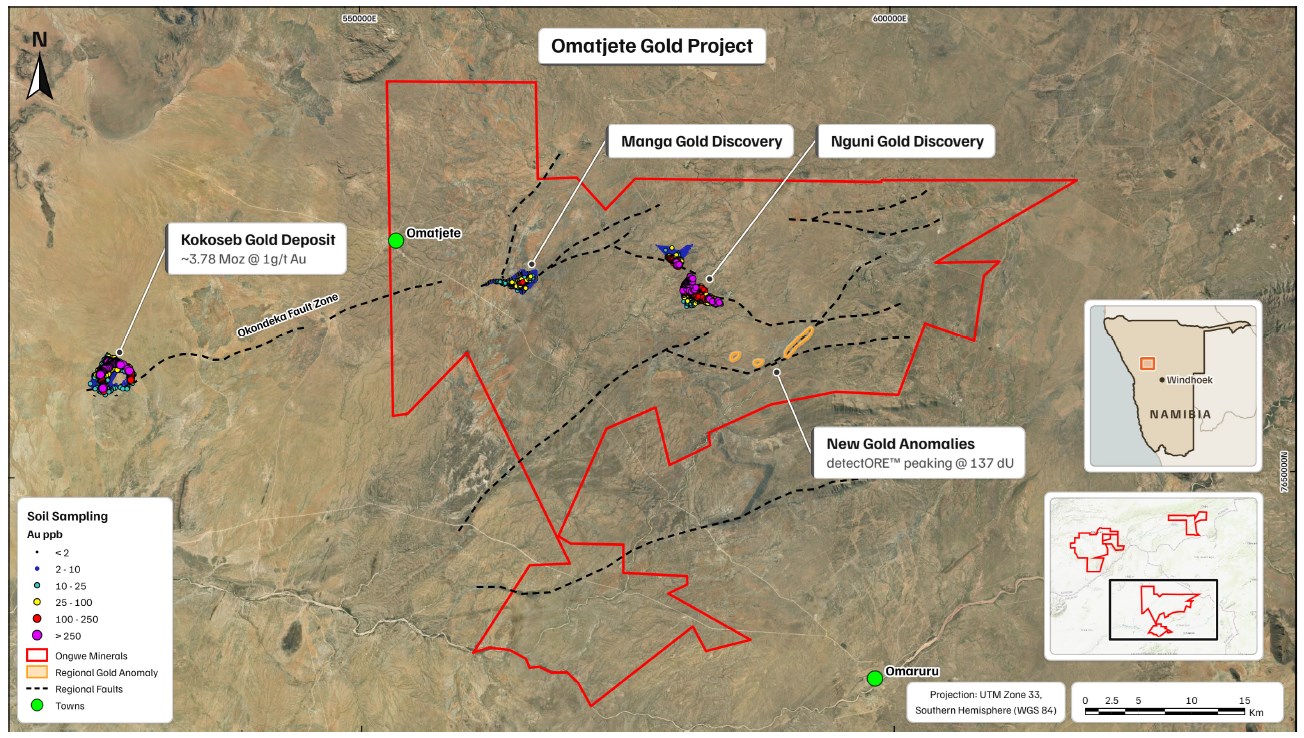
Figure 1: Regional map illustrating the Nguni Gold Discovery in relation to the Manga Gold Discovery and the Kokoseb Gold Deposit (54.2Mt at 1.04 g/t Indicated, 35Mt at 0.99 g/t Inferred, released 16 July 2026, ASX, WIA Gold). The map highlights the primary structural control of the Okondeka Fault Zone on all three gold systems and points out the three new gold-in-soil anomalies.
To view an enhanced version of this graphic, please visit:
https://images.newsfilecorp.com/files/12469/325295_c1c9d62bd49e589b_001full.jpg
Nguni Gold System
Nguni forms part of a large orogenic gold system controlled by the regionally significant Okondeka Fault Zone (OFZ) and its associated fault network - see Figure 1. Work to date confirms that these fault zones are preferentially developed within the more ductile metasedimentary units that occur as narrow belts between the granite intrusions. The regional significance of this structural corridor is reinforced by the discovery of three new gold-in-soil anomalies to the southeast of Nguni, all of which coincide with regional fault structures - see Figure 2. The grade potential of these new anomalies is still to be confirmed by follow-up sampling, but each carries anomalous gold associated with the fault zones.
Gold mineralization at Nguni is hosted within the metasedimentary sequence, predominantly in quartz-biotite schist, rather than in the surrounding granites. Two generations of granite are recognized. The older Salem granites are interpreted to pre-date mineralization, while the younger leucogranites are interpreted to be syn- or post-mineralization. Early drilling has shown that while gold occurs sporadically throughout the quartz-biotite schist, economic grades and widths develop where there are lithological contacts between units of different competency. To date the better intercepts have been located on contacts between quartz-biotite schist and cordierite schist.
At the local scale, the mineralization is structurally controlled and structurally complex. Folding of the metasedimentary sequence, which pre-dates the intrusion of the leucogranites, is interpreted to be the main driver of mineralization. The later emplacement of the leucogranites further complicated the structure, with the resulting updoming deforming the pre-existing mineralized zones. As a result, the gold wraps around the leucogranite bodies, although the granites did not play a role in the gold mineralization.
Nguni displays the characteristics of a typical orogenic gold system and shows strong similarities to the Kokoseb Gold Deposit, particularly in its sulphide assemblage. Arsenopyrite is the primary sulphide occurring with the gold, while pyrrhotite and pyrite are more widely distributed in the higher strain zones. The gold mineralized zones are accompanied by intense biotite alteration.
The Nguni gold system remains open in all directions. Soil sampling will continue across the corridor between Manga and Nguni and along the immediate strike extensions of Nguni. The Company expects that this sampling will increase the footprint of the gold-in-soil anomaly and generate additional targets. Future drill targeting will focus on locating and following the contact between the quartz-biotite and cordierite schist as well as locating other suitable trap sites.
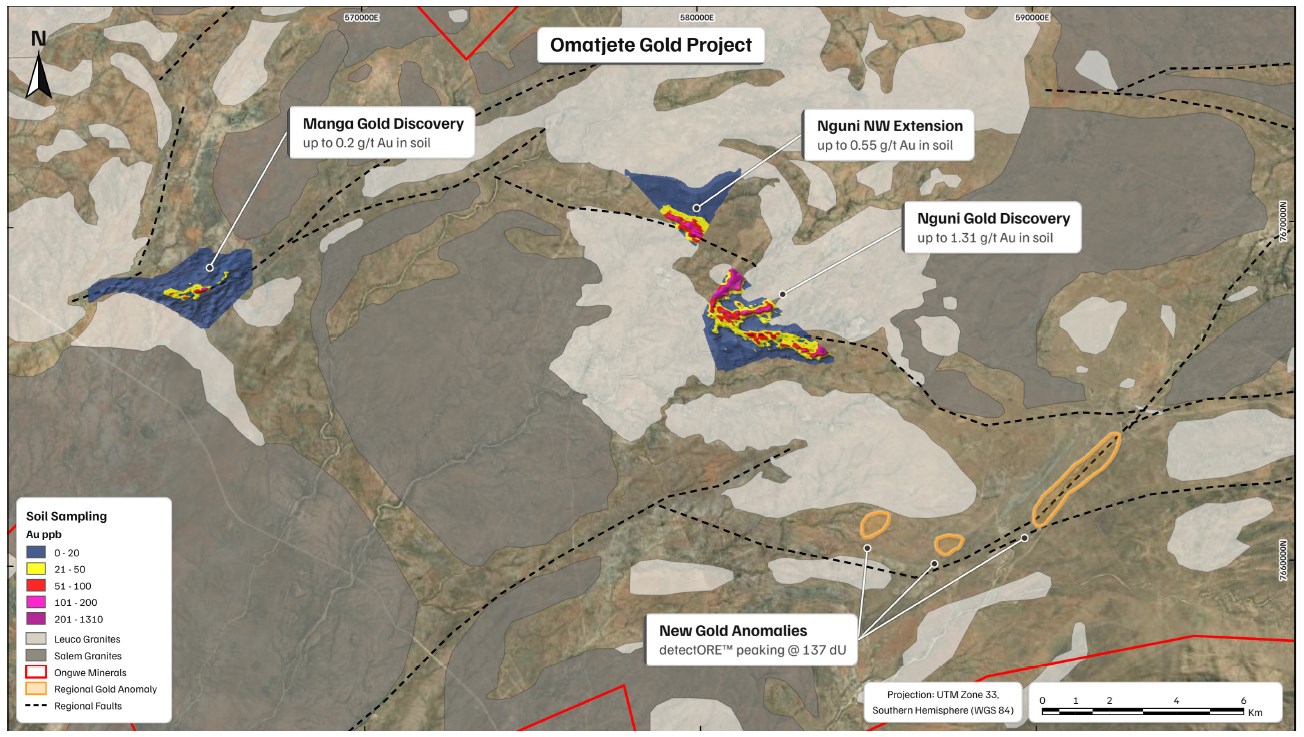
Figure 2: Gold-in-soil heat maps of the Manga Gold Discovery, the Nguni Gold Discovery and the Nguni NW Extension, shown with the Salem granites, leucogranites and the regional faults that follow the metasedimentary corridors between them. The three new detectORE™ gold anomalies (up to 137 dU) are outlined in orange.
To view an enhanced version of this graphic, please visit:
https://images.newsfilecorp.com/files/12469/325295_c1c9d62bd49e589b_002full.jpg
Nguni Drilling
To date, Ongwe has completed 3,974m of reverse circulation (RC) drilling in 37 holes and 1,161m of diamond drilling (DD) in 7 holes at Nguni, for a total of 5,135m. The RC holes have an average depth of 107m and the diamond holes an average depth of 166m. This release reports assay results for 4,263m of drilling from 28 RC holes and all 7 diamond holes, with assays outstanding for the remaining 9 RC holes - see Figure 3.
The initial drill program focused on the highest-grade portions of the gold-in-soil anomaly and on the leucogranite and quartz-biotite schist contact. Drilling soon showed that soil grades are a poor predictor of in-situ grades, because the superficial cover across Nguni varies between 1m and 10m in thickness. High-grade soils therefore do not necessarily overlie high-grade bedrock and as a result a number of the early holes were not optimally positioned. A combination of RC and DD drilling was used, with the oriented diamond core acting as a geological control and providing key structural information.
As the association between gold mineralization and the cordierite schist contact was only recognized during the later stages of the program, much of the drilling did not target this contact and intersected predominantly low-grade mineralization, particularly in the northwestern zone. To date, the cordierite schist units have only been confirmed in the eastern part of Nguni, where most of the economic intercepts were returned. The Company believes these units are continuous across the project area, providing significant scope for the next round of drilling that specifically targets the quartz-biotite schist and cordierite schist contact.
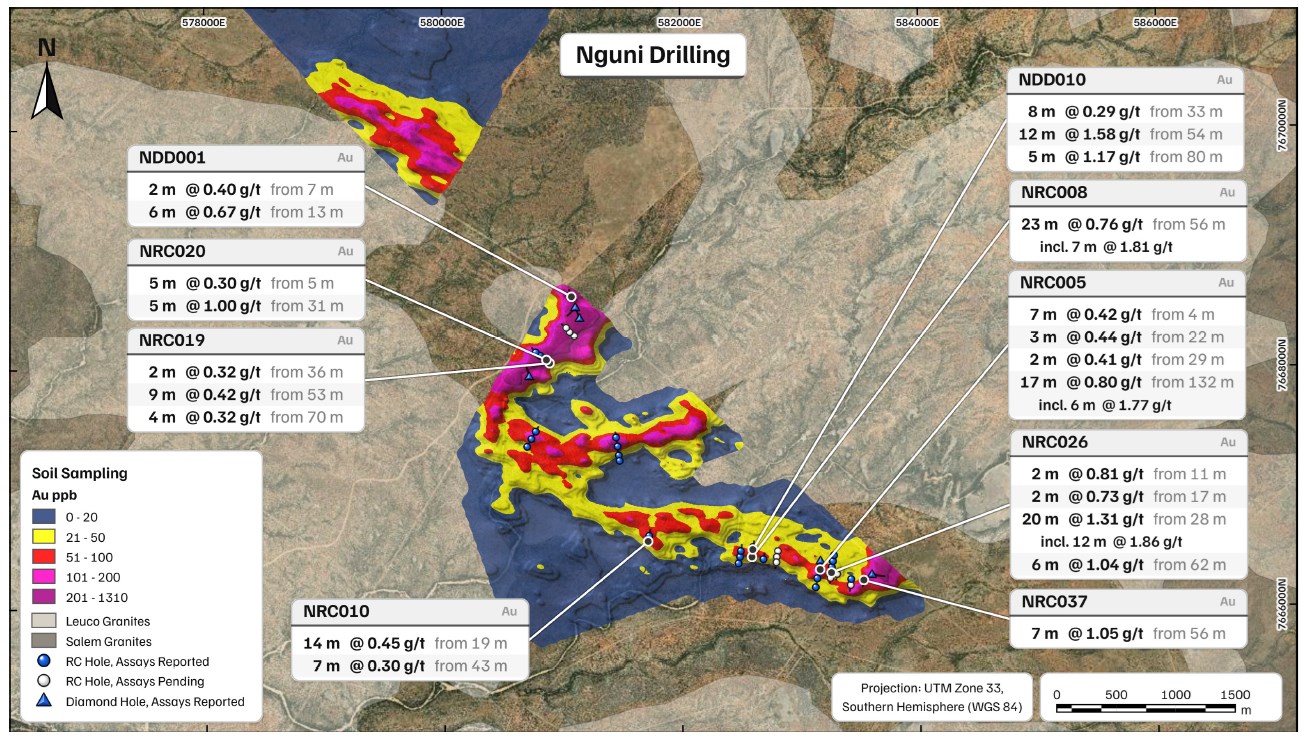
Figure 3: Gold-in-soil heat map of the Nguni Gold Discovery and the Nguni NW Extension, showing the RC and diamond drill collars by assay status and the significant drill intercepts (0.3 g/t Au cut-off, maximum 3m internal dilution, minimum 2m length). Cross-sections A-A′ (NRC026), B-B′ (NRC008 and NDD010) and C-C′ (NRC005 and NDD009) are shown in Figures 4, 5 and 6. All drill intercepts reported are downhole lengths.
To view an enhanced version of this graphic, please visit:
https://images.newsfilecorp.com/files/12469/325295_c1c9d62bd49e589b_003full.jpg
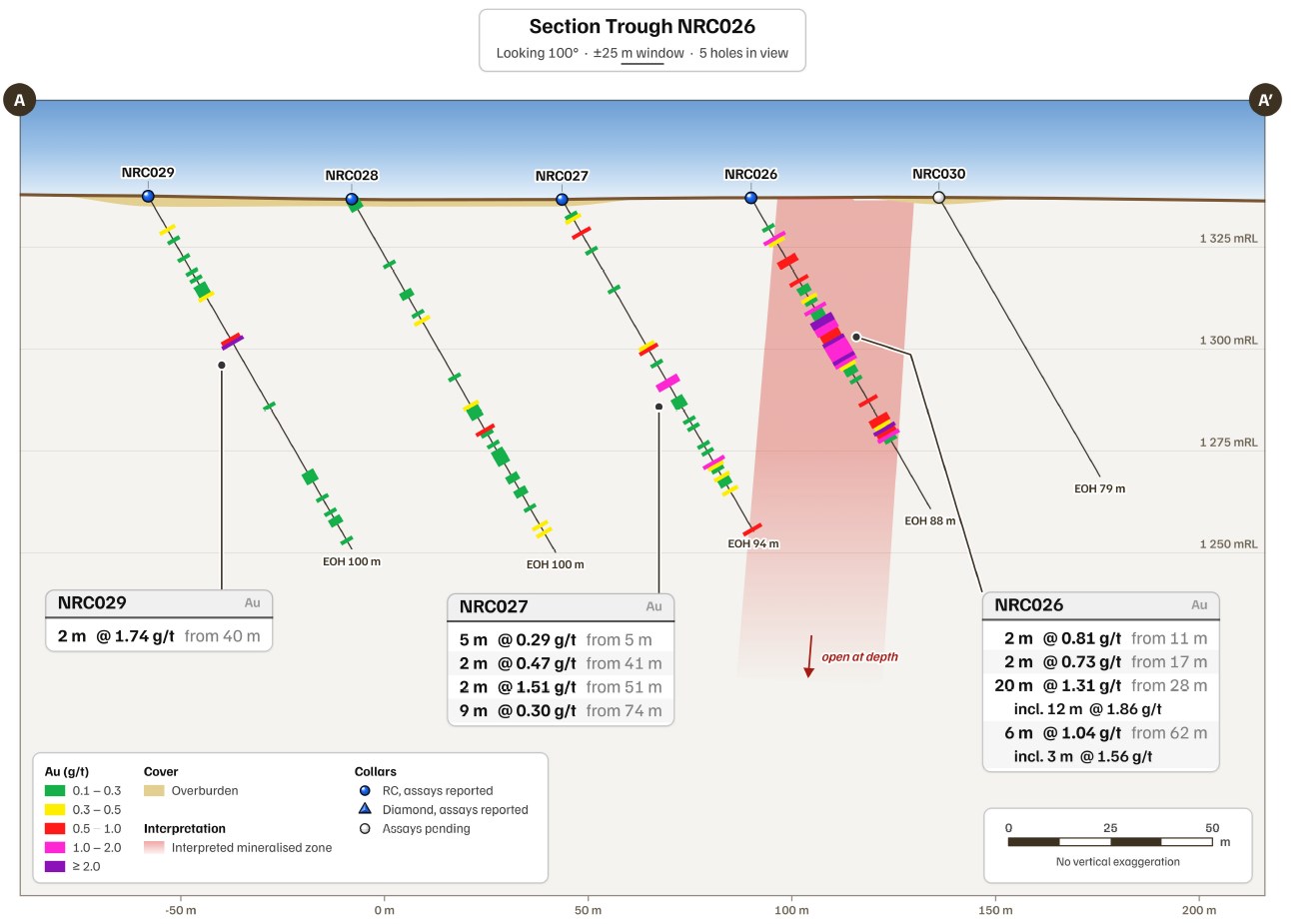
Figure 4: Cross-section A-A′ through headline hole NRC026 (looking 100°, ±25m window), showing the downhole gold assays and the interpreted mineralized zone, which remains open at depth.
To view an enhanced version of this graphic, please visit:
https://images.newsfilecorp.com/files/12469/325295_c1c9d62bd49e589b_004full.jpg
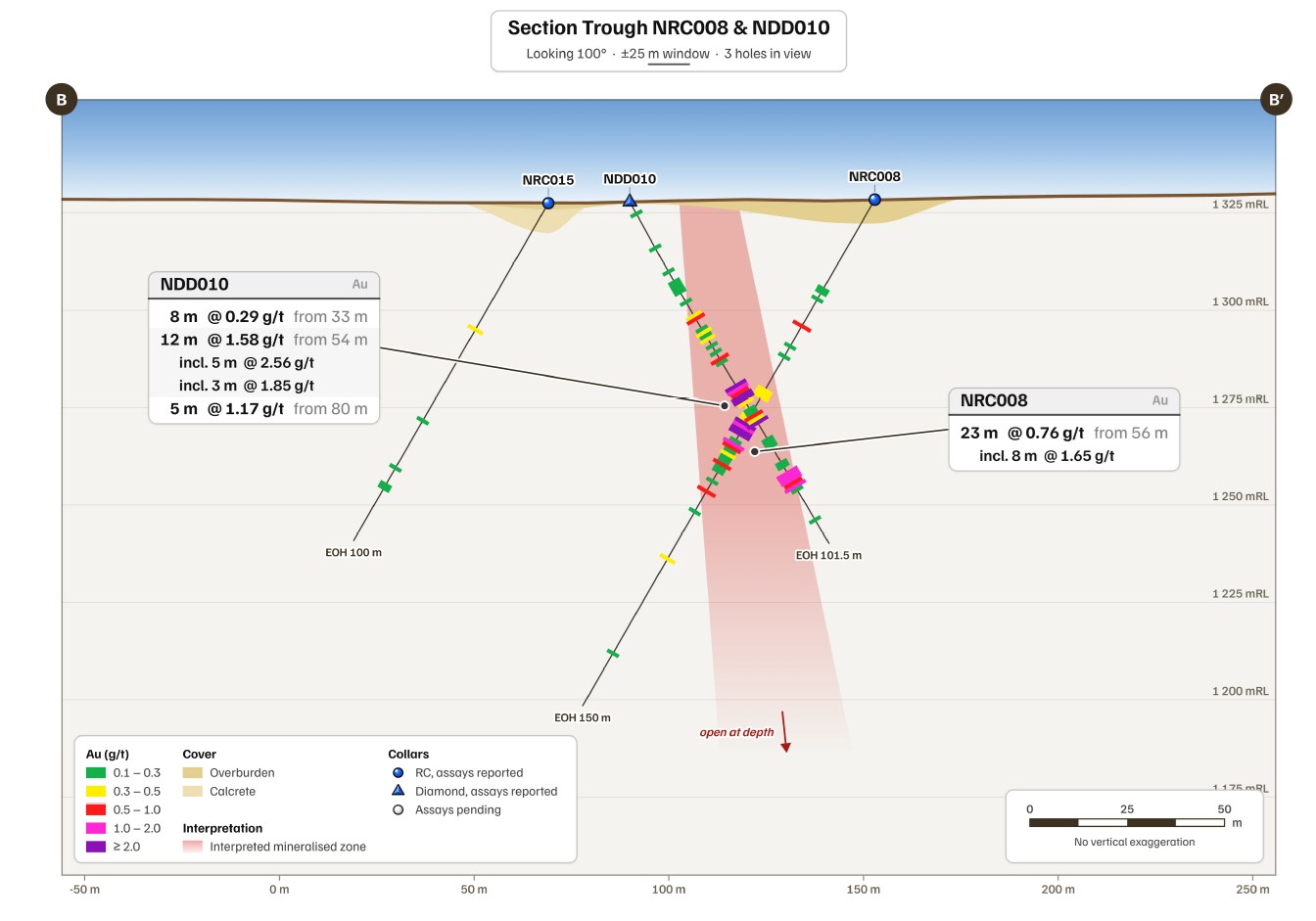
Figure 5: Cross-section B-B′ through headline holes NRC008 and NDD010 (looking 100°, ±25m window), showing the downhole gold assays and the interpreted mineralized zone intersected by both holes, which remains open at depth.
To view an enhanced version of this graphic, please visit:
https://images.newsfilecorp.com/files/12469/325295_c1c9d62bd49e589b_005full.jpg
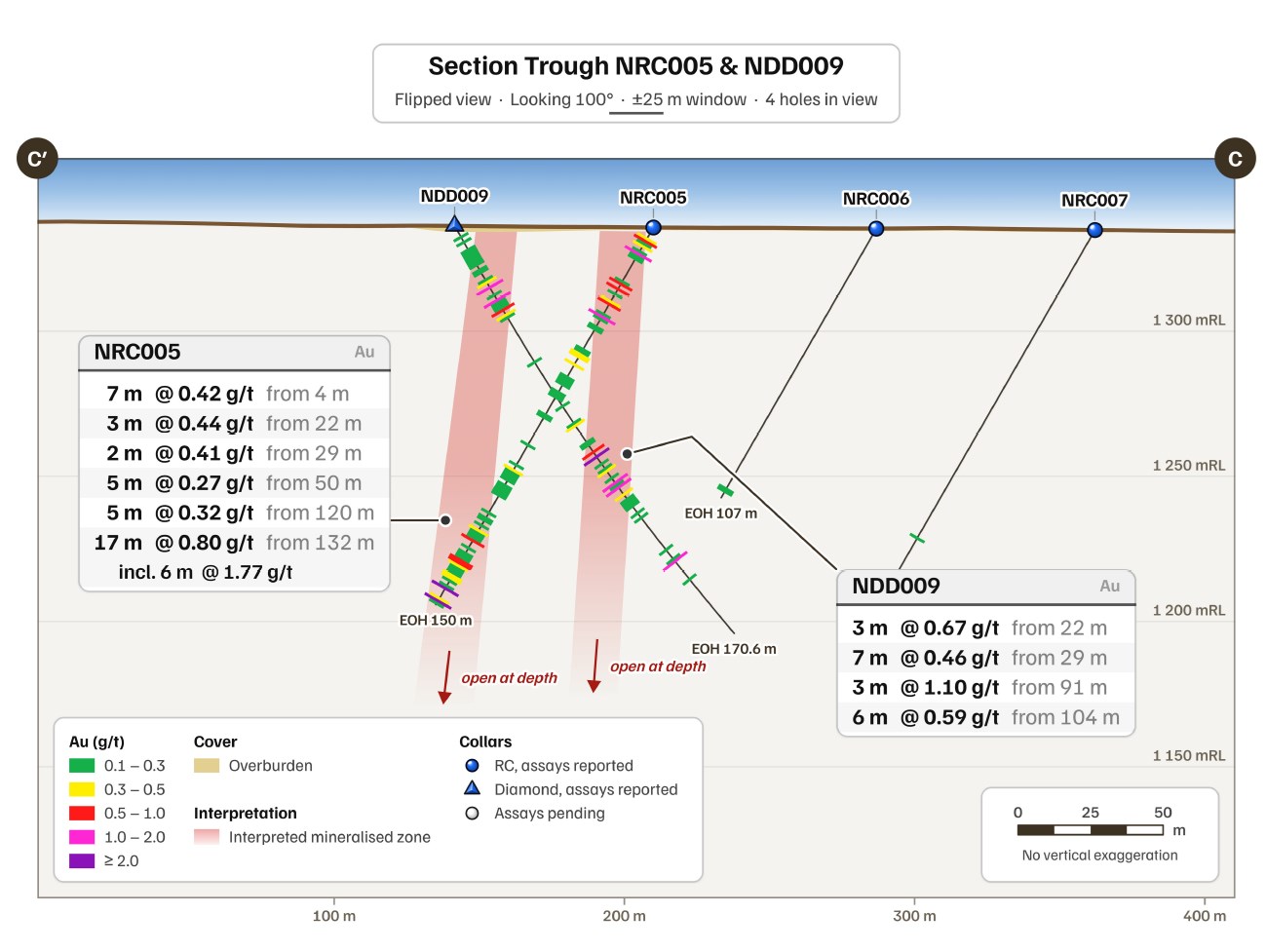
Figure 6: Cross-section C-C′ through headline holes NRC005 and NDD009 (looking 100°, ±25m window), showing the downhole gold assays and the interpreted mineralized zone intersected by the holes, which remains open at depth.
To view an enhanced version of this graphic, please visit:
https://images.newsfilecorp.com/files/12469/325295_c1c9d62bd49e589b_006full.jpg
Nguni Exploration Strategy
Results from the maiden drill program have demonstrated that the Nguni gold system has the potential to host large-scale economic gold mineralization. The system is extensive, stretching from the Manga Gold Discovery in the west through Nguni and open to the east. Drilling has also established that, as is typical of orogenic gold systems, the mineralization is structurally complex, and the juxtaposition of different geological units plays a key role in developing economic grades. To date the contact between the quartz-biotite schist and cordierite schist units has provided the first promising grade and width intercepts. The Company expects to find other host zones as this very large system is explored systematically.
With these key controls now understood, the Company's immediate focus is to define the full extent of the gold system ahead of a significantly larger and more targeted drill program, expected to start in early 2027. The next steps are:
Soil sampling: extensive soil sampling to close the gaps between Manga and Nguni, between the Nguni NW Extension and the main Nguni anomaly, and immediately east of Nguni, to define the full gold footprint - see Figure 2.
Geological mapping: detailed surface mapping of the cordierite schist and the structural features now known to control mineralization.
Drone magnetics: drone magnetic surveys across the entire Manga-Nguni corridor to trace the favourable units and structures beneath the cover.
Drilling review: a detailed review of all drilling completed to date, integrating the lithological, structural and assay data, including the outstanding assays from the remaining 9 RC holes.
New anomalies: in parallel, infill soil sampling is underway over the three new gold-in-soil anomalies to the southeast of Nguni, and regional exploration will continue along the Okondeka Fault Zone to identify further anomalies.
Drill program: the results of the above work will be used to design the next drill program, targeting the quartz-biotite schist and cordierite schist contact across the system, as well as other prospective lithological and structural targets. Drilling on the existing Nguni anomaly is expected to start in early 2027 and will continue along strike as and when access is granted.
Land Access
Gaining land access to parts of the Nguni area has taken longer than initially expected. However, the Company has made significant progress over the last few weeks. Access terms have largely been negotiated with the landowner, and the final legal agreements are being drafted. The timeline on final completion of the access agreement is still uncertain, however, the Company remains positive that it should be complete by early 2027. Once finalized, Ongwe will have full access to the stretch between Manga and the Nguni NW Extension, the gap between the Nguni NW Extension and the main Nguni anomaly, and the eastern extent of Nguni. This will allow the soil sampling and mapping programs outlined above to proceed across the entire Manga-Nguni corridor.
Assay Method
The Company uses the detectORE™ analytical technique for the analysis of surface samples. The technique is designed to enable the measurement of trace gold concentrations in geological samples using a portable X-Ray Fluorescence (pXRF) instrument. This process overcomes the traditional limitations of gold analysis by pXRF including low gold concentrations and metal peak interference. The method involves leaching 250g of sieved material in a sealed pouch with 500ml of GLIX-20™ lixiviant and a Collector Device (CD). Following a 16-hour tumble in a Maxi Mixer barrel to dissolve the gold, the CD is removed, rinsed, and analyzed for 150 seconds using detectORE™ mode firmware. This partial analysis technique is managed through pLIMS™ software with strict QA/QC protocols to identify relative gold anomalism. The detectORE™ gold technique is designed for rapid on-site assessment and is not used for the formal quantification of gold content or the estimation of Mineral Resources. An extensive orientation program was carried out before putting the detectORE™ methodology into production by comparing soil, calcrete and rock chip sample assays with Aqua Regia and FireICP. The detectORE™ system performed extremely well and identified the same anomalies as the laboratory techniques in all conditions.
As part of the current exploration program, all RC and diamond drill samples are sent directly for analysis by Fire Assay at the MSALABS facility in Omaruru, Namibia, or by Photon Assay at the Gloriosa facility in Otjiwarongo, Namibia. The Fire Assay procedure involves drying and splitting the sample to 1kg, followed by crushing to 2mm. A 250g sub-sample is then pulverized to 85% passing 75 microns, from which a final 50g aliquot is taken for Fire Assay with an Atomic Absorption (AA) finish. For Photon Assay, the prepared sample is split to approximately 500g and loaded into a barcoded, labelled plastic jar. The sealed sample is irradiated with high-energy X-rays, which excite gold nuclei; as the nuclei return to a stable state, they emit gamma rays at characteristic energies. Detectors measure these emissions and the instrument calculates the gold concentration across the bulk sample. The analysis is non-destructive and is conducted using a four-cycle protocol, providing a stated gold detection limit of 20 ppb. For this press release, all holes report Photon Assay results except for hole NRC005 which reports a Fire Assay result.
Quality Assurance & Quality Control
All of Ongwe's sample assay results have been independently monitored through a quality assurance and quality control ("QA/QC") program including the insertion of blind standards, blanks, and field duplicate samples. The Company maintains rigorous monitoring for both in-house and laboratory analyses to ensure data reliability. For the detectORE™ process, which provides rapid on-site assessment of gold anomalism, a Certified Reference Material (CRM) sample is inserted every 15 samples to monitor the performance of the pXRF instrument and the leaching efficiency. For the formal Fire Assay verification conducted at MSALABS, or Photon Assay conducted at Gloriosa, a CRM is inserted every 30 samples. This MSALABS laboratory procedure involves precise pulverization and a 50g Fire Assay with an Atomic Absorption (AA) finish to provide formal quantification for prioritized drill samples. At Gloriosa, the sample is systematically split to approximately 500g, sealed in a barcoded jar and analyzed using a four-cycle Photon Assay protocol. Each cycle irradiates the bulk sample with high-energy X-rays and measures the characteristic gamma-ray emissions generated by activated gold nuclei; the measurements are combined to improve analytical precision.
Data Verification
Carl Joone, BSc. (Hons), the President and Co-Founder of Ongwe Minerals Inc., and a Qualified Person for the purposes of National Instrument 43-101, has verified all the data disclosed, including a review of the sampling procedures, chain of custody, and assay results underlying the disclosure, by plotting and verifying against raw data received. Mr. Joone noted no errors or omissions during the data verification process.
Qualified Person
Carl Joone, BSc. (Hons) is the President and Co-Founder of Ongwe Minerals Inc. and is a registered Professional Natural Scientist with the South African Council for Natural Scientific Professions (Pr. Sci. Nat. No. 172695) and a Qualified Person for the purposes of National Instrument 43-101. Mr. Joone has reviewed and approved the scientific and technical information in this news release.
About Ongwe Minerals Inc.
Ongwe Minerals Inc. is a Canadian listed gold exploration company focused on the discovery and advancement of new gold systems in Namibia. The Ongwe team, previously with Osino Resources (sold to Shanjin International), has a history of making and advancing gold discoveries in Namibia, including Osino's Twin Hills (currently in construction) and Eureka deposits, and the advancement and sale of Auryx Gold's Otjikoto gold deposit (in production, sold to B2Gold).
The Company's current focus is on three promising gold projects in the emerging Northwest Damara gold belt in Namibia, with a focus on the Omatjete and Khorixas Gold Projects.
The Omatjete Gold Project is strategically located along the regional Okondeka Fault Zone, which also hosts the Kokoseb gold deposit (WIA Gold). Early surface work by Ongwe led to the Manga Gold Discovery, which has a 4.5km × 1km footprint of gold-in-soil and early scout drilling indicating gold in bedrock. Recent regional sampling in 2026 has led to the discovery of the large-scale, high-tenor Nguni anomaly 14km east of Manga. Nguni currently has a strike length of more than 9km and is open in all directions. The Omatjete Project still has significant growth potential and work is ongoing to define further anomalies along the Okondeka Fault system.
The Khorixas Gold Project is situated just 50km west of Osino's Eureka gold project, adjacent to the northern margin of the Damara Orogenic Belt. Khorixas hosts two large-scale surface discoveries called Belmont and K17. The Belmont prospect has a surface gold footprint of approximately 12 × 6km and lies between the regional scale, basin margin, Khorixas Fault and the Belmont Thrust Zone. Calcrete and grab sampling to date have indicated eighteen target areas.
ON BEHALF OF THE BOARD OF DIRECTORS
"Dave Underwood"
Chief Executive Officer
CONTACT INFORMATION
| Ongwe Minerals Inc. Dave Underwood, Chief Executive Officer Email: dave@ongweminerals.com | Ongwe Minerals Inc. Carl Joone, President & Co-Founder Email: carl@ongweminerals.com |
Neither the TSX Venture Exchange nor its Regulation Services Provider (as that term is defined in the policies of the TSX Venture Exchange) accepts responsibility for the adequacy or accuracy of this press release.
Cautionary Statements Regarding Forward Looking Information
This press release contains "forward-looking information" within the meaning of applicable Canadian securities legislation. Forward-looking information includes, without limitation, statements regarding the use of proceeds from the Company's future plans or prospects of the Company, including prospects for discovery of mineral resources or the results of future exploration programs. Generally, forward-looking information can be identified by the use of forward-looking terminology such as "plans", "expects" or "does not expect", "is expected", "budget", "scheduled", "estimates", "forecasts", "intends", "anticipates" or "does not anticipate", or "believes", or variations of such words and phrases or state that certain actions, events or results "may", "could", "would", "might" or "will be taken", "occur" or "be achieved". Forward-looking statements are necessarily based upon a number of assumptions that, while considered reasonable by management, are inherently subject to business, market and economic risks, uncertainties and contingencies that may cause actual results, performance or achievements to be materially different from those expressed or implied by forward-looking statements. Although the Company has attempted to identify important factors that could cause actual results to differ materially from those contained in forward-looking information, there may be other factors that cause results not to be as anticipated, estimated or intended. There can be no assurance that such information will prove to be accurate, as actual results and future events could differ materially from those anticipated in such statements. Accordingly, readers should not place undue reliance on forward-looking information. Other factors which could materially affect such forward-looking information are described in the risk factors in the Company's most recent annual management's discussion and analysis which is available on the Company's profile on SEDAR+ at www.sedarplus.ca. The Company does not undertake to update any forward-looking information, except in accordance with applicable securities laws.
To view the source version of this press release, please visit https://www.newsfilecorp.com/release/325295
Source: Ongwe Minerals Inc.