
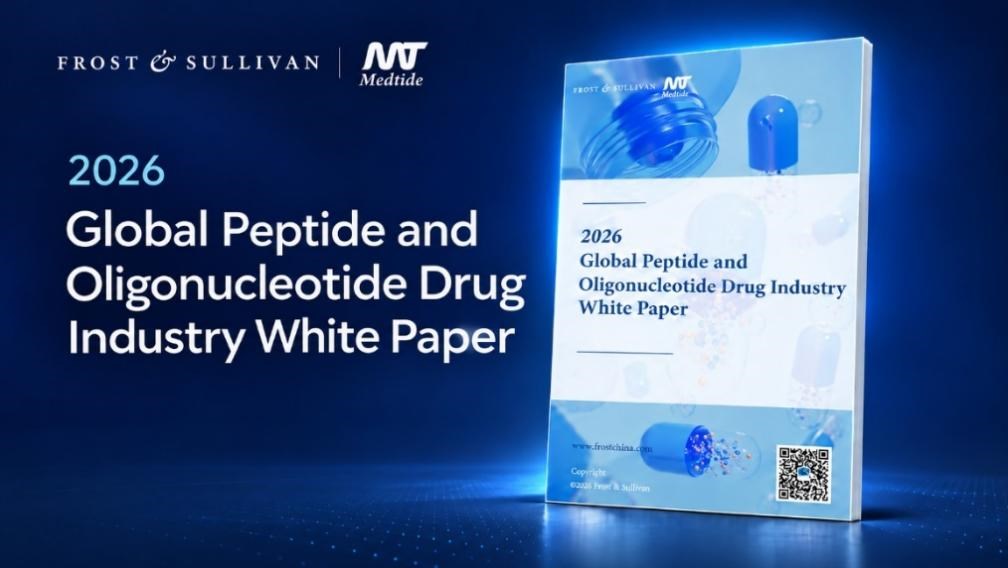
Shanghai, China--(Newsfile Corp. - November 20, 2026) - Frost & Sullivan and Medtide Inc. have jointly released the 2026 Global Peptide and Oligonucleotide Drug Industry White Paper. The report examines the global market for peptide and oligonucleotide therapeutics, collectively known as TIDES, and the manufacturing capabilities needed to bring these medicines from clinical development to commercial supply.
The white paper highlights distinct manufacturing challenges across the two markets. Widespread use of GLP-1 therapies for diabetes and obesity has increased demand for peptide active ingredients, making large-scale synthesis and purification a priority. In oligonucleotides, advances in drug delivery are expanding development beyond rare diseases to more common cardiovascular and metabolic conditions. As candidates move into late-stage trials, developers need reliable ways to identify closely related impurities and maintain consistent quality across larger batches.
These demands shape how drugmakers select contract development and manufacturing organizations (CDMOs). Early in development, a partner's ability to solve problems quickly can determine how soon a program reaches its next clinical milestone. As launch approaches, drugmakers place greater weight on demonstrated scale-up experience, access to critical raw materials and the ability to reserve capacity for commercial supply. For companies planning launches across several markets, a partner's experience supporting regulatory submissions and transferring production between sites also matters.
The white paper maps the global TIDES CDMO landscape and examines how providers are responding, including by qualifying alternative suppliers, investing in purification capacity and using digital batch records to strengthen traceability. It also reviews market trends through 2030 and the implications for drugmakers planning their next generation of peptide and oligonucleotide products.
Download the full white paper from the Frost & Sullivan website: https://hub.frost.com/the-next-wave-of-tides-market-growth-manufacturing-scale-up-and-the-cdmo-industry-outlook/
Global market trends and the outlook for peptide and oligonucleotide therapeutics
The white paper examines the global market for peptide and oligonucleotide therapeutics, collectively known as TIDES, and its outlook through 2030. In peptides, demand for GLP-1 therapies has driven much of the recent sales growth. In oligonucleotides, advances in drug delivery are opening commercial opportunities in cardiovascular and metabolic disease. The report reviews approved products and late-stage pipelines worldwide to assess where demand is growing today and which therapies could shape the market in the years ahead.
Commercial scale brings different manufacturing challenges for peptides and Oligonucleotides
For peptide manufacturers, a central challenge is increasing output while maintaining purity and yield. Solid-phase peptide synthesis is widely used for synthetic peptides, with liquid-phase synthesis and fragment condensation offering additional options for certain molecules. As peptide structures become more complex, the choice of synthesis route and purification process can materially affect how much usable product a manufacturer obtains from each batch.
Oligonucleotide manufacturers face a different challenge. Synthesis can produce impurities that closely resemble the intended sequence, making them difficult to detect and remove. Depending on the product, manufacturers may also need to pair two strands, attach a targeting molecule such as GalNAc or formulate the drug in lipid nanoparticles. Moving from clinical batches to commercial production requires analytical methods that can verify product identity and demonstrate consistent quality at the intended scale.
Drugmakers are involving CDMOs earlier in development
Drugmakers are turning to contract development and manufacturing organizations (CDMOs) for support that begins well before commercial production. In early development, a partner may help select a viable manufacturing route, develop analytical methods and supply material for clinical trials. Involving the manufacturing team at this stage gives developers an opportunity to address problems that could become harder to resolve at larger volumes.
Priorities change as a program approaches launch. Drugmakers need a partner that can validate the process, reserve sufficient capacity and deliver batches that consistently meet specifications. For programs targeting several markets, the ability to transfer processes between sites and support regulatory filings also becomes important.
Critical materials can determine supply continuity
A delay in a specialized raw material can disrupt a manufacturing campaign even when production capacity is available. Peptide manufacturers depend on inputs such as nonstandard amino acids and resins. Oligonucleotide manufacturers may require modified nucleotide building blocks or conjugation materials from a limited number of qualified suppliers. Switching sources can require additional testing to establish whether the change affects product quality.
The white paper examines how manufacturers manage these risks by qualifying alternative suppliers in advance, holding inventory for materials with long lead times and reserving capacity for late-stage programs. It also considers when regional manufacturing networks can help sustain supply if trade or logistics disruptions affect a site or supplier.
Quality and environmental expectations shape manufacturing decisions
For complex peptides and oligonucleotides, manufacturers need to understand which impurities a process can generate, how reliably their methods detect them and whether a process change alters the impurity profile. The white paper examines these issues across the United States, Europe and China, including the implications of China's continued alignment with international standards. For CDMOs supporting filings in several markets, consistent quality systems, traceable data and documented change controls are particularly important.
Environmental considerations also influence process design. Both synthesis and purification can consume substantial volumes of solvent. The report examines how solvent recovery, waste treatment and alternative processes can reduce material use and the burden of waste disposal as production expands.
Global CDMOs are expanding capacity and investing in manufacturing technology
The white paper examines the global TIDES CDMO landscape, highlighting leading providers such as WuXi AppTec, CordenPharma, Bachem, PolyPeptide, Medtide, Agilent, Nitto Avecia, and ST Pharm. It compares specialist manufacturers with broader service providers and companies entering TIDES from adjacent businesses. The comparison considers which molecules each company supports, how far its services extend from process development to commercial production, and where it can manufacture and supply products.
The report also distinguishes technologies in use today from those still under development. Manufacturers are automating individual synthesis steps, introducing continuous purification and using digital batch records to trace production and quality data. End-to-end continuous manufacturing remains under development. Companies are also exploring whether AI can help optimize processes and predict batch outcomes.
Selecting a CDMO partner for the life of a program
The white paper sets out a framework that drugmakers can use to qualify a CDMO and assess its suitability for a long-term partnership. Initial qualification focuses on good manufacturing practice (GMP), analytical capabilities and experience with comparable molecules. For a program approaching launch, the assessment extends to evidence of successful scale-up, technology transfer and reliable delivery at the required volume.
The framework also addresses how the partnership will operate when circumstances change. Before committing to a long-term agreement, drugmakers can examine how a CDMO reports quality deviations, communicates changes in production schedules and assigns responsibility for resolving supply interruptions. These questions give both parties a clearer basis for agreeing on how the program will be managed.
About Frost & Sullivan
Frost & Sullivan is a global growth consulting firm founded in 1961 in Carlow, Ireland, with approximately 3,000 consultants and analysts. For over 60 years, Frost & Sullivan has supported 10,000+ clients, including Fortune 1000 companies and leading financial institutions, through nearly 50 offices worldwide, leveraging industry expertise, databases and consulting capabilities to drive growth, innovation and capital market success.
About Medtide Inc.
Medtide Inc. (HKEX: 03880.HK) is a contract research, development, and manufacturing organization (CRDMO) focused on peptides and oligonucleotides, providing full-lifecycle services from early discovery and preclinical research through clinical development to commercial manufacturing. With 25 years of experience in the peptide field, the company operates through two entities-Chinese Peptide Company (China) and CPC Scientific, Inc. (USA)-which undertake the group's R&D, manufacturing, and commercialization functions in China and the United States, respectively. Together, they form an integrated CRDMO platform with global operations and comprehensive service capabilities.
The company provides CRDMO services covering the entire drug development lifecycle, including the discovery and synthesis of new chemical entities (NCEs), chemistry, manufacturing, and controls (CMC) development, and commercial manufacturing. Since its establishment, the company has served more than 1,000 clients worldwide, providing peptide and oligonucleotide synthesis, development, manufacturing, and CMC regulatory submission support in compliance with the regulatory requirements of major global markets. Its projects span more than 50 countries and regions, including major markets such as China, the United States, Japan, Europe, South Korea, and Australia.
As a trusted and continuously growing company, Medtide Inc. has established long-term partnerships with numerous clients. Through close collaboration, the company helps clients bring medicines with a profound impact on human health to market. With a patient-centered approach, Medtide Inc. is committed to improving patients' lives and advancing human health.
Media Contact
Contact: Qian Li
Company Name: Frost & Sullivan
Website: https://www.frostchina.com
Email: PR@frostchina.com
Contact: Ye Wang
Company Name: Medtide Inc.
Website: https://www.medtideinc.com/
Email: ye.wang@chinesepeptide.com ; mkt@medtideinc.com
To view the source version of this press release, please visit https://www.newsfilecorp.com/release/324860
Source: Hmedium