
Ashland, Kentucky--(Newsfile Corp. - October 9, 2026) - PrymaLab, a veteran-owned research peptide supplier, has published safety data sheets for its entire catalog. The library, issued October 3, 2026 and available at prymalab.net/testing/sds, holds 189 sheets covering 97 compounds and blends, one sheet for each compound in each form it is supplied. Thirty-three of the sheets carry a GHS hazard classification. The remaining 156 state that the material is not classified as hazardous under the OSHA Hazard Communication Standard or UN GHS Revision 7, and name the supplier data behind that conclusion.
The company's reasoning is simple. A safety data sheet is the document a laboratory safety officer asks for before a new material is allowed on the bench, and in this category it usually does not exist. A researcher who receives a vial of a research peptide typically gets a label, a purity figure and nothing about hazard classification, handling, spill response or disposal. PrymaLab's view is that the sheet should be one click away for every item it supplies, whether or not anyone has asked.
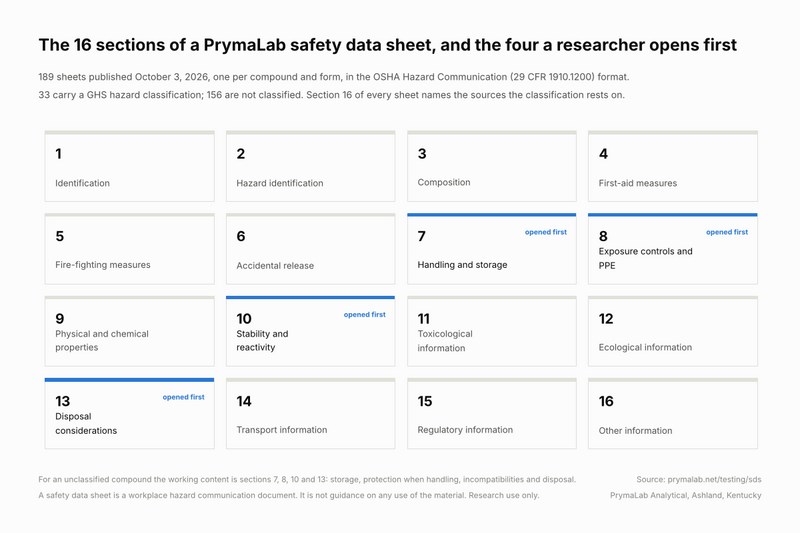
PrymaLab publishes a safety data sheet for every research compound it supplies: 189 sheets across 97 compounds, 33 carrying a GHS hazard classification
To view an enhanced version of this graphic, please visit:
https://images.newsfilecorp.com/files/8814/318189_4bc1c844d4463856_002full.jpg
What each sheet contains
Every sheet follows the 16-section structure that OSHA requires for workplace hazard communication, from identification and hazard identification through handling and storage, exposure controls, stability, toxicology and disposal to transport and regulatory information. Document numbers run from PL-SDS-001 to PL-SDS-189, each at revision 1.0 dated October 3, 2026.
For a compound that is not classified, the practical content is in sections 7, 8, 10 and 13: how to store it, what protection to use when handling the powder, what it is incompatible with and how to dispose of it. For a classified compound, section 2 adds the signal word, the pictograms and the hazard statements, and section 11 sets out the toxicological basis for them.
How the classifications were decided
Section 16 of every sheet states the policy. For research peptides and novel small molecules, the primary reference is the safety data sheet published by Cayman Chemical for the same compound; where a pharmaceutical manufacturer's sheet or a notified European classification is more conservative and internally consistent, that is adopted instead. For commodity materials such as vitamins, amino acids and excipients, Sigma-Aldrich and Merck sheets are the reference. Where no supplier sheet exists, PrymaLab has self-classified by read-across from the closest well-characterized analogue and says so on the sheet. Acute toxicity figures are quoted only where a supplier sheet quotes them.
Mixtures, including the company's blends, are classified under the cut-off rules in Appendix A of the OSHA standard. Most come out unclassified because no classified ingredient reaches its threshold concentration; the ones that do are classified accordingly and the sheet shows the calculation. The sources consulted are listed by name on each sheet, and the company says classifications will be reviewed as new hazard data become available.
A GHS classification describes a hazard property of a substance for the purpose of handling it in a workplace. It is not a statement about any use of the material, and the sheets do not make one. Thirty-three sheets carrying a classification is, in PrymaLab's view, a more useful number to publish than zero would have been.
Storage, in writing
The question PrymaLab's customers ask most often is how to store what they have received, and the sheets now answer it in a form that can be printed and kept with the material. Section 7 of the lyophilized-powder sheets gives the storage temperature for the sealed vial, the acceptable short-term range, and the requirement to keep the material desiccated and protected from light. Section 10 covers stability and the conditions to avoid. Putting them on a numbered, dated document with a source line is different from putting them in a blog post, and it is the form a laboratory's own records expect.
Semrush data for the United States records several thousand searches a month across storage and stability questions for research peptides, with the fastest-growing of them concerning refrigeration and shelf life. Google Trends shows interest in "peptide storage" peaking in April and May 2026 alongside interest in the category as a whole.
Where the sheets appear
Each sheet is published in three places. The full sheet and a PDF sit in the Additional information tab of the relevant product page, below the lot certificate of analysis, across the company's research peptide pages. An index at prymalab.net/testing/sds lists every sheet by compound, with its hazard status and links to read or download. A researcher who verifies a lot certificate can reach the compound's safety data sheet from the same page. The sheets sit alongside the company's other laboratory references, including its Research Hub and its free peptide calculator.
What is and is not being claimed
PrymaLab does not synthesize the compounds it supplies; they are made at synthesis facilities in the United States and are tested, packed, labelled and shipped from Ashland. The sheets are issued by PrymaLab Analytical, the company's own laboratory, and compiled from the supplier and public sources named on each; they are not an independent toxicological assessment. The compounds are supplied for laboratory research use only and none is an approved drug. A safety data sheet is a hazard communication document for people handling a material at work, and nothing in it is guidance on any other use.
What comes next
The company plans a first revision cycle in early 2027, to incorporate new hazard data and customer corrections, and intends to supply the sheets in the documentation pack that accompanies its partner and white-label shipments.
Sources
PrymaLab, safety data sheet index at prymalab.net/testing/sds, revision of October 3, 2026, and individual sheets PL-SDS-001 to PL-SDS-189.
OSHA, Hazard Communication Standard, 29 CFR 1910.1200, Appendices A and D.
Semrush, U.S. keyword volume data for storage and stability queries, September 2026.
Google Trends, United States, twelve months to October 4, 2026, "peptide storage" and "research peptides."
About PrymaLab
PrymaLab is a veteran-owned research peptide supplier based in Ashland, Kentucky. It supplies research peptides, bioregulators and research chemicals to laboratories, publishes a certificate of analysis for each lot it releases and a safety data sheet for each compound it supplies, and operates an in-house analytical laboratory, PrymaLab Analytical. More information is at prymalab.net.
All products referenced are supplied for laboratory research use only. They are not drugs, foods or dietary supplements, are not for human or veterinary use, and are not intended to diagnose, treat, cure or prevent any disease. Safety data sheets are hazard communication documents compiled from the sources named on each sheet; they are not an independent assessment and do not establish suitability or safety for any use. Nothing in this release is medical advice or a therapeutic claim. None of the compounds discussed is approved by the U.S. Food and Drug Administration.
Contact Info:
Name: Clarence Michael Phelps
Email: michael@prymalab.net
Organization: PrymaLab
Address: 3705 Music Branch
Phone: 6064659063
Website: https://prymalab.net
To view the source version of this press release, please visit https://www.newsfilecorp.com/release/318189
Source: Plentisoft