
Key Highlights
High-Grade Radioactivity at Fox: Third hole FOX26-003 intersected five main zones of uranium mineralization over an 89.8 metre interval, with radioactivity up to 15,022 cps¹, the strongest hole drilled at Fox to date. Assays are pending.
Mineralization From Just 41 Metres: Mineralization in FOX26-003 begins at only 41.0 metres depth, substantially shallower than the discovery hole, the system is strengthening toward surface.
Three for Three: Every hole drilled at Fox has intersected uranium mineralization and/or extensive alteration across a 1.3-kilometre target that remains open and largely untested.
Two New Discoveries, One District: Fox and Apollo, both discovered this season, 10 kilometres apart, sit directly on the Andrew Lake Fault, along strike from Orano's Kiggavik-area deposits (~127 million pound historical mineral resource²). The corridor extends 17 kilometres across Geiger's Aberdeen Project, with numerous analogous targets untested.
Clear Roadmap for 2027: Aggressive follow-up drilling at Fox and Apollo, and systematic testing of look-alike gravity targets along the corridor.
Toronto, Ontario--(Newsfile Corp. - September 21, 2026) - Geiger Energy Corp. (TSXV: BEEP) (OTCQB: BSENF) ("Geiger" or the "Company") is pleased to announce that follow-up drilling at the Fox Zone has intersected the strongest radioactivity encountered to date on its Aberdeen Project in the Thelon Basin, Nunavut (Figure 1 and Figure 2). Two follow-up holes were completed at Fox after the discovery hole before the 2026 weather window closed (Table 1).
Fox Delivers Its Strongest Hole Yet
FOX26-003, stepped 25 metres northwest of the discovery hole, intersected intermittent elevated to high-grade radioactivity over an 89.8 metre interval from 41.0 to 130.8 metres (Figure 3, Figure 4, and Table 2):
6.7 m (high of 7,418 cps) from 41.0 to 47.7 m - Average: 1,639 cps
5.3 m (high of 15,022 cps) from 56.6 to 61.9 m - Average: 3,417 cps
7.9 m (high of 1,889 cps) from 70.5 to 78.4 m - Average: 516 cps
21.8 m (high of 4,108 cps) from 84.5 to 106.3 m - Average: 1,187 cps
18.0 m (high of 9,512 cps) from 112.8 to 130.8 m - Average: 2,099 cps
"FOX26-003 is the strongest hole we have drilled at Fox, high-grade radioactivity beginning just 41 metres from surface, in only the third hole ever drilled into this 1.3-kilometre target. Every hole at Fox has hit mineralization or the alteration that surrounds it, and we have tested only a fraction of the target. Just as important is what Fox and Apollo mean together. Two grassroots discoveries in one season, 10 kilometres apart, on the same structure that hosts Orano's Kiggavik deposits — we are no longer testing isolated targets. We are drilling what we believe is an emerging uranium district, and the corridor gives us a compelling roadmap for systematic drilling in 2027," stated Rebecca Hunter, President and CEO of Geiger Energy.
Mineralization is structurally controlled, hosted in altered feldspar porphyry to granite intercalated with psammopelitic gneiss. Uranium occurs primarily as black pitchblende, moderately to locally heavily disseminated along fractures and breccias and into adjacent wall rock, with local pale-yellow secondary minerals (Figure 5, Figure 6 and Figure 7). Alteration throughout the hole is extensive and locally intense — strong clay, limonite, sooty pyrite and secondary red hematite — the classic signature of uranium mineralized systems in the region. Assays for all 2026 drill holes are pending and will be reported once received.
FOX26-002, stepped 25 metres southwest, intersected extensive clay, sooty pyrite and hematite alteration similar to the discovery hole, including an elevated zone from 163.2 to 169.7 metres (largely 100-300 cps) followed by a thick, bleached, clay-altered silicified fault zone to 250 metres. The hole was stopped at 404 metres to allow a final hole to be completed in 2026.
Watch Now: CEO Rebecca Hunter Discusses Near-Surface Uranium Mineralization
An Emerging District on the Kiggavik Trend
Fox lies directly on the Andrew Lake Fault, the major structural corridor associated with Orano's Kiggavik-area deposits, which host an approximate 127 million pound historical mineral resource². That corridor extends approximately 17 kilometres across Geiger's Aberdeen Project, and this season Geiger made grassroots discoveries at two points along it: Fox, and Apollo, 10 kilometres to the southwest.
Both targets were generated from Geiger's interpretation of gravity, magnetic and structural data and were completely untested prior to 2026. At Fox, three holes into a target defined by two conjoined gravity-low anomalies have confirmed a broad, structurally controlled uranium-bearing hydrothermal system — not a single-hole occurrence — with increasingly intense radioactivity and mineralization strengthening toward surface. Numerous analogous gravity anomalies along the corridor remain untested.
These discoveries materially expand the Company's opportunity beyond its established Tatiggaq and Qavvik discoveries and define a clear strategy for 2027: aggressively follow up Fox and Apollo while systematically testing additional targets along the corridor.
Figure 1: Aberdeen Project map showing the Fox discovery, the Andrew Lake Fault Trend, and Orano's Kiggavik-area deposits along strike.
Figure 2: The Andrew Lake Fault Trend over total-field magnetics, showing the structural corridor extending from the Kiggavik area across Geiger's ground, the Fox target and additional untested anomalies along trend.
Figure 3: Core photograph of the strongest mineralized interval in drill hole FOX26-003 from 109.6 to 122.3 m.
Figure 4: Cross section of FOX26-001 and FOX26-003 showing the main zone of elevated radioactivity and uranium mineralization. The red histogram is the downhole probe radioactivity.
Figure 5: Close-up core photograph of disseminated uranium mineralization bleeding out from fractures.
Figure 6: Close-up core photograph of fine disseminated uranium mineralization including abundant yellow secondary minerals in a limonite-altered, medium-grained granite to porphyry unit.
Figure 7: Close-up core photograph of blebby black uranium mineralization along clay-coated fractures.
Table 1: Drill hole locations.

To view an enhanced version of this graphic, please visit:
https://images.newsfilecorp.com/files/6412/315131_geigertable1.jpg
Table 2: FOX26-003 intervals of radioactivity from the downhole probe data.
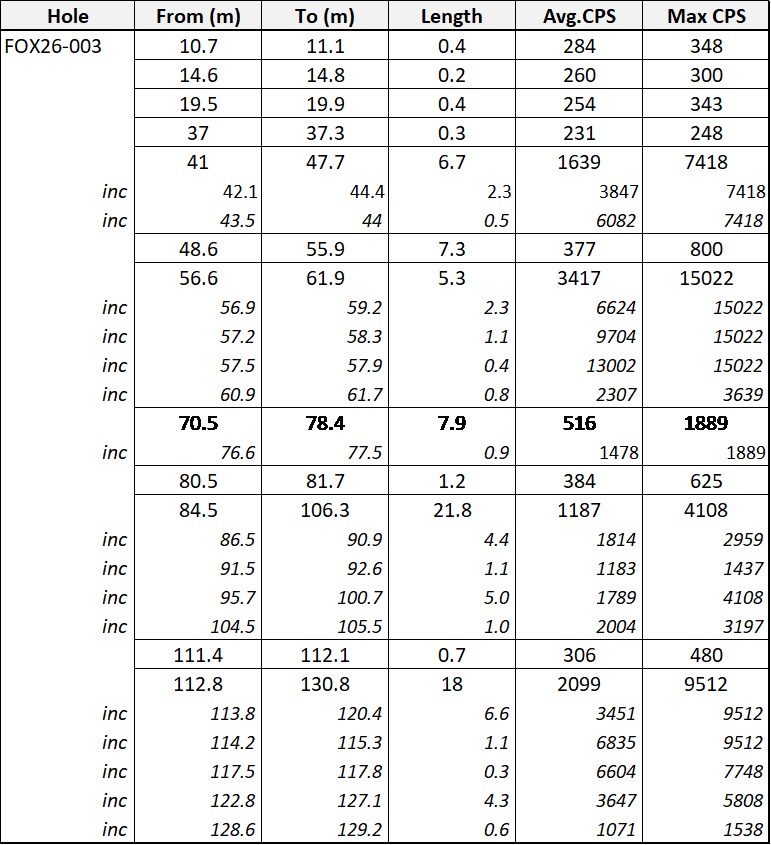
To view an enhanced version of this graphic, please visit:
https://images.newsfilecorp.com/files/6412/315131_478ce14894888ae2_003full.jpg
¹ Radioactivity reported in this release is in counts per second ("cps") as measured from down hole radiometric logging. All downhole radiometric logging was conducted using a Mount Sopris 2GHF-1000 downhole triple-gamma probe (SN-3790) connected to a Mount Sopris MATRIX Logger box (731). The Logger box and probe were then attached to a Mount Sopris 4MXC 500m 1/8" logging winch (SN-4244, 4323) to conduct the downhole radiometric surveys. Mount Sopris' 2GHF-1000 downhole triple-gamma probe utilizes a sodium iodine (Nal) crystal to detect changes in natural radioactivity for concentrations of uranium, thorium and potassium from gamma rays emitted from the rock formations. Not only does the probe use a Nal crystal, it also contains two Geiger Mueller tubes which allows the instrument to conduct precise Natural Gamma measurements that range from 0.1% to 20% concentrations of U3O8 in radioactive zones. Geiger Energy Corp submits its 500 m and 1,000 m Mount Sopris winches and downhole gamma probes to alphaNUCLEAR in Saskatoon, Saskatchewan, for comprehensive servicing and calibration before the field season commences. Maintenance on the winches includes full cable and head inspections, re-heading, and re-spooling to ensure optimal mechanical reliability during field operations. Each gamma probe is tested against a known radiation standard to verify accuracy within strict specifications, undergoing full recalibration whenever necessary to guarantee reliable, high-precision data acquisition. Drill core is measured using a handheld GammaGuard CT-007 scintillometer. Scintillometer readings provide a qualitative indication of the presence of radioactive minerals only and are not a substitute for, and may not correlate with, uranium grades determined by geochemical assay. Prior to each field program, all of Geiger Energy Corp CT-007-M scintillometers are sent to Environmental Instruments Canada Inc. in Saskatoon, Saskatchewan, for professional calibration and servicing to guarantee sensor accuracy and compliance with industry standards. During active field operations, individual CT-007-M units are routinely cross-tested against one another on defined sections of drill core to identify instrument drift and maintain consistency across operators. Radiation measurements from the handheld CT-007-M scintillometers are systematically correlated with data from our downhole gamma probe to validate readings.
Down hole radiometric probe and scintillometer readings provide a qualitative indication of the presence of radioactive minerals only and are not a substitute for, and may not correlate with, uranium grades determined by geochemical assay.
² Historical Kiggavik Mineral Resource Estimate: Source: Orano, 2025 Annual Activity Report, published 2026. Orano reports for the Kiggavik Project a historical estimate of 10.418 million tonnes grading 0.47% U (approximately 0.55% U₃O₈), containing 48,953 tonnes U (approximately 127.3 million pounds U₃O₈) in the Indicated category, and 0.733 million tonnes grading 0.28% U (approximately 0.33% U₃O₈), containing 2,059 tonnes U (approximately 5.4 million pounds U₃O₈) in the Inferred category.
The historical estimate is considered relevant to Geiger because the Kiggavik deposits occur along the same regional structural trend as the targets discussed in this news release and provide geological context for exploration at Geiger's Aberdeen Project. Geiger considers the historical estimate sufficiently reliable for this limited contextual purpose because it is reported by Orano, the operator of the Kiggavik Project; however, Geiger has not independently verified the estimate.
The cut-off grades and other assumptions, parameters and methods used to prepare the historical estimate are not known to Geiger. The historical estimate uses the categories "Indicated" and "Inferred"; however, Geiger has not completed sufficient work to determine whether these historical categories are directly comparable to the current CIM Definition Standards for Mineral Resources and Mineral Reserves.
The 2025 Annual Activity Report is the most recent estimate for the Kiggavik Project known to Geiger. To verify the historical estimate as a current mineral resource, a qualified person would need to review and verify the underlying geological, drilling, sampling, analytical and estimation data and assumptions and, if appropriate, prepare a current mineral resource estimate in accordance with NI 43-101 and current CIM Definition Standards.
A qualified person has not completed sufficient work to classify the historical estimate as current mineral resources or mineral reserves, and Geiger is not treating the historical estimate as current mineral resources or mineral reserves.
About Geiger
Geiger controls approximately 338,000 hectares in Saskatchewan's Athabasca Basin and 95,000 hectares in Nunavut's Thelon Basin, two of the world's most prospective uranium districts. The Company's flagship Aberdeen Project (Thelon Basin) hosts the high-grade, basement-hosted Tatiggaq and Qavvik discoveries — both shallow systems open along strike and at depth — together with more than 50 high-priority targets, many showing strong alteration and anomalous uranium from limited historical drilling and several, like Fox, previously untested. In the Athabasca Basin, Geiger is advancing the Hook Project, host to the near-surface ACKIO uranium discovery, which comprises at least nine mineralized pods beginning at 28 metres depth and remains open in multiple directions.
Qualified Person Statement
The technical information contained in this news release has been reviewed and approved by Rebecca Hunter, Ph.D., P.Geo., President & CEO of Geiger Energy Corp., a Qualified Person as defined in National Instrument 43-101, Standards of Disclosure for Mineral Projects.
For More Information Please Contact:
Geiger Energy Corp.
Rebecca Hunter, Ph.D., P.Geo.
CEO, President & Director
Email: info@oregroup.ca
Phone: 416-644-1567
Cautionary Statement
Certain information in this news release is considered forward-looking within the meaning of certain securities laws and is subject to important risks, uncertainties and assumptions. This forward-looking information includes, among other things, information with respect to Geiger's beliefs, plans, expectations, anticipations, estimates and intentions. The words "may", "could", "should", "would", "suspect", "outlook", "believe", "anticipate", "estimate", "expect", "intend", "plan", "target" and similar words and expressions are used to identify forward-looking information. The forward-looking information in this news release describes Geiger's expectations as of the date of this news release.
The results or events anticipated or predicted in such forward-looking information may differ materially from actual results or events. Material factors which could cause actual results or events to differ materially from such forward-looking information include, among others, risks arising from general economic conditions; adverse industry events; inability to realize anticipated synergies; future legislative and regulatory developments; inability to access sufficient capital from internal and external sources, and/or inability to access sufficient capital on favourable terms; income tax and regulatory matters; the ability of Geiger to implement its business strategies; competition; currency and interest rate fluctuations and other risks. Readers are cautioned that the foregoing list is not exhaustive.
Geiger cautions that the foregoing list of material factors is not exhaustive. When relying on forward-looking information to make decisions, investors and others should carefully consider the foregoing factors and other uncertainties and potential events. Geiger has assumed a certain progression, which may not be realized. It has also assumed that the material factors referred to in the previous paragraph will not cause such forward-looking information to differ materially from actual results or events. However, the list of these factors is not exhaustive and is subject to change and there can be no assurance that such assumptions will reflect the actual outcome of such items or factors.
THE FORWARD-LOOKING INFORMATION CONTAINED IN THIS NEWS RELEASE REPRESENTS THE EXPECTATIONS OF GEIGER AS OF THE DATE OF THIS NEWS RELEASE AND, ACCORDINGLY, IS SUBJECT TO CHANGE AFTER SUCH DATE. READERS SHOULD NOT PLACE UNDUE IMPORTANCE ON FORWARD-LOOKING INFORMATION AND SHOULD NOT RELY UPON THIS INFORMATION AS OF ANY OTHER DATE. WHILE GEIGER MAY ELECT TO, IT DOES NOT UNDERTAKE TO UPDATE THIS INFORMATION AT ANY PARTICULAR TIME.
Neither the TSXV nor its Regulation Services Provider (as that term is defined in the policies of the TSXV) accepts responsibility for the adequacy or accuracy of this release.

To view the source version of this press release, please visit https://www.newsfilecorp.com/release/315131
Source: Geiger Energy Corporation