
Vancouver, British Columbia--(Newsfile Corp. - November 24, 2026) - First Atlas Resources Corp. (CSE: HHE) (OTC Pink: BTKRF) (FSE: 0NB0) ("First Atlas" or the "Company") is pleased to announce initial results from its November 2026 soil-gas sampling program on the Matane Project, located on the Gaspé Peninsula, Quebec. A total of 30 samples were obtained from prospective areas on the property as a first pass reconnaissance. The results indicate that Hydrogen soil-gas concentrations along the Shickshock-Sud fault stand out clearly as elevated values. This geochemical survey is all the more important as it presents the first evidence of natural hydrogen potential in the Gaspé Peninsula.
Sampling Program
First Atlas Resources Corp November 2026 sampling program included 30 soil-gas samples over six locations that were determined to have potential for natural hydrogen development. The samples were collected using gas probes and electric percussion drill at locations along road and trail-based lines. Samples were placed in aluminum foil gas sampling bags and analyzed on a gas detector equipped with infrared and electrochemical detection cells. Dr. Richer-LaFlèche developed and implements the Soil-Gas protocol and analysis method currently used for natural hydrogen exploration in Ontario, Quebec, and Nova Scotia.
Sample Results
Despite the late autumn survey period and weather conditions showing relatively cold daytime temperatures (8 +/- 1.4 °C), the field measured data are particularly high.
The reconnaissance soil-gas survey results range from 55 parts per million by volume (ppmV) to 1175 ppmV Hydrogen with a median of 463 ppmV (Fig. 1). The sampling on the Matane property validates the predictive model for the Gaspé Peninsula, developed by Pr. Richer-LaFlèche suggesting that the Shickshock-South fault zone may be highly favorable for the presence of natural hydrogen.
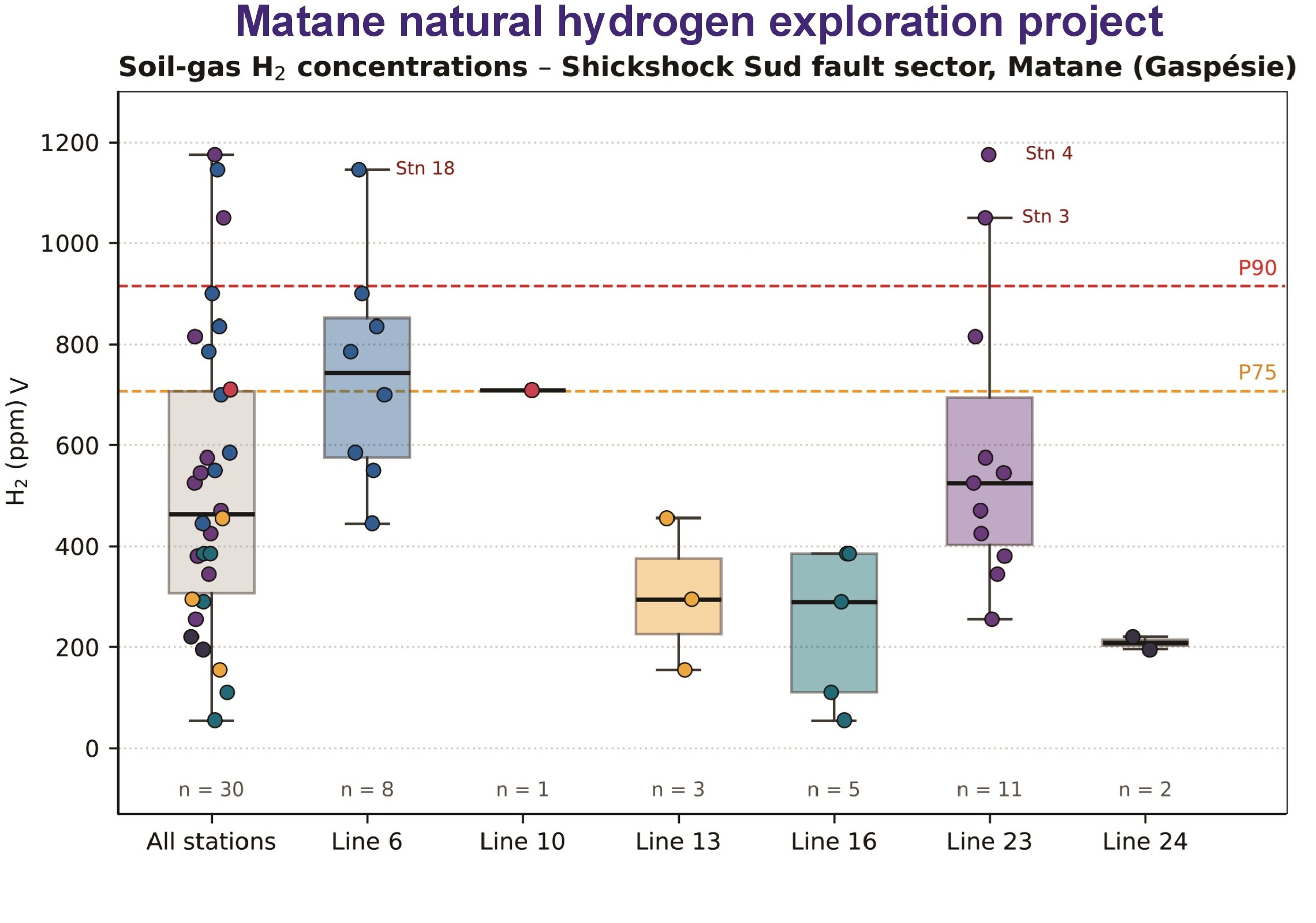
Figure 1. Variability of H2 (ppmV) concentrations measured in soil gas samples from lines 6, 10, 13, 16, 23, and 24 of the Matane property.
To view an enhanced version of this graphic, please visit:
https://images.newsfilecorp.com/files/11423/325498_atlas1.jpg
Geologic Model and Exploration Targeting
The elevated hydrogen concentrations correlate spatially with ultramafic rocks of the Ruisseau Isabelle Mélange, which were tectonically emplaced along the fault plane. In this part of the Appalachians, some peridotites, such as those of Mont Olivine (Mont Albert Massif, Parc national de la Gaspésie), contain a high proportion of unserpentinized olivine. Along a structure such as the Shickshock Sud Fault, this olivine could serve as the reactive source mineral for natural hydrogen generation through serpentinization, given favourable hydrogeological conditions and temperatures above approximately 200 °C. Similar ultramafic rocks may occur at depth within the Shickshock Sud Fault zone, one of the most significant structures in this part of the peninsula.
The fault juxtaposes volcanic rocks of the Shickshock Group to the northwest against Siluro-Devonian sedimentary rocks to the southeast. These sedimentary rocks comprise limestone of the Forillon Formation and siltstone, sandstone and mudstone of the St-Léon Formation. In a conceptual exploration model for natural hydrogen, the fractured rocks of the fault zone would act as a migration pathway for hydrogen, while the more porous Siluro-Devonian units, such as dolomitized limestone, could host potential reservoirs. Mudstone within the sedimentary succession could act as a low-permeability barrier, slowing hydrogen migration.
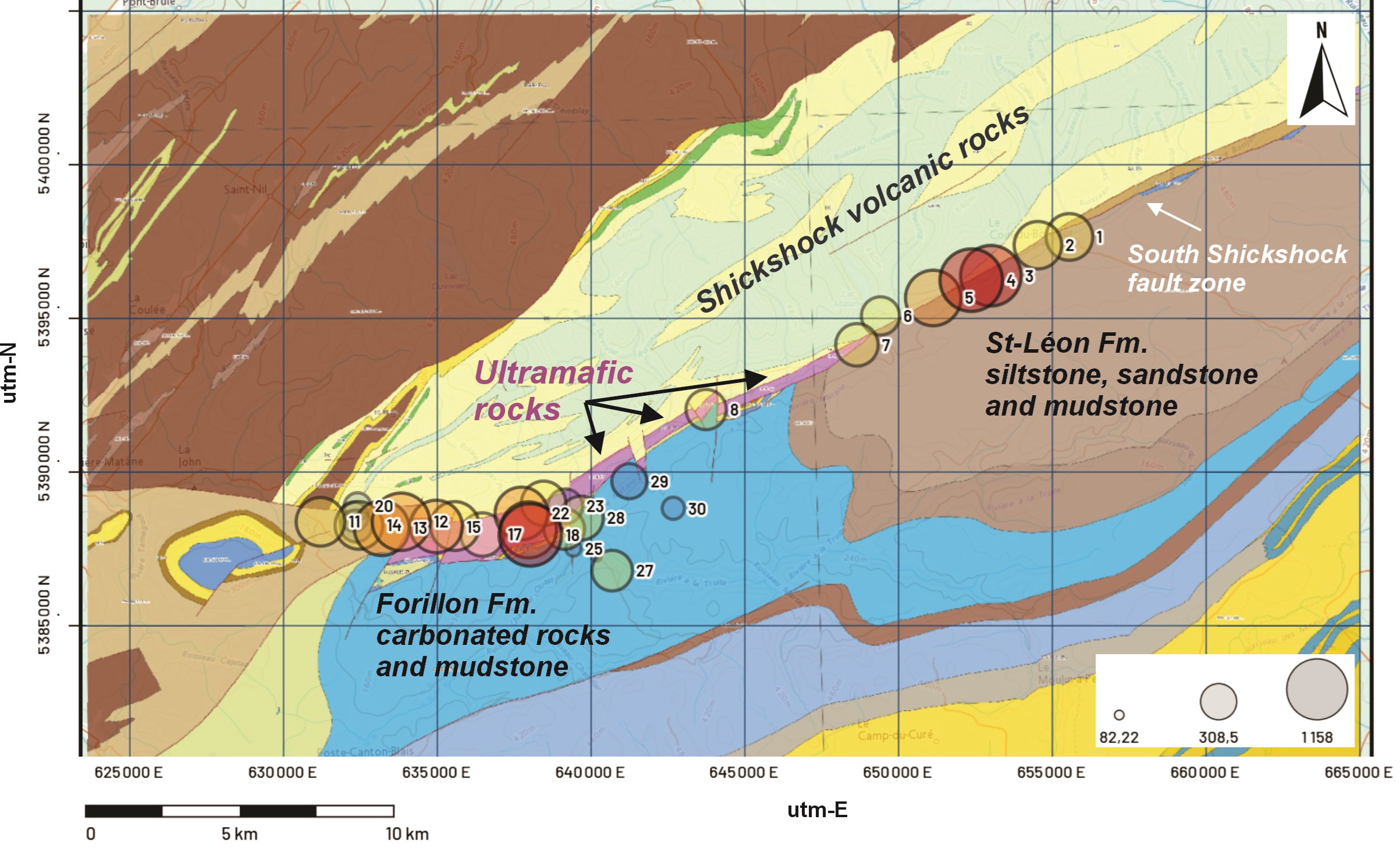
Figure 2. Simplified geological map of the area south of Matane. The map highlights the presence of ultramafic rocks from the Ruisseau Isabelle Mélange and Siluro-Devonian rocks southeast of the Shickshock-South fault. The circles represent hydrogen concentrations (ppmV) measured in soils. Modified geological map from the Sigéom site of the Quebec MERN.
To view an enhanced version of this graphic, please visit:
https://images.newsfilecorp.com/files/11423/325498_5829b3b20427580c_002full.jpg
Expanded Property Claims
Due to the positive reconnaissance sampling results, First Atlas was advised to expand the claim holdings to cover a greater area of the Siluro-Devonian sedimentary units. These rocks offer both potential gas reservoirs and sealing shale horizons, key elements of a natural hydrogen system.
A total of 90 new claims were staked on November 13, 2026, with 38 approved at the time of writing. The new claims will more than double the property size once all claims are approved.
Next Steps: Geophysics
Gravimetric and audio magnetotelluric surveys are currently being designed by INRS to clarify the deep geology in this region of the Gaspé Peninsula. The deep penetrating imaging will be carried out be INRS on the Matane Property and the results will be combined with the soil-gas data to map potential subsurface fault geometry and structural traps. Timing of this survey is yet to be determined, but is expected in early 2027.
Institut National de la Recherche Scientifique (INRS)
First Atlas has a working agreement with INRS for geophysical studies in the Matane project area. The work is headed by Dr. Richer-LaFlèche who developed the working model that prioritized the deformation zone of the Shickshock-Sud fault zone as one of the most important targets in eastern Quebec. He has provided scientific oversight of the Matane Project, ensuring consistency with validated methodology. Dr. Richer-LaFlèche Specializes in geophysical and geochemical studies applied to mining and petroleum exploration, marine geosciences, vadose-zone soil-gas analysis, archaeological site prospecting, and forensic scene investigation.
About First Atlas Resources Corp
First Atlas Resources Corp. is a Canadian exploration company pursuing natural hydrogen, helium and critical mineral opportunities in Eastern Canada. Its portfolio includes natural hydrogen exploration licences in Nova Scotia's Cumberland Basin and the Matane natural hydrogen project in Québec. The Company combines geological, geochemical and geophysical work to evaluate exploration targets.
The scientific and technical information contained in this news release has been reviewed and approved by Edward Procyshyn, P.Geo.
For Further Information
First Atlas Resources Corp.
Richard Penn, President and Chief Executive Officer
Telephone: (778) 384-8923
Email: richard@firstatlasresources.com
Website: www.firstatlasresources.com
The Canadian Securities Exchange has not reviewed this news release and accepts no responsibility for its accuracy or adequacy.
Forward-Looking Information
This news release contains forward-looking information under applicable Canadian securities laws, including statements about the interpretation of gas anomalies and their possible association with subsurface structures; receipt and interpretation of analytical and seismic results; integration of geological, geochemical and geophysical information; and the scope, timing and objectives of additional sampling, seismic work and other exploration. This information reflects management's current expectations and assumptions concerning access, funding, authorizations, personnel, contractors and field conditions.
Actual results may differ materially because of uncertainties in sampling, laboratory measurements and geological or geophysical interpretation, delays in receiving results, changes in program costs or scope, and constraints on funding, access or authorizations. Regional reference thresholds may not characterize local background conditions, and additional work may not confirm the interpreted anomalies or identify a commercially viable gas accumulation. Forward-looking information is provided as of the date of this release. The Company undertakes no obligation to update it except as required by law.
To view the source version of this press release, please visit https://www.newsfilecorp.com/release/325498
Source: First Atlas Resources Corp.