
HIGHLIGHTS
- Gallium mineralization extends significantly beyond the currently defined main rare earth mineralized zones, demonstrating a broader gallium distribution.
- Gallium mineralization extends vertically 210 m past the outline of the current open pit in both SL26-31 and SL26-33, and SL26-32 ends in mineralization at 426 m and remains open at depth, indicating resource growth potential beyond the current pit-constrained estimate.
- 51.8 g/t Ga₂O₃ over the entire 399.0 m length of drill hole SL26-31 (3.0-402.0 m).
- The highest gallium interval of the three holes is: 236.6 g/t Ga₂O₃ and 6.41% TREO over 0.5 m (67.1-67.6 m) in SL26-31, also containing Premium Magnet Rare Earths:
- 6,730 g/t Neodymium oxide (Nd₂O₃), 2,598 g/t Praseodymium oxide (Pr₆O₁₁), 414 g/t Samarium Oxide (Sm₂O₃), and 265 g/t Gadolinium oxide (Gd₂O₃).
- SL26-32 intersected 1.22% TREO and 47.0 g/t Ga₂O₃ over 53.9 m (372.1-426.0 m), extending to the bottom of the hole, which ended in mineralization.
- Gallium is not included in the current Springer mineral resource estimate.
Toronto, Ontario--(Newsfile Corp. - August 10, 2026) - Volta Metals Ltd. (CSE: VLTA) (FSE: D0W) (OTCQB: VOLMF) ("Volta" or the "Company") announces assay results from drill holes SL26-31, SL26-32 and SL26-33, completed as part of the 2026 winter drill program at its Springer Rare Earth Element deposit (the "Property"), near Sturgeon Falls, Ontario, Canada.
"The gallium story at Springer continues to strengthen with every drill hole. What is most compelling is that gallium is not confined to the higher-grade rare earth mineralization. It is broadly distributed throughout the host rocks across the deposit, giving us confidence that the gallium footprint may ultimately extend beyond the current rare earth resource. Contingent on positive metallurgical confirmation, this supports our objective of delivering an updated mineral resource estimate incorporating both rare earth and gallium content later this year. On the rare earth side, SL26-32 delivered one of the strongest mineralized intercepts drilled to date, returning 53.9 metres grading 1.22% TREO. That interval exceeds the grade of the near-surface high-grade core in our current Indicated Mineral Resource and lies below the optimized pit shell, with the hole ending in mineralization, further highlighting the resource expansion potential," said Kerem Usenmez, President and CEO of Volta.
Gallium is among the most concentrated supply risks in the global critical minerals market: China controls the large majority of global production and has required export licences for gallium since August 2023, making gallium supply security a stated priority for the United States, Canada and allied governments. Today's results confirm that gallium at Springer is a deposit-wide feature, independent of rare earth grade, supporting Volta's plan to deliver an updated mineral resource estimate incorporating both rare earth and gallium content later this year.
From January to April 2026, Volta completed a 13-hole, 5,452-metre ("m") drill program (SL26-27 to SL26-39) at the Springer REE deposit (Figure 1). The program was designed to upgrade the current mineral resource estimate ("MRE") through infill drilling and to expand the known gallium and rare earth element ("Ga-REE") mineralization. Results reported on June 15, 2026, confirmed the mineralization to the south first identified in SL12-17 (see NR dated June 15, 2026 for details). Drill holes SL26-31 and 33 reported in this release were drilled in the northern portion of the deposit and confirm that the gallium and rare earth mineralization continues to the north. All three holes confirm that gallium is a deposit-wide feature independent of rare earth grade. Drill hole SL26-32 confirms that rare earth grade increases with depth. Assay results for the remaining holes of the program will be reported as they are received. Following receipt of all 2026 assays, Volta is targeting an updated mineral resource estimate incorporating both rare earth and gallium content for Springer later in 2026.
DETAILS
Gallium Across the Full Length of All Three Holes
All three holes carry gallium over their entire assayed length, demonstrating that gallium mineralization extends over the length of drill holes similar to the main rare earth zones. Of the 863 samples collected, 90% exceed 30 g/t Ga2O3. SL26-31 returned the highest full-length gallium grade at 51.8 g/t Ga₂O₃ over 399.0 m, followed by SL26-32 at 41.5 g/t Ga₂O₃ over 422.6 m and SL26-33 at 39.1 g/t Ga₂O₃ over 399.0 m. SL26-32 is the highest-grade hole of the three for rare earths, returning 53.9 m grading 1.22% Total Rare Earth Oxides ("TREO") at the bottom of the hole and ending in mineralization.
Gallium Extends Beyond the Rare Earth Zones
The most important observation from these three holes is where the gallium sits. Gallium and TREO are only partly correlated across the three holes. Gallium assay highlights are given in Table 2.
Detailed interpretation of the data suggests that gallium is substituting for aluminum in the K-feldspar (a common rock-forming mineral) of the syenite and granitic gneiss (the deposit's two main silicate rock types) host rocks, in addition to the portion of the gallium hosted with the rare earth elements in the carbonatite veins.
The practical consequence is that the gallium mineralized envelope at Springer may not share the same boundaries as the rare earth envelope, and a material volume of rock that carries lower rare earth values carries gallium at or near the deposit-wide average. Gallium is not included in the current MRE and metallurgical testwork is ongoing.
Subject to positive metallurgical test results, Volta is targeting an updated mineral resource estimate incorporating both rare earth and gallium content for Springer later this year.
About Gallium
Gallium mineralization is generally considered economic where grade exceeds a project-specific cut-off grade. For context, Gold Canyon Resources Inc., which held the gallium exploration rights to the Cordero property in Nevada, USA (now controlled by Silver Predator Corp.), applied a cut-off grade of 30 g/t gallium in a 2008 update to its drill-indicated gallium resource at Cordero (Gold Canyon Resources, March 3, 2008 press release), with grades above that threshold considered economic under that estimate. Cut-off grades are specific to each project's metallurgy, recoveries and costs, and Volta has not yet established an economic cut-off grade or demonstrated economic gallium recovery for Springer. For reference, 90% of the 863 samples collected across the three holes reported today exceed that 30 g/t threshold, and the highest interval reported today (236.6 g/t Ga₂O₃) is roughly eight times the threshold.
Gallium is one of the most concentrated supply risks in the global critical minerals market, used in semiconductors, electric vehicles, 5G infrastructure and radar systems. China remains the dominant global producer and has required export licences for gallium since August 2023. A broader restriction on gallium, germanium and antimony shipments to the United States, imposed in December 2024, was suspended by China's Ministry of Commerce in November 2025 through November 27, 2026, although controls on military end-uses remain in place. This evolving policy backdrop continues to make gallium supply security a stated priority for the United States, Canada and allied governments. Springer's current resource already ranks among the top 10 largest rare earth deposits in North America, based on the S&P Global Market Intelligence database (2025), and the results announced today confirm gallium across the full length of all three new drill holes, supporting Volta's plan to deliver an updated mineral resource estimate incorporating both rare earth and gallium content later this year.
SL26-31, Full-Length Gallium and High-Grade Magnet Rare Earths
Drill hole SL26-31 was collared in the northern part of the Springer Carbonatite (Figure 1). The upper third of the hole is syenite, followed by a middle third of granitic gneiss and a lower third of syenite. Both silicate rock types are cut by white carbonatite veins. High-grade gallium is present throughout both rock types, producing a continuous 399.0 m intersection grading 0.27% TREO and 51.8 g/t Ga2O3 from 3.0 m to 402.0 m, confirming gallium as a deposit-wide feature at Springer (Figure 2). Drill hole SL26-31 extends the Ga mineralization vertically 210 m past the outline of the current open pit.
Where carbonatite veins cut the silicate host rocks, grades step up sharply. A near-surface package of carbonatite veins in syenite returned 0.51% TREO and 54.1 g/t Ga2O3 over 85.5 m (3.0-88.5 m), including 0.99% TREO and 68.9 g/t Ga2O3 over 16.4 m (43.65-60.0 m).
Mineralization is not confined to near surface. A second carbonatite vein intruding syenite near the base of the hole graded 2.27% TREO and 104.7 g/t Ga2O3 over 1.6 m from 379.5 to 381.1 m, showing high-grade veining continues to the bottom of the hole and that the system remains open at depth.
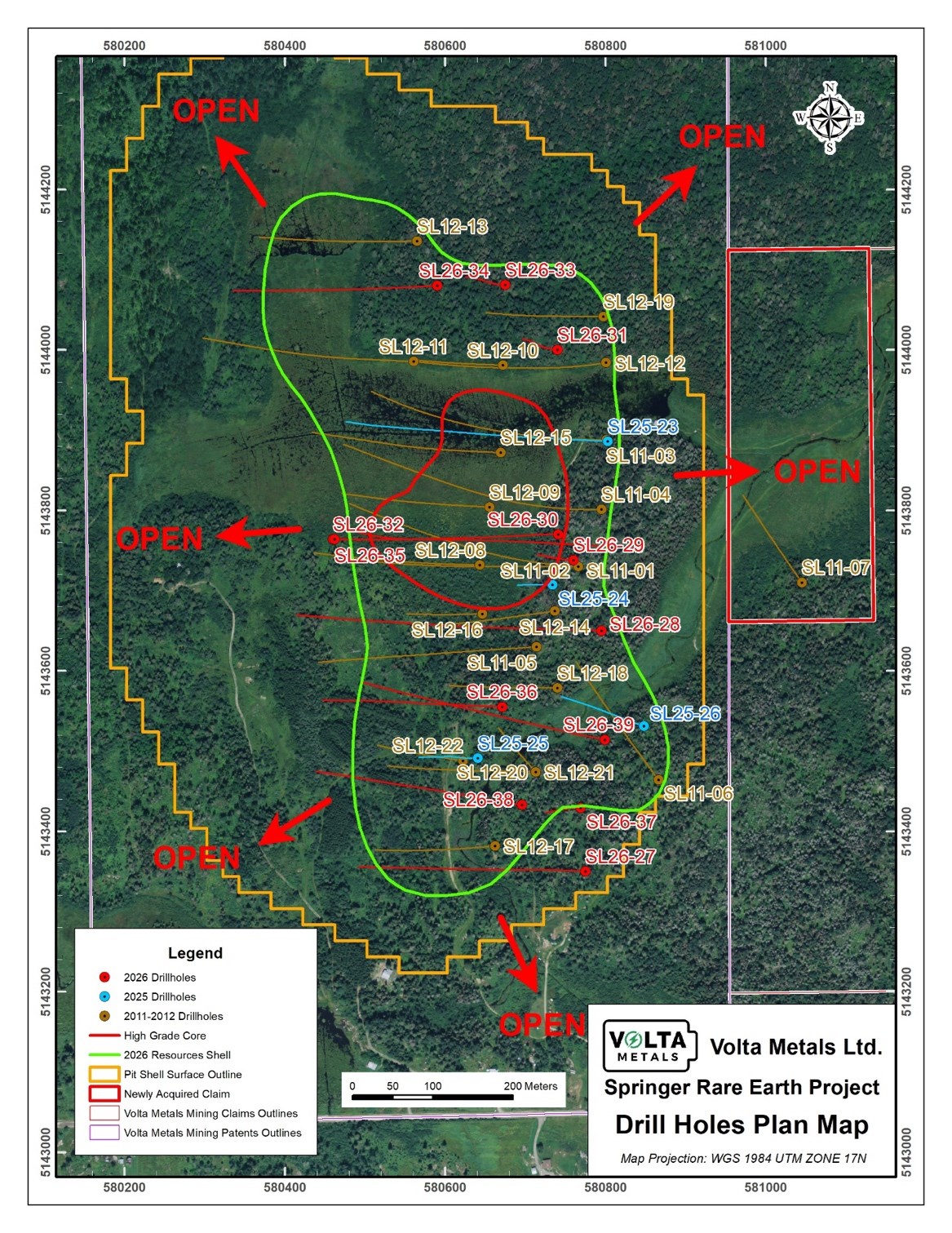
Figure 1. Springer drilling overview map showing the locations of drill holes SL26-31, SL26-32 and SL26-33 relative to the deposit and previously reported holes.
To view an enhanced version of this graphic, please visit:
https://images.newsfilecorp.com/files/9598/308812_ebe92d64941bcb66_001full.jpg
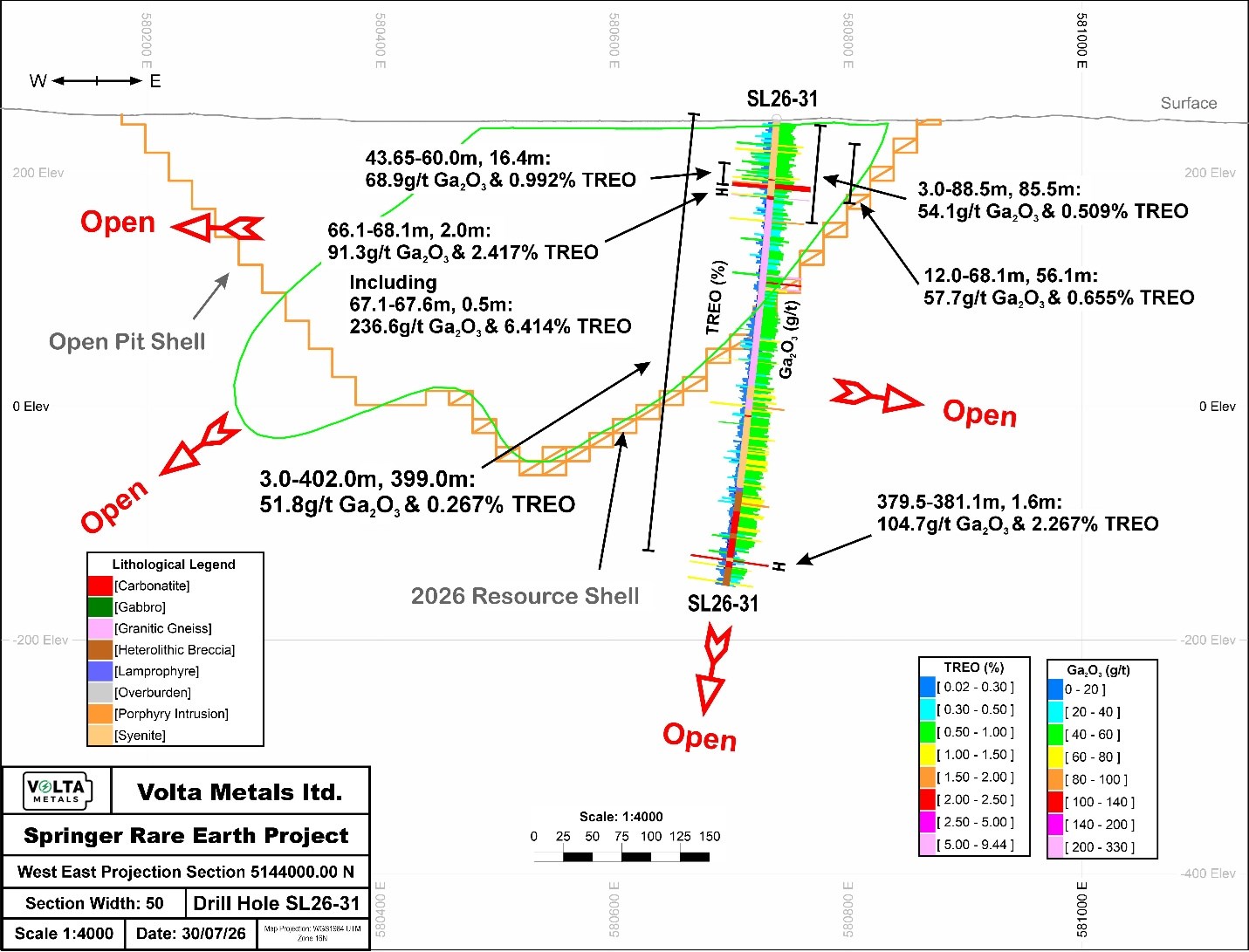
Figure 2. Cross section of SL26-31 showing TREO% and Ga2O3 g/t assays along the drill hole trace.
To view an enhanced version of this graphic, please visit:
https://images.newsfilecorp.com/files/9598/308812_ebe92d64941bcb66_002full.jpg
The highest Gallium grade in the three holes is:
- 236.6 g/t Ga₂O₃ and 6.41% TREO over 0.5 m (67.1-67.6 m) in SL26-31, also containing Premium Magnet Rare Earths (Figure 3):
- 6,730 g/t Neodymium oxide (Nd₂O₃), 2,598 g/t Praseodymium oxide (Pr₆O₁₁), 414 g/t Samarium Oxide (Sm₂O₃), and 265 g/t Gadolinium oxide (Gd₂O₃).
This interval is a white carbonatite vein in sharp contact with red syenite and irregular contact with red hematite (Figure 3).

Figure 3. SL26-31, box 16, 67.1-67.6 m, 0.5 m interval with white carbonatite vein in sharp contact with red syenite (bottom) and red hematite pod (top).
To view an enhanced version of this graphic, please visit:
https://images.newsfilecorp.com/files/9598/308812_ebe92d64941bcb66_003full.jpg
SL26-32, Ending in High Grade REE Mineralization at 426 m
Drill hole SL26-32 was collared on the west side of the patented claims, through the center of the Springer Deposit (Figure 1). This drill hole is almost vertical (dip of 85°) and reaches 30 m past the bottom of the current conceptual open pit (Figure 6). This drill hole is in close proximity to the high-grade resource wireframe. Drill hole SL26-32 passes through syenite to granitic gneiss to syenite and ends in carbonatite with REE mineralization. REE-Ga in carbonatite veins crosscuts both silicate rock units.
Drill hole SL26-32 was assayed continuously from 3.4 m to 426.0 m, returning 0.44% TREO and 41.5 g/t Ga₂O₃ over 422.6 m.
The highest TREO% interval in hole SL26-32 is 5.39 % TREO and 194.91 g/t Ga2O3 over 1.0 m from 44.0 to 45.0 m (Figure 4). This metre carries the highest heavy magnet rare earth grades of the three holes reported today, at 150.3 g/t Dy₂O₃ and 42.6 g/t Tb₄O₇, together with 7,232 g/t Nd₂O₃, 2,416 g/t Pr₆O₁₁, 784 g/t Sm₂O₃ and 536 g/t Gd₂O₃. This interval has 2.62% CeO2 and 1.52% La2O3 and consists of a black Fe-Mg-rich mafic rock (possibly ferrocarbonatite) with vuggy carbonatite veins. The lithology of the black rock will be identified during the ongoing mineralogy-petrology study.

Figure 4. SL26-32, box 11, 43.9-45.0 m with 5.39% TREO and 194.91 g/t Ga2O3 in mafic rock with carbonatite vein.
To view an enhanced version of this graphic, please visit:
https://images.newsfilecorp.com/files/9598/308812_ebe92d64941bcb66_004full.jpg
Other high-grade intervals include:
- 3.44% TREO and 143.83 g/t Ga2O3 over 0.5 m, 136.4-136.9 m in black rock with fluorite-bearing carbonatite vein
- 1.56% TREO and 49.1 g/t Ga2O3 over 11.9 m, 372.1-384 m in red syenite with fluorite-bearing carbonatite veins (Figure 5).
The most significant result in SL26-32 is at its base, from 372.1 m to 426.0 m, returning 1.22% TREO and 47.0 g/t Ga₂O₃ over 53.9 m. The final sample of the hole, from 424.5 m to 426.0 m, returned 1.15% TREO. Mineralization is open below 426 m.
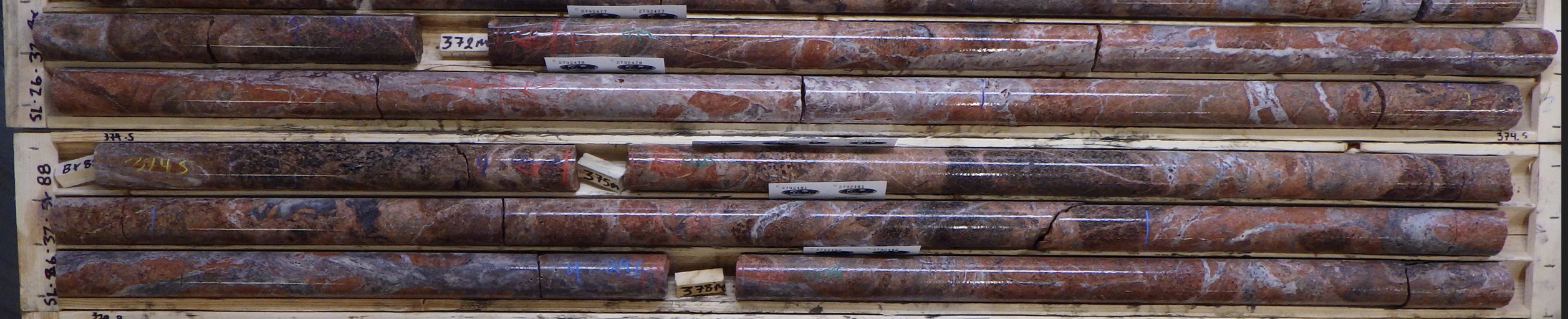
Figure 5. SL26-32, boxes 87 and 88, 372.1-378 m with high grade TREO % in carbonatite veins in red syenite.
To view an enhanced version of this graphic, please visit:
https://images.newsfilecorp.com/files/9598/308812_ebe92d64941bcb66_005full.jpg
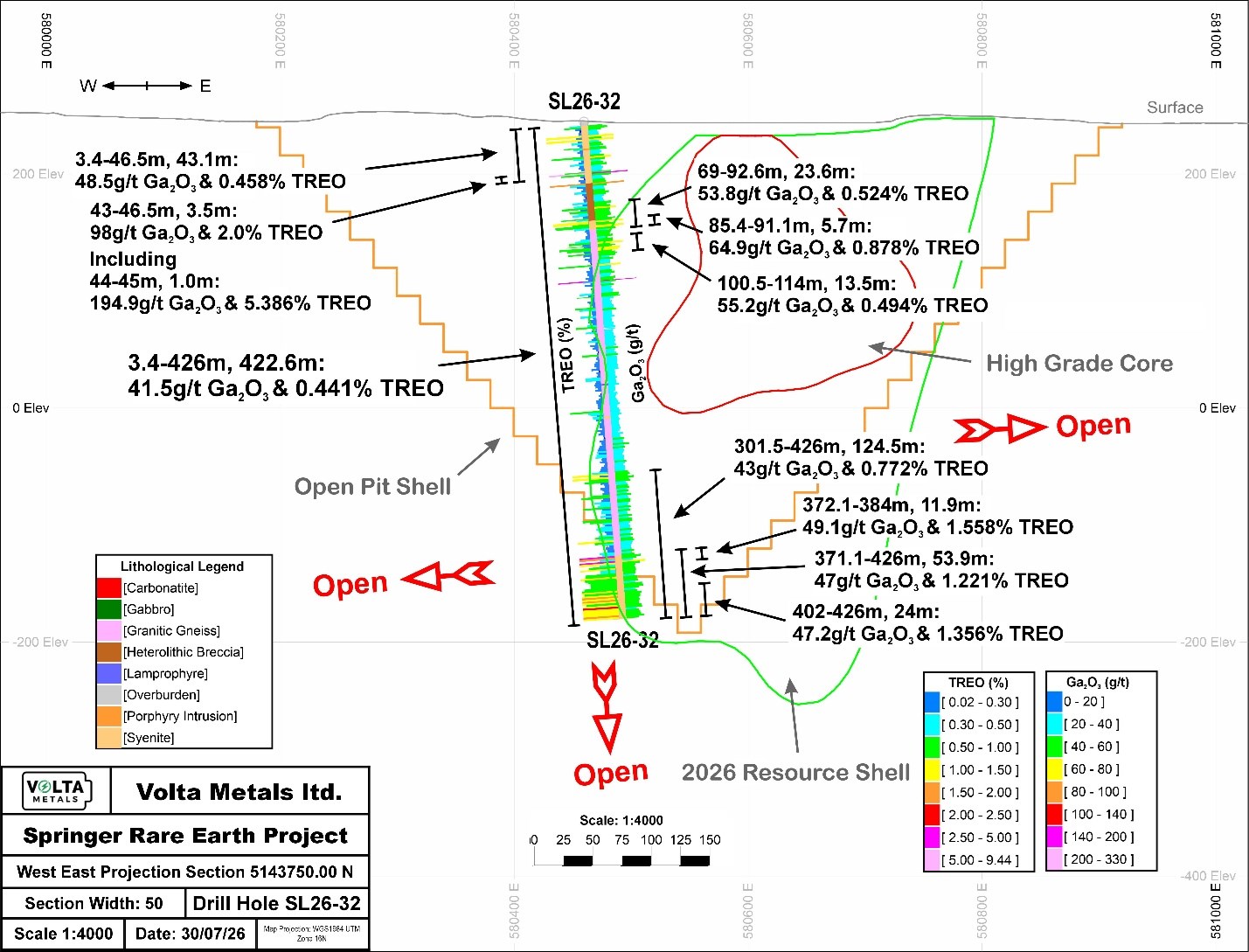
Figure 6. Cross section of SL26-32 showing TREO% and Ga2O3 g/t assays along the drill hole trace.
To view an enhanced version of this graphic, please visit:
https://images.newsfilecorp.com/files/9598/308812_ebe92d64941bcb66_006full.jpg
SL26-33
Drill hole SL26-33 is the northernmost hole that Volta has drilled and was completed as infill between previously drilled holes SL12-12, SL12-13 and SL12-19 (Figure 1). The majority of the 402 m hole is granitic gneiss, cut by carbonatite and related veins (Figure 7). Gallium is elevated across the full length of the hole, producing a continuous 399.0 m intersection grading 0.25% TREO and 39.1 g/t Ga₂O₃ from 3.0 m to 402.0 m. Average grades in SL26-33 are lower than in the deposit core because the hole sits further from the centre of the carbonatite pipe. Drill hole SL26-33 extends the Ga mineralization vertically 210 m past the outline on the east side of the current conceptual open pit.
Rare earth grades climb sharply where veins are present. The upper part of the hole returned 0.35% TREO and 39.8 g/t Ga₂O₃ over 172.5 m (22.5 to 195.0 m) within granitic gneiss, including 0.80% TREO and 57.8 g/t Ga₂O₃ over 36.0 m (129.0 to 165.0 m) with minor carbonatite veins in the granitic gneiss.
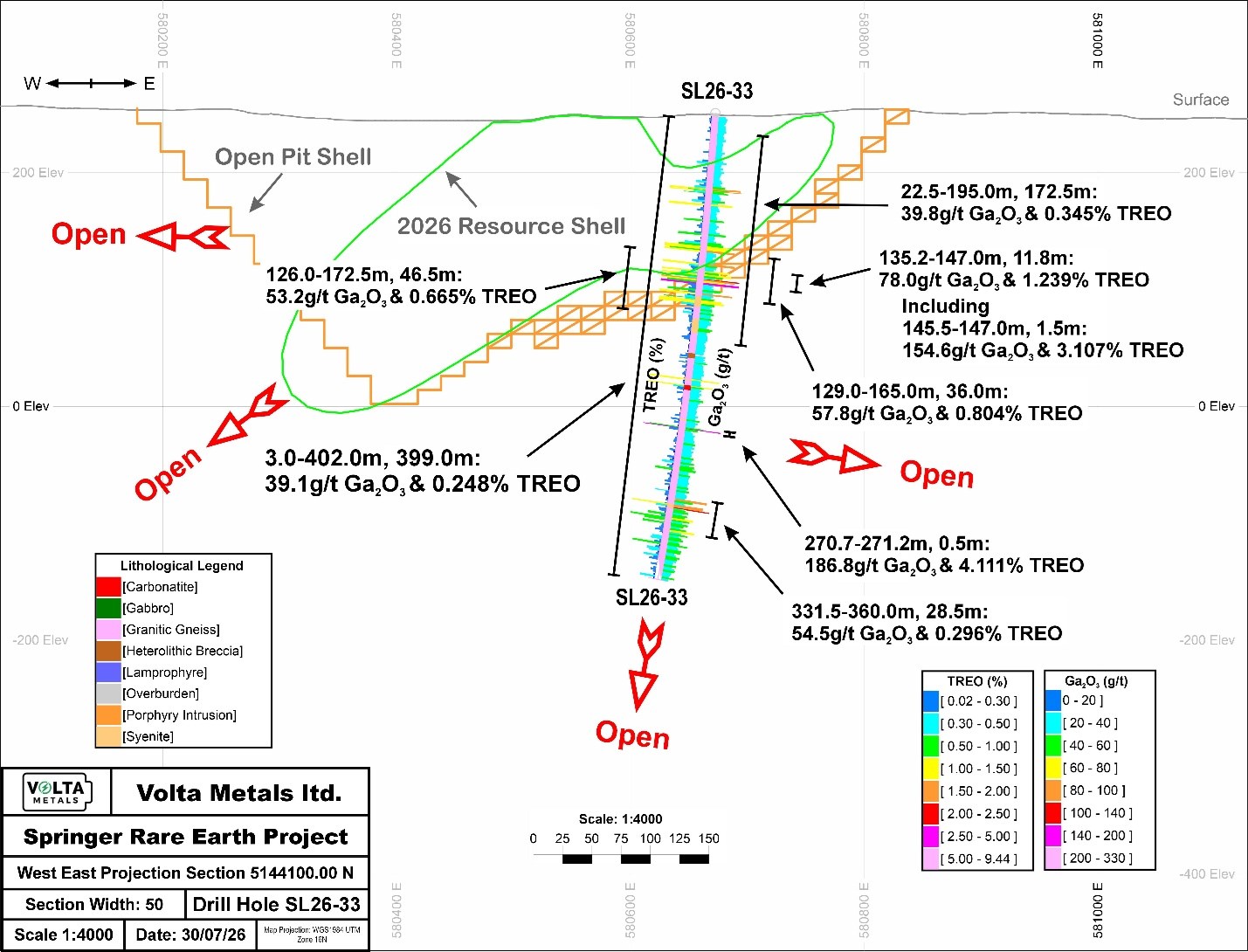
Figure 7. Cross section of SL26-33 showing TREO% and Ga₂O₃ g/t assays along the drill hole trace.
To view an enhanced version of this graphic, please visit:
https://images.newsfilecorp.com/files/9598/308812_ebe92d64941bcb66_007full.jpg
A Repeatable Targeting Model
The geology of the Springer mineralization is brecciated and hematitized syenite crosscut by white carbonatite veins. There is an excellent correlation between gallium and the rare earths within the carbonatite, while the gallium also remains elevated in the K-feldspar of the surrounding silicate rocks (i.e., syenite and granitic gneiss). The rare earths, together with a portion of the gallium, are primarily hosted in synchysite, a well-recognized calcium-cerium fluorocarbonate mineral that concentrates light rare earths such as cerium, lanthanum, neodymium and praseodymium, as well as heavy rare earths such as dysprosium and terbium, and is amenable to well-established REE recovery processes.
Assay highlights for drill holes SL26-31, SL26-32 and SL26-33 are given in Table 1, and gallium highlights are given in Table 2. The best intervals for individual rare earth elements are given in Table 3. Drill hole collar coordinates are given in Table 4. Assays are pending for additional drill holes from the 2026 program.
Table 1: Assay highlights from drill holes SL26-31, SL26-32 and SL26-33, Springer.
| Drill Hole No. | From (m) | To (m) | Interval (m) | TREO (%) | Ga2O3 (g/t) | Dy2O3 (g/t) | Nd2O3 (g/t) | Pr6O11 (g/t) | Tb4O7 (g/t) | % Magnet REO |
| SL26-31 | 3.0 | 402.0 | 399.0 | 0.267 | 51.8 | 18.4 | 431.7 | 131.7 | 4.2 | 21.8 |
| including | ||||||||||
| SL26-31 | 3.0 | 88.5 | 85.5 | 0.509 | 54.1 | 20.0 | 738.9 | 243.8 | 5.2 | 19.6 |
| including | ||||||||||
| SL26-31 | 12.0 | 68.1 | 56.1 | 0.655 | 57.7 | 22.4 | 926.9 | 310.5 | 5.9 | 19.2 |
| including | ||||||||||
| SL26-31 | 43.65 | 60.0 | 16.4 | 0.992 | 68.9 | 29.6 | 1,301.7 | 456.2 | 7.9 | 18.0 |
| including | ||||||||||
| SL26-31 | 66.1 | 68.1 | 2.0 | 2.417 | 91.3 | 30.7 | 2,796.4 | 1,039.4 | 10.1 | 15.9 |
| including | ||||||||||
| SL26-31 | 67.1 | 67.6 | 0.5 | 6.414 | 236.6 | 38.0 | 6,730.1 | 2,597.6 | 16.0 | 14.5 |
| SL26-31 | 379.5 | 381.1 | 1.6 | 2.267 | 104.7 | 56.8 | 2,974.3 | 1,051.1 | 17.3 | 17.9 |
| SL26-32 | 3.4 | 426.0 | 422.6 | 0.441 | 41.5 | 15.4 | 658.3 | 209.1 | 4.2 | 20.0 |
| including | ||||||||||
| SL26-32 | 3.4 | 46.5 | 43.1 | 0.458 | 48.5 | 16.7 | 687.5 | 218.4 | 4.8 | 20.1 |
| including | ||||||||||
| SL26-32 | 43.0 | 46.5 | 3.5 | 2.000 | 98.0 | 58.7 | 2774.4 | 914.6 | 16.7 | 18.6 |
| including | ||||||||||
| SL26-32 | 44.0 | 45.0 | 1.0 | 5.386 | 194.9 | 150.3 | 7,231.7 | 2,416.4 | 42.6 | 18.1 |
| SL26-32 | 69.0 | 92.6 | 23.6 | 0.524 | 53.8 | 18.2 | 794.3 | 254.2 | 5.2 | 20.3 |
| including | ||||||||||
| SL26-32 | 85.4 | 91.1 | 5.7 | 0.878 | 64.9 | 29.1 | 1,328.0 | 424.7 | 8.6 | 20.2 |
| SL26-32 | 100.5 | 114.0 | 13.5 | 0.494 | 55.2 | 15.7 | 748.4 | 241.7 | 5.0 | 20.3 |
| SL26-32 | 301.5 | 426.0 | 124.5 | 0.772 | 43.0 | 19.5 | 1,124.2 | 357.7 | 5.5 | 19.4 |
| including | ||||||||||
| SL26-32 | 372.1 | 426.0 | 53.9 | 1.221 | 47.0 | 24.6 | 1,782.3 | 559.7 | 6.9 | 19.3 |
| including | ||||||||||
| SL26-32 | 372.1 | 384 | 11.9 | 1.558 | 49.1 | 31.5 | 2,240.8 | 707.9 | 9.2 | 19.2 |
| including | ||||||||||
| SL26-32 | 402.0 | 426.0 | 24.0 | 1.356 | 47.2 | 26.3 | 1,969.0 | 620.9 | 6.9 | 19.2 |
| SL26-33 | 3.0 | 402.0 | 399.0 | 0.248 | 39.1 | 13.6 | 366.3 | 115.8 | 2.9 | 20.0 |
| including | ||||||||||
| SL26-33 | 22.5 | 195.0 | 172.5 | 0.345 | 39.8 | 15.0 | 477.7 | 157.1 | 3.3 | 18.8 |
| including | ||||||||||
| SL26-33 | 126.0 | 172.5 | 46.5 | 0.665 | 53.2 | 20.4 | 860.0 | 291.4 | 4.6 | 17.6 |
| including | ||||||||||
| SL26-33 | 129.0 | 165.0 | 36.0 | 0.804 | 57.8 | 21.7 | 1,025.3 | 350.8 | 5.0 | 17.3 |
| including | ||||||||||
| SL26-33 | 135.2 | 147.0 | 11.8 | 1.239 | 78.0 | 26.1 | 1,542.5 | 531.7 | 6.4 | 16.9 |
| including | ||||||||||
| SL26-33 | 145.5 | 147.0 | 1.5 | 3.107 | 154.6 | 33.9 | 3,615.8 | 1,292.8 | 10.9 | 15.8 |
| SL26-33 | 270.7 | 271.2 | 0.5 | 4.111 | 186.8 | 105.8 | 5,143.8 | 1,788.1 | 26.1 | 17.0 |
| SL26-33 | 331.5 | 360 | 28.5 | 0.296 | 54.5 | 13.5 | 458.1 | 139.1 | 3.6 | 20.6 |
*TREO (%) = La2O3 + CeO2 + Pr6O11 + Nd2O3 + Sm2O3 + Eu2O3 + Gd2O3 + Tb4O7 + Dy2O3 + Ho2O3 + Er2O3 + Tm2O3 + Yb2O3 + Lu2O3 + Y2O3 (%).
Ga2O3 (g/t) is calculated from assayed gallium (Ga) ppm using the stoichiometric factor 1.3442. True thickness/width of mineralization is unknown; intervals are reported as downhole core lengths.
% Magnet REO = (Pr2O3 + Nd2O3 + Tb2O3 + Dy2O3) / TREO x 100. Pr2O3 and Tb2O3 are derived from assayed Pr and Tb ppm using stoichiometric conversion factors of 1.2082 and 1.1762, respectively.
Table 2: Gallium highlights from drill holes SL26-31, SL26-32 and SL26-33, Springer.
| Drill Hole No. | From (m) | To (m) | Interval (m) | Ga2O3 (g/t) | TREO (%) | Dy2O3 (g/t) | Nd2O3 (g/t) | Pr6O11 (g/t) | Tb4O7 (g/t) |
| SL26-31 | 3.0 | 402.0 | 399.0 | 51.8 | 0.267 | 18.4 | 431.7 | 131.7 | 4.2 |
| including | |||||||||
| SL26-31 | 46.0 | 61.5 | 15.5 | 71.0 | 1.003 | 29.6 | 1,311.4 | 460.0 | 7.9 |
| including | |||||||||
| SL26-31 | 55.5 | 60.0 | 4.5 | 107.7 | 2.092 | 38.5 | 2,577.7 | 944.4 | 10.4 |
| SL26-31 | 133.5 | 147.0 | 13.5 | 94.6 | 0.202 | 23.4 | 379.7 | 100.9 | 5.8 |
| including | |||||||||
| SL26-31 | 144.0 | 147.0 | 3.0 | 139.4 | 0.179 | 19.1 | 349.3 | 91.5 | 5.0 |
| SL26-31 | 229.7 | 317.3 | 87.6 | 56.2 | 0.202 | 16.3 | 360.1 | 102.9 | 3.6 |
| SL26-31 | 322.0 | 367.5 | 45.5 | 58.5 | 0.177 | 15.2 | 308.9 | 90.5 | 3.3 |
| SL26-31 | 67.1 | 67.6 | 0.5 | 236.6 | 6.414 | 38.0 | 6,730.1 | 2,597.6 | 16.0 |
| SL26-32 | 3.4 | 426.0 | 422.6 | 41.5 | 0.441 | 15.4 | 658.3 | 209.1 | 4.2 |
| including | |||||||||
| SL26-32 | 69.0 | 92.6 | 23.6 | 53.8 | 0.524 | 18.2 | 794.3 | 254.2 | 5.2 |
| including | |||||||||
| SL26-32 | 79.5 | 92.6 | 13.1 | 56.6 | 0.611 | 20.9 | 921.7 | 295.2 | 6.0 |
| SL26-32 | 103.5 | 115.5 | 12.0 | 56.4 | 0.492 | 15.7 | 741.4 | 240.2 | 5.0 |
| SL26-32 | 372.1 | 379.5 | 7.4 | 53.4 | 2.035 | 38.8 | 2,929.4 | 919.0 | 11.7 |
| SL26-32 | 44.0 | 45.0 | 1.0 | 194.9 | 5.386 | 150.3 | 7,231.7 | 2,416.4 | 42.6 |
| SL26-33 | 3.0 | 402.0 | 399.0 | 39.1 | 0.248 | 13.6 | 366.3 | 115.8 | 2.9 |
| including | |||||||||
| SL26-33 | 112.5 | 119.2 | 6.7 | 67.1 | 1.020 | 23.7 | 1,341.0 | 447.4 | 6.0 |
| SL26-33 | 135.2 | 147.0 | 11.8 | 78.0 | 1.239 | 26.1 | 1,542.5 | 531.7 | 6.4 |
| including | |||||||||
| SL26-33 | 142.05 | 147.0 | 4.95 | 102.9 | 1.811 | 29.0 | 2,209.4 | 772.7 | 7.9 |
| SL26-33 | 331.5 | 339.8 | 8.3 | 71.4 | 0.249 | 19.9 | 500.0 | 122.7 | 5.9 |
| SL26-33 | 270.7 | 271.2 | 0.5 | 186.8 | 4.111 | 105.8 | 5,143.8 | 1,788.1 | 26.1 |
Gallium intervals are selected on Ga2O3 grade and are reported with the coincident TREO and individual rare earth oxide grades over the same interval. Ga2O3 (g/t) is calculated from assayed gallium (Ga) ppm using the stoichiometric factor 1.3442. True thickness/width of mineralization is unknown; intervals are reported as downhole core lengths.
Table 3: Best intervals for individual rare earth elements in SL26-31, SL26-32 and SL26-33, Springer.
| Drill Hole No. | From (m) | To (m) | Interval (m) | Dy2O3 (g/t) | Gd2O3 (g/t) | Nd2O3 (g/t) | Pr6O11 (g/t) | Sm2O3 (g/t) | Tb4O7 (g/t) |
| SL26-32 | 44.0 | 45.0 | 1.0 | 150.3 | 536.0 | 7,231.7 | 2,416.4 | 783.9 | 42.6 |
| SL26-31 | 67.1 | 67.6 | 0.5 | 38.0 | 265.1 | 6,730.1 | 2,597.6 | 414.0 | 16.0 |
| SL26-33 | 270.7 | 271.2 | 0.5 | 105.8 | 351.5 | 5,143.8 | 1,788.1 | 439.5 | 26.1 |
Values reported as oxide grades in grams per tonne (g/t).
Table 4: Springer drill hole collar locations. UTM NAD 83, Zone 17.
| Drill Hole No. | Easting (m) | Northing (m) | Elevation (m) | Azimuth (°) | Dip (°) | Length (m) |
| SL26-32 | 580460 | 5143764 | 244 | 90 | -85 | 426 |
| SL26-31 | 580740 | 5144000 | 250 | 270 | -85 | 402 |
| SL26-33 | 580675 | 5144081 | 251 | 270 | -85 | 402 |
Azimuth and dip are collar orientations. No downhole directional survey was completed.
Resource Estimate
On February 23, 2026, Volta reported an updated Mineral Resource Estimate ("MRE") for the Springer deposit, effective December 31, 2025, prepared by SLR Consulting (Canada) Ltd. The MRE comprises 56.6 Mt Indicated at 0.70% TREO (including a near-surface high-grade core of 11.5 Mt at 1.10% TREO) and 119.5 Mt Inferred at 0.58% TREO (including a near-surface high-grade core of 3.0 Mt at 1.16% TREO). Resources are reported within an optimized open pit shell above a C$43/t net metal revenue cut-off. Revenue is driven primarily by praseodymium and neodymium, which together account for approximately 90% of total net metal value. The updated MRE places Springer among the top 10 largest REE deposits in North America based on the S&P Global Market Intelligence database (2025). The Company cautions that mineral resources are not mineral reserves and do not have demonstrated economic viability.
Mineralization remains open in all directions. Gallium results from the 2025 drill program are not included in the current MRE and will be reported separately. An NI 43-101 Technical Report supporting the MRE was filed on SEDAR+ on April 9, 2026.
Next Steps and Upcoming Milestones
Assays remain pending for the balance of the 13-hole, 5,452 m 2026 winter drill program. Volta will report those results as they are received from the Saskatchewan Research Council ("SRC").
Following receipt of all 2026 assay results, Volta is targeting an updated mineral resource estimate incorporating both rare earth and gallium content for the Springer deposit late 2026.The estimate would incorporate the 2026 infill and expansion drilling, including the depth extension demonstrated by SL26-32 and the southern extension reported on June 15, 2026, and would be prepared in accordance with National Instrument 43-101 and CIM Definition Standards.
The Company cautions that the timing of mineral resource estimate depends on receipt of all outstanding assay results, on the completion of supporting metallurgical and analytical work, and on the availability of the Company's independent consultants. There is no assurance that either estimate will be completed within the anticipated timeframe, that a gallium mineral resource will be defined at all, or that any updated rare earth mineral resource estimate will be larger or higher grade than the current MRE. Mineral resources are not mineral reserves and do not have demonstrated economic viability.
QA/QC Protocol
All drilling was completed by a diamond drill rig producing NQ-size core. Volta implemented a strict QA/QC protocol in processing all rock samples collected from the diamond core obtained from the Springer property. The protocol included inserting reference materials, in this case high-concentration and low-concentration certified rare earth element and gallium standards, blanks, and drill core duplicates, to validate the accuracy and precision of the assay results. All collected rock core samples were cut in half by a rock saw, placed in sturdy plastic bags and zip-tied shut while under the supervision of a professional geologist. The remaining half core was returned to the core box, which is stored on the Property. The samples were shipped from Volta's core shack in Sturgeon Falls to the Saskatchewan Research Council's ("SRC") facility in Saskatoon, Saskatchewan, using the Manitoulin Transport freight shipping company.
The drill core samples were analyzed at SRC using Lithium metaborate fusion with subsequent analysis by ICP-MS. SRC holds ISO/IEC 17025:2017 accreditation from the Standards Council of Canada ("SCC"). Syenite standard SY-5 from Natural Resources Canada was inserted by SRC in the sample stream for every 20 drill core samples. Standard SY-5 passed within two standard deviations for rare earth elements (La to Lu) and Ga. All internal standards and duplicates, and all external blanks, standards and core duplicates, passed a Quality Control review by the Qualified Person.
Qualified Person
The technical content of this press release has been reviewed and approved by Dr. Julie Selway, P.Geo., VP, Exploration, and Qualified Person ("QP") as defined in National Instrument 43-101, Standards of Disclosure for Mineral Projects.
For more information about the Company, please visit Volta's website at www.voltametals.ca.
ABOUT VOLTA METALS LTD.
Volta Metals Ltd. (CSE: VLTA) (FSE: D0W) (OTCQB: VOLMF) is a critical mineral exploration company focused on rare earths, gallium, lithium, cesium, and tantalum. Volta owns, has optioned, and is currently exploring a critical minerals portfolio of rare earth, gallium, lithium, cesium, and tantalum projects in Ontario, one of the world's most prolific and emerging hard-rock critical mineral districts.
Volta is advancing its 4,750-hectare Springer REE Deposit, located on the traditional territory of the Nipissing First Nation in Sturgeon Falls. The Springer Rare Earth Element deposit sits approximately 70 km east of Sudbury, Ontario, with direct access via the Trans-Canada Highway and Highway 64. The project benefits from well-developed infrastructure, including paved road access, on-site power lines fed from the Crystal Falls hydroelectric dam, a natural gas pipeline, and Canadian National Railway service, all within 8 km of the deposit.
To learn more about Volta and its Springer and Aki Projects, please visit www.voltametals.ca.
ON BEHALF OF THE BOARD
For further information, contact:
Kerem Usenmez, President & CEO
Tel: 416.919.9060
Email: info@voltametals.ca
Website: www.voltametals.ca
Neither the CSE nor the Canadian Investment Regulatory Organization (CIRO) accepts responsibility for the adequacy or accuracy of this release.
This news release contains forward-looking statements relating to exploration activities, plans, strategies, and other statements that are not historical facts. Forward-looking statements are often identified by terms such as "will", "may", "should", "anticipate", "expects", "targeting" and similar expressions. All statements other than statements of historical fact included in this news release are forward-looking statements that involve risks and uncertainties. Forward-looking information in this news release includes, but is not limited to, the expected timing of assay results from the Saskatchewan Research Council, the Company's stated intention and timing to complete a maiden gallium mineral resource estimate and an updated rare earth mineral resource estimate for the Springer deposit in late 2026, statements regarding the potential extent of the gallium mineralized envelope relative to the rare earth mineralized envelope, the geological interpretation of the Springer REE deposit as a vertically extensive carbonatite system, statements regarding gallium market conditions and Chinese export control measures, and the potential for the 2026 drilling program to support future resource estimation. There can be no assurance that such statements will prove to be accurate, and actual results and future events could differ materially from those anticipated. Important factors that could cause actual results to differ materially from the Company's expectations include the risks detailed from time to time in the filings made by the Company with securities regulators, the future prices and demand for rare earth elements and gallium, changes to export control or trade measures affecting gallium supply, the absence to date of metallurgical test work demonstrating that gallium can be economically recovered from the Springer mineralization, laboratory results that differ from visual or geological observations, and delays or the inability of the Company to obtain any necessary approvals, permits and authorizations required to carry out its business plans. The reader is cautioned not to place undue reliance on any forward-looking statements. Forward-looking statements contained in this news release are made as of the date of this news release, and the Company disclaims any intention or obligation to update or revise any forward-looking statements, whether as a result of new information, future events, or otherwise, other than as required by law.

To view the source version of this press release, please visit https://www.newsfilecorp.com/release/308812
Source: Volta Metals Ltd.