Vancouver, British Columbia and Melbourne, Australia--(Newsfile Corp. - August 4, 2026) - Southern Cross Gold Consolidated Ltd (TSX: SXGC) (ASX: SX2) (OTCQX: SXGCF) (FSE: MV3) ("SXGC", "SX2" or the "Company") announces an updated Exploration Target for the 100%-owned Sunday Creek Gold-Antimony Project in Victoria, Australia (Figures 1 and 2).
HIGHLIGHTS
- The estimated range of potential mineralization for the Exploration Target is (also see Table 1):
| | - 10.4 – 11.9 million tonnes grading from 8.9 g/t gold equivalent (“AuEq”) to 12.1 g/t AuEq for:
3.0 Moz AuEq to 4.6 Moz AuEq
The potential quantity and grade of the Exploration Target is conceptual in nature and therefore is an approximation. There has been insufficient exploration to estimate a Mineral Resource and it is uncertain if further exploration will result in the estimation of a Mineral Resource. The Exploration Target has been completed in accordance with National Instrument 43-101 – Standards of Disclosure for Mineral Projects ("NI 43-101") and the Australasian Code for Reporting of Exploration Results, Mineral Resources and Ore Reserves, 2012 Edition ("JORC").
* (AuEq = Au (g/t) + 2.39 x Sb (%)) Differences may occur in totals due to rounding. |
Michael Hudson, President & CEO, states: "We've grown this Exploration Target from three prospects to five, from 1,020 metres of strike to over 1,500 metres and we are nowhere near done.
"The target captures less than 15% of the 11 km mineralized corridor. Extensions at depth remain open below every prospect. Christina was added for the first time to the Exploration Target calculation. Golden Dyke and Apollo East have added significantly.
"Nine rigs are turning on site with two more testing regional targets up to 8 km away. We have 35 km of core in the shed, being logged and awaiting results, and expect to complete another 135 km of drilling through to Q1 2027. Every hole we drill either extends what we know or opens something new.
"The path forward is clear. The geology keeps delivering. Our job is to keep drilling."
Exploration Target
The updated Exploration Target contains 3.0 to 4.6 Moz AuEq at grades of 8.9 to 12.1 g/t AuEq across 10.4 to 11.9 million tonnes, representing the Christina, Golden Dyke, Rising Sun, Apollo and Apollo East prospects along 1,500 m of strike. The Exploration Target is based on 125 vein set shapes constrained to diamond drilling data (Figure 1 and 2).
The updated Exploration Target ranges are listed in Table 1.
Table 1. Sunday Creek Exploration Target for Christina, Golden Dyke, Rising Sun, Apollo and Apollo East Prospects
| Range | Tonnes (Mt) | AuEq g/t* | Au g/t | Sb % | AuEq (Moz) | Au (Moz) | Sb (ktonnes) |
| Lower Case | 10.4 | 8.9 | 7.4 | 0.6 | 3.0 | 2.5 | 63 |
| Upper Case | 11.9 | 12.1 | 10.3 | 0.8 | 4.6 | 3.9 | 95 |
| * (AuEq = Au (g/t) + 2.39 x Sb (%)) Differences may occur in totals due to rounding. |
The potential quantity and grade of the Exploration Target is conceptual in nature and therefore is an approximation. There has been insufficient exploration to estimate a Mineral Resource and it is uncertain if further exploration will result in the estimation of a Mineral Resource. The Exploration Target has been completed in accordance with National Instrument 43-101 - Standards of Disclosure for Mineral Projects ("NI 43-101") and the Australasian Code for Reporting of Exploration Results, Mineral Resources and Ore Reserves, 2012 Edition ("JORC").
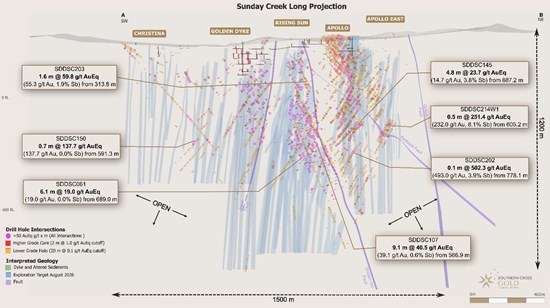
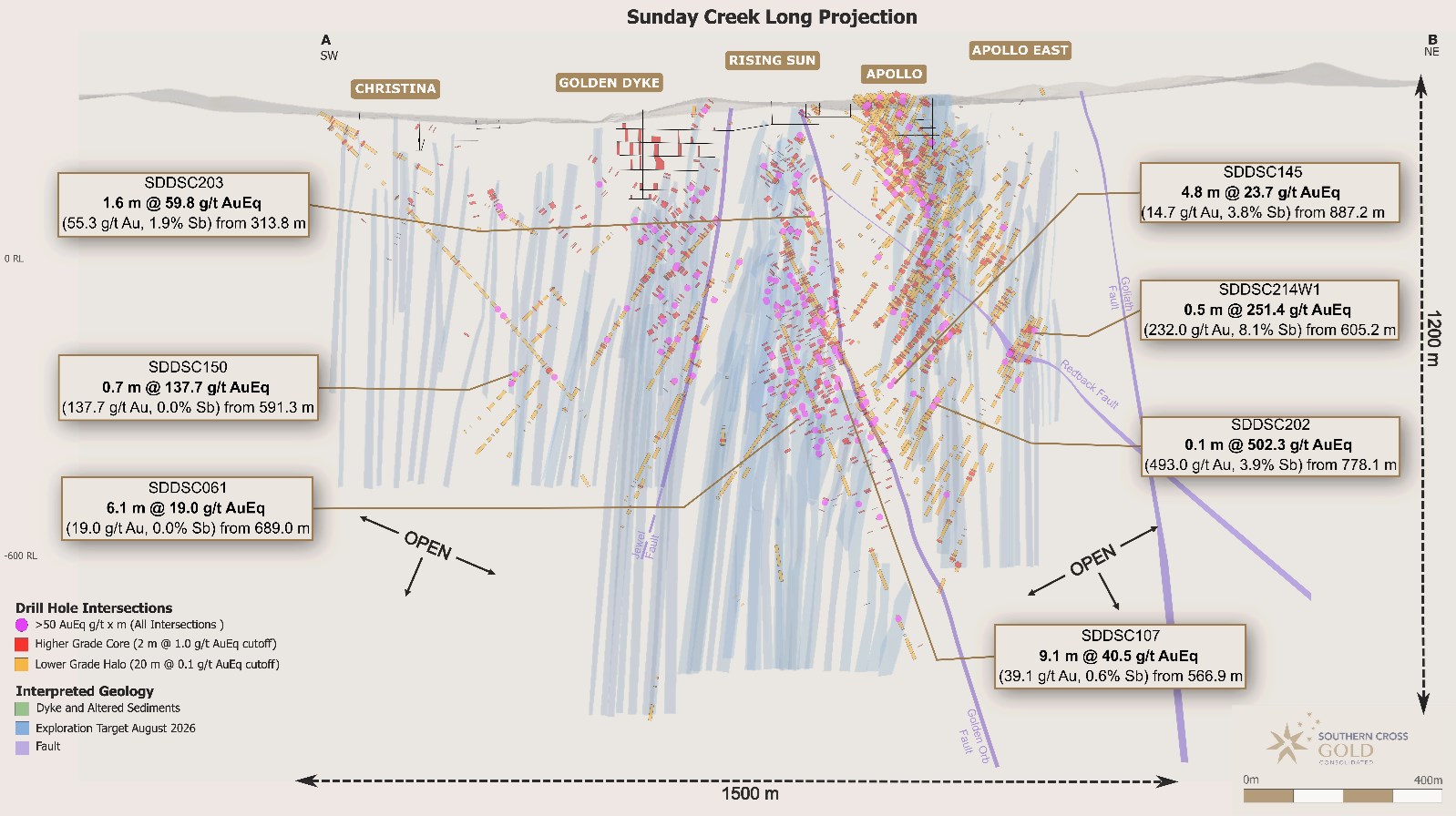
Figure 1. Longitudinal Section A-B of Exploration Target Vein Sets Sunday Creek (Looking Northwest). Highlighting drill intersections outside the current Exploration Target boundary which demonstrate potential for expansion with further drilling.
To view an enhanced version of this graphic, please visit:
https://images.newsfilecorp.com/files/11541/307857_b04e528d14d639f4_002full.jpg
Basis for the Exploration Target
The Exploration Target is based on geological interpretation and projection of mineralization intersected in diamond drilling. The target area encompasses five prospects along the main structure at Sunday Creek: Christina, Golden Dyke, Rising Sun, Apollo, and Apollo East. The tonnage and grade ranges reflect the geological uncertainty inherent in early-stage exploration and are based on:
- Interpreted geometry of the host structures from drilling
- Observed widths and extents of mineralized zones
- Variation in gold and antimony values from drill intersections
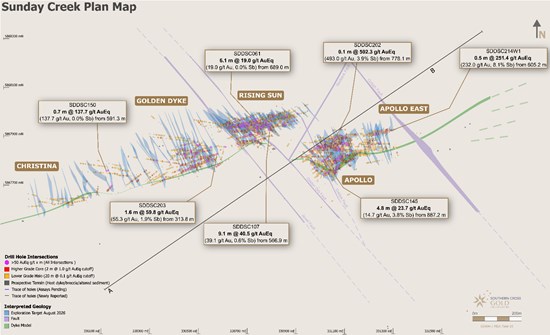
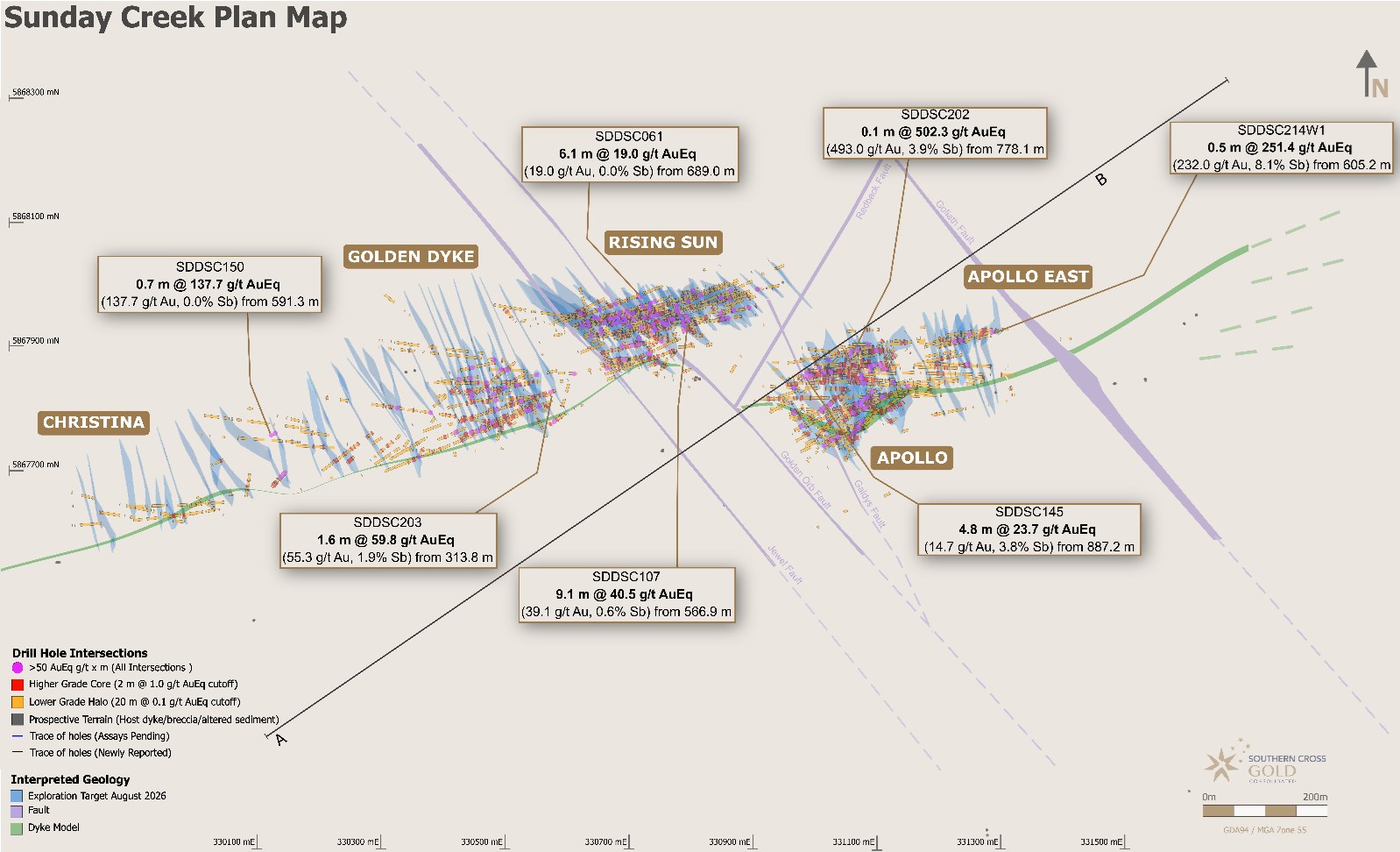
Figure 2. Plan view of Exploration Target Vein Sets Sunday Creek. Highlighting drill intersections outside the current Exploration Target boundary which demonstrate potential for expansion with further drilling.
To view an enhanced version of this graphic, please visit:
https://images.newsfilecorp.com/files/11541/307857_b04e528d14d639f4_003full.jpg
The Exploration Target is constrained to five areas along the strike of the dyke breccia host: Christina (over 330 m strike), Golden Dyke (over 400 m strike), Rising Sun (over 410 m strike), Apollo (over 220 m strike), and Apollo East (over 140 m strike) for a total of 1,500 m of strike. A total of 125 mineralized vein set shapes were created for the Exploration Target (Fig 1 and 2).
Areas Not Included in Exploration Target
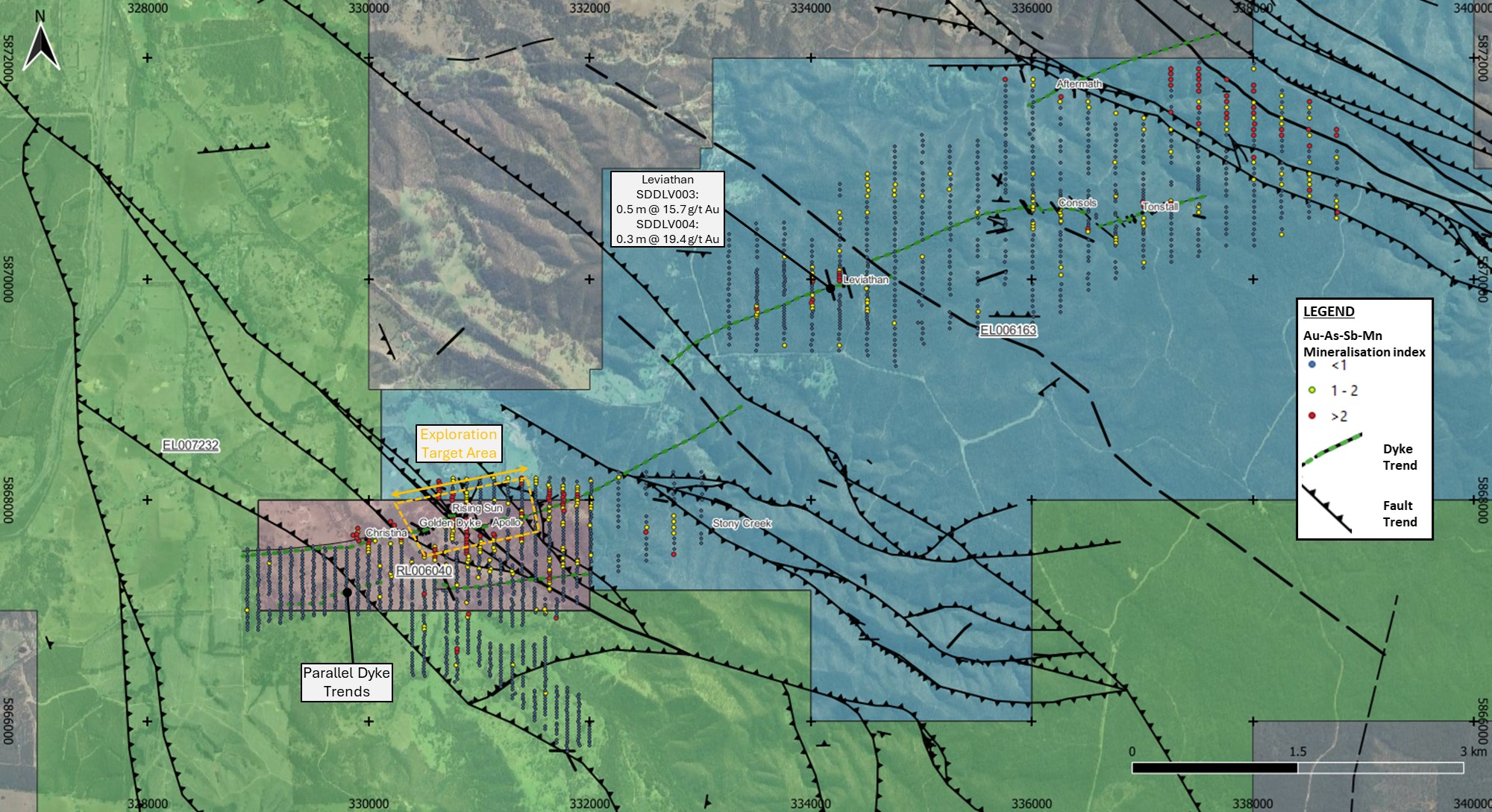
The Exploration Target covers the core 1.5 km main drill area down to varying depths. This area remains open to the immediate west and east. Drilled areas not yet included in the Exploration Target due to insufficient drill density include extensions at depth below current drilling, and regional prospects along the 11 km mineralized trend (Figure 3).
Drill intersections outside the current Exploration Target boundary (Figure 2) demonstrate potential for expansion with further drilling:
- Christina: SDDSC150 - 0.7 m @ 137.7 g/t AuEq (137.7 g/t Au) from 591.3 m
- Golden Dyke: SDDSC203 - 1.6 m @ 59.8 g/t AuEq (55.3 g/t Au, 1.9% Sb) from 313.8 m
- Rising Sun: SDDSC061 - 6.1 m @ 19.0 g/t AuEq (19.0 g/t Au) from 689.0 m
- Rising Sun: SDDSC107 - 9.1 m @ 40.5 g/t AuEq (39.1 g/t Au, 0.6% Sb) from 566.9 m
- Apollo: SDDSC145 - 4.8 m @ 23.7 g/t AuEq (14.7 g/t Au, 3.8% Sb) from 887.2 m
- Apollo East: SDDSC202 - 0.1 m @ 502.3 g/t AuEq (493.0 g/t Au, 3.9% Sb) from 778.1 m
- Apollo East: SDDSC214W1 - 0.5 m @ 251.4 g/t AuEq (232.0 g/t Au, 8.1% Sb) from 605.2 m
These results occur along strike and at depth from the current Exploration Target and are not included due to insufficient drill density to constrain vein geometry.
Additional Information
Cultural Heritage Clearances
Heritage walkovers required to gain access to the Exploration Target area have been completed in conjunction with the Taungurung Land and Waters Council who represent the Native Title holders the Taungurung People. A Cultural Heritage Management Plan (CHMP) over the larger project remains in progress.
Approvals
The majority of the Exploration Target is contained within a small crown land allotment. SXGC owns 1,392 hectares of freehold land that encloses the crown land. Approvals required for exploration drilling to test the Exploration Target have all been obtained for both the crown land and the freehold land. The Company is also fully permitted under an existing work plan to construct a 1.2 km exploration decline that remains under construction.
Exploration Licences
The Exploration Target is located within granted Retention Licence RL6040 and surrounded by granted EL6163. No further Exploration Licences are required to be granted to test the Exploration Target.
Exploration Program
Expansion and resource definition drilling are continuing at the project with nine diamond rigs operating to extend the mineralization drill-out within the Exploration Target and to test whether sufficient geological and grade continuity exists to support a Mineral Resource Estimate and a further two rigs focused on regional exploration targets. A total of 130.6 km of drilling has been reported from Sunday Creek, with 35 km of drilling remaining in the core shed and assay lab to be reported. In addition, a further 135 km is expected to be completed from today to the end of calendar Q1 2027.
Metallurgical test work
Stage 2 metallurgical test work reported in August 2025 (144 samples) demonstrated successful selective flotation processing that produces a high-grade, low-arsenic antimony-gold concentrate from the upper antimony-rich zones of the deposit, alongside excellent recovery of native gold. Overall gold recovery of 92.3% to 95.6% across three product streams:
Gravity gold concentrate (37.3 – 51.4% recovered gold).
Antimony-gold concentrate (28.8 – 36.5% recovered gold): Antimony grades 48.2 – 53.1%, gold grades up to 93.2 g/t and arsenic grades 0.1% to 0.2% (well below the 0.6% threshold). Antimony recovery 83.2% to 92.7%.
Sulphide concentrate (15.5 – 18.0% recovered gold)
Geological Modelling
SRK Consulting (Australasia) Pty Ltd ("SRK") has continued to be engaged for ongoing geological modelling assistance consistent with the requirements of National Instrument 43-101 - Standards of Disclosure for Mineral Projects ("NI 43-101") and the Australasian Code for Reporting of Exploration Results, Mineral Resources and Ore Reserves, 2012 Edition ("JORC"). Subject to achieving sufficient drill density and establishing geological and grade continuity, this work may support consideration of a future Mineral Resource Estimate.
About Sunday Creek
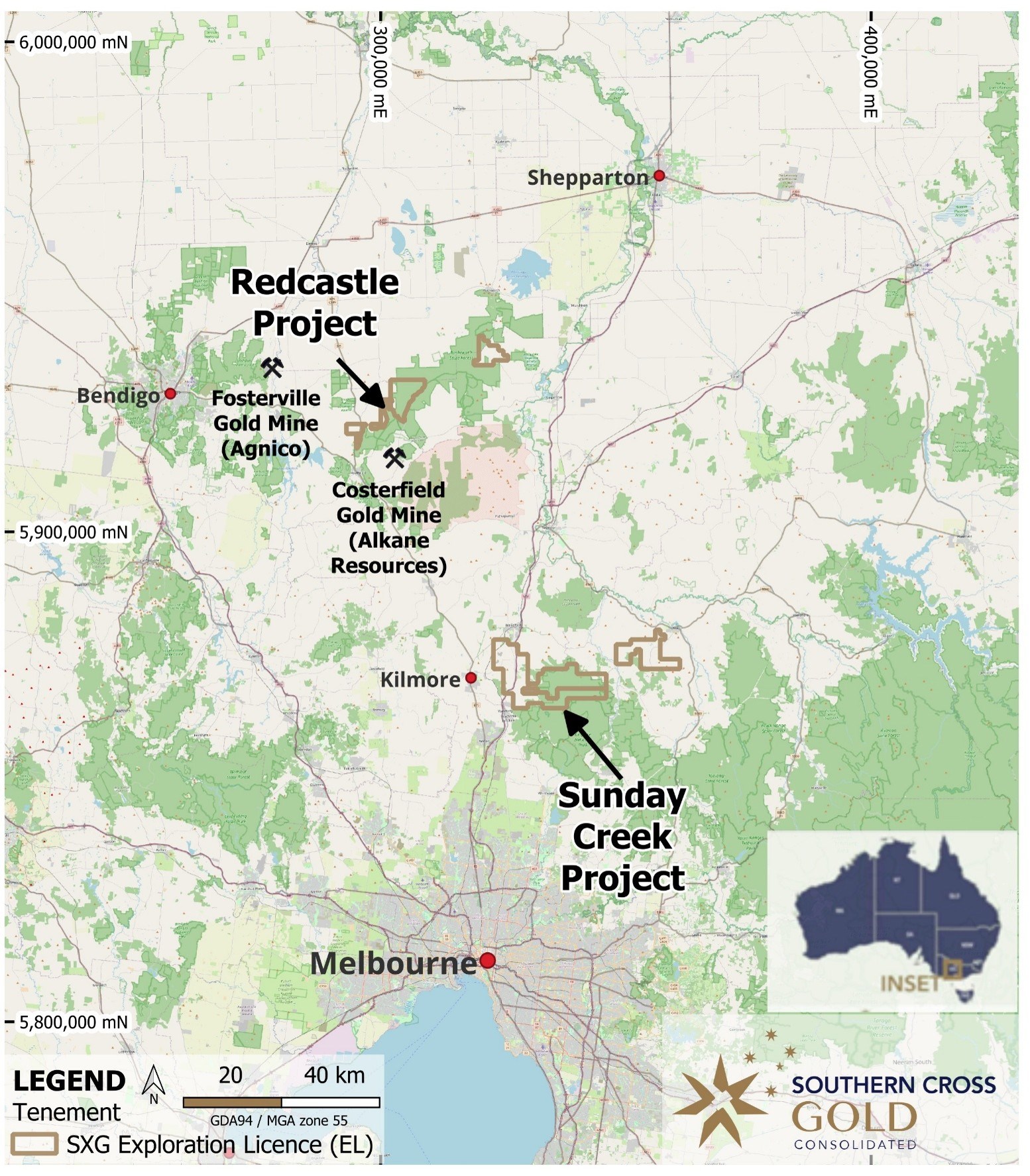
The Sunday Creek epizonal-style gold project (Figure 4) is located 60 km north of Melbourne within 16,900 hectares ("Ha") of granted exploration tenements. SXGC is also the freehold landholder of 1,392 Ha that forms the key portion in and around the main drilled area at the Sunday Creek Project.
Gold and antimony form in a relay of vein sets that cut across a steeply dipping zone of intensely altered rocks (the "host"). These vein sets are like a "Golden Ladder" structure where the main host extends between the side rails deep into the earth, with multiple cross-cutting vein sets that host the gold forming the rungs. At Apollo, Golden Dyke and Rising Sun these individual 'rungs' have been defined over 600 m depth extent from surface to over 1,200 m below surface, are 2.5 m to 3.5 m wide (median widths) (and up to 10 m), and 20 m to 100 m in strike.
Cumulatively, 273 drill holes for 130,610.13 m have been reported from Sunday Creek since late 2020. This amount includes five holes for 929 m that have been drilled for geotechnical purposes and 22 holes for 2,972.92 m that were abandoned due to deviation or hole conditions. Fourteen drill holes for 2,382.74 m have been reported regionally outside of the main Sunday Creek drill area with seventeen (17) additional regional holes currently being processed. A total of 64 historic drill holes for 5,599 m were completed from the late 1960s to 2008. The project now contains a total of ninety-three (93) composite intersections exceeding 100 g/t Au and seventy-nine (79) composite intersections between 50 g/t and 100 g/t Au, and one hundred and ten (110) composite intersections exceeding 10% Sb by applying a 1 m (down hole length) @ 5 g/t AuEq lower cut.
Southern Cross Gold's systematic drill program is strategically targeting these significant vein formations, which are currently drill defined over 1,550 m strike of the host dyke/sediment ("rails of the ladder") from Christina to Apollo prospects, of which approximately 650 m has been more intensively drill tested (Golden Dyke to Apollo). At least 125 'rungs' have been defined to date, defined by high-grade intercepts (20 g/t Au to >7,330 g/t Au) along with lower grade edges. Ongoing step-out drilling is aiming to uncover the potential extent of this mineralized system (Figure 2).
Geologically, the project is located within the Melbourne Structural Zone in the Lachlan Fold Belt. The regional host to the Sunday Creek mineralization is an interbedded turbidite sequence of siltstones and minor sandstones metamorphosed to sub-greenschist facies and folded into a set of open north-west trending folds.
Further Information
Further discussion and analysis of the Sunday Creek project is available through the interactive Vrify 3D animations, presentations and videos all available on the SXGC website. These data, along with an interview on these results with President & CEO/Managing Director Michael Hudson can be viewed at www.southerncrossgold.com.
No upper gold grade cut is applied in the averaging and intervals are reported as drill thickness. However, during future Mineral Resource studies, the requirement for assay top cutting will be assessed. The Company notes that due to rounding of assay results to one decimal place, minor variations in calculated composite grades may occur.
Figures 1 to 4 show project location, plan and longitudinal views of the Exploration Target reported here. The true thickness of the mineralized intervals is reported individually as estimated true widths ("ETW") where known; otherwise, they are interpreted to be approximately 40% to 90% of the sampled thickness for other reported holes. Lower grades were cut at 1.0 g/t AuEq lower cutoff over a maximum width of 2 m with higher grades cut at 5.0 g/t AuEq lower cutoff over a maximum of 1 m width.
Critical Metal Epizonal Gold-Antimony Deposits
Sunday Creek (Figure 4) is an epizonal gold-antimony deposit formed in the late Devonian (like Fosterville, Costerfield and Redcastle), 60 million years later than mesozonal gold systems formed in Victoria (for example Ballarat and Bendigo). Epizonal deposits are a form of orogenic gold deposit classified according to their depth of formation: epizonal (<6 km), mesozonal (6 km to 12 km) and hypozonal (>12 km).
Epizonal deposits in Victoria often have associated high levels of the critical metal, antimony, and Sunday Creek is no exception. China claims a 56 per cent share of global mined supplies of antimony, according to a 2023 European Union study. Antimony features highly on the critical minerals lists of many countries including Australia, the United States of America, Canada, Japan and the European Union. Australia ranks seventh for antimony production despite all production coming from a single mine at Costerfield in Victoria, located nearby to all SXGC projects. Antimony alloys with lead and tin, which results in improved properties for solders, munitions, bearings and batteries. Antimony is a prominent additive for halogen-containing flame retardants. Adequate supplies of antimony are critical to the world's energy transition, and to the high-tech industry, especially the semi-conductor and defence sectors where it is a critical additive to primers in munitions.
Antimony represents approximately 15% to 17% in situ recoverable value of Sunday Creek at an AuEq of 2.39 ratio.
About Southern Cross Gold Consolidated Limited (TSX: SXGC) (ASX: SX2) (OTCQX: SXGCF) (FSE: MV3)
Southern Cross Gold Consolidated Ltd. (TSX: SXGC) (ASX: SX2) (OTCQX: SXGCF) is advancing the Sunday Creek Gold-Antimony Project, located 60 km north of Melbourne. Sunday Creek is a gold and antimony drill discovery, with high-grade drill results including 93 composite intersections exceeding 100 g/t Au from 136.2 km of drilling (including historic drilling). The mineralization follows a "Golden Ladder" structure over 11 km of interpreted strike length, with structures drill tested from surface to 1,200 m depth.
Sunday Creek's strategic value is enhanced by its dual-metal profile. The Company has a critical mineral the Western world needs. This has gained increased significance following China's export restrictions on antimony, a critical metal for defence and semiconductor applications. Southern Cross' inclusion in the US Defense Industrial Base Consortium (DIBC) and Australia's AUKUS-related legislative changes position it as a potential key Western antimony supplier.
Technical fundamentals further strengthen the investment case, with preliminary metallurgical work showing non-refractory mineralization suitable for conventional processing and total gold recoveries of 93% to 98% through gravity and flotation.
With a strong cash position, 1,392 Ha of strategic freehold land ownership, and a large 200 km drill program planned through Q1 2027, SXGC is well-positioned to advance this gold-antimony discovery, delivering milestone by milestone.
- Ends -
For ASX Compliance: This announcement has been approved for release by the Board of Southern Cross Gold Consolidated Ltd.
NI 43-101 Technical Background and Qualified Person
Kenneth Bush, Head of Exploration for SXGC, a Member of the Australian Institute of Geoscientists and a Registered Professional Geologist in the fields of Mining and Exploration (#10315), is the Qualified Person as defined by NI 43-101. He has prepared, reviewed, verified and approved the technical contents of this release.
Analytical samples are transported to the Bendigo facility of On Site Laboratory Services ("On Site") which operates under both an ISO 9001 and NATA quality systems. Samples were prepared and analyzed for gold using the fire assay technique (PE01S method; 25 gram charge), followed by measuring the gold in solution with flame AAS equipment. Samples for multi-element analysis (BM011 and over-range methods as required) use aqua regia digestion and ICP-OES analysis. The QA/QC program of Southern Cross Gold consists of the systematic insertion of certified standards of known gold content, blanks within interpreted mineralized rock and quarter core duplicates. In addition, On Site inserts blanks and standards into the analytical process.
SXGC considers that both gold and antimony that are included in the gold equivalent calculation ("AuEq") have reasonable potential to be recovered and sold at Sunday Creek, given current geochemical understanding, historic production statistics and geologically analogous mining operations. Historically, ore from Sunday Creek was treated onsite or shipped to the Costerfield mine, located 54 km to the northwest of the project, for processing during World War I. The Costerfield mine corridor, now owned by Alkane Resources (previously Mandalay Resources) contains two million ounces of equivalent gold (Mandalay Resources Q3 2021 Results).
SXGC considers that it is appropriate to adopt the same gold equivalent variables as Mandalay Resources Ltd in its 2024 End of Year Mineral Reserves and Resources Press Release, dated February 20, 2025. The gold equivalence formula used by Mandalay Resources was derived using Costerfield's 2024 production costs, using a gold price of US$2,500 per ounce, an antimony price of US$19,000 per tonne and 2024 total year metal recoveries of 91% for gold and 92% for antimony, and is as follows:
AuEq = Au (g/t) + 2.39 × Sb (%)
Based on the latest Costerfield calculation and given the similar geological styles and historic toll treatment of Sunday Creek mineralization at Costerfield, SXGC considers that a AuEq = Au (g/t) + 2.39 × Sb (%) is appropriate to use for the initial exploration targeting of gold-antimony mineralization at Sunday Creek.
JORC Competent Person Statement
Information in this announcement that relates to the exploration target contained in this report is based on information compiled by Mr Kenneth Bush, a Member of the Australian Institute of Geoscientists and a Registered Professional Geologist in the fields of Mining and Exploration (#10315). Mr Bush has sufficient experience relevant to the style of mineralization and type of deposit under consideration, and to the activities undertaken, to qualify as a Competent Person as defined in the 2012 Edition of the Joint Ore Reserves Committee (JORC) Australasian Code for Reporting of Exploration Results, Mineral Resources and Ore Reserves. Mr Bush is Head of Exploration of Southern Cross Gold Consolidated Limited and consents to the inclusion in the report of the matters based on his information in the form and context in which it appears.
Certain information in this announcement that relates to prior exploration results is extracted from the Independent Geologist's Report dated 11 December 2024 which was issued with the consent of the Competent Person, Mr Steven Tambanis. The report is included in the Company's prospectus dated 11 December 2024 and is available at www.asx.com.au under code "SX2". The Company confirms that it is not aware of any new information or data that materially affects the information related to exploration results included in the original market announcement. The Company confirms that the form and context of the Competent Person's findings in relation to the report have not been materially modified from the original market announcement.
Certain information in this announcement also relates to prior drill hole exploration results which are available to view on www.southerncrossgold.com.
The Company confirms that it is not aware of any new information or data that materially affects the information included in the original document/announcement and the Company confirms that the form and context in which the Competent Person's findings are presented have not been materially modified from the original market announcement.
Forward-Looking Statement
This news release contains "forward-looking information" or "forward-looking statements" within the meaning of applicable securities laws and other statements that are not historical facts. Forward-looking statements are included to provide information about management's current expectations and plans that allows investors and others to have a better understanding of the Company's business plans and financial performance and condition. Forward-looking statements involve known and unknown risks, uncertainties and assumptions and accordingly, actual results and future events could differ materially from those expressed or implied in such statements. You are hence cautioned not to place undue reliance on forward-looking statements. All statements other than statements of present or historical fact are forward-looking statements. Forward-looking statements include words or expressions such as "proposed", "will", "subject to", "near future", "in the event", "would", "expect", "prepared to" and other similar words or expressions. Forward-looking statements in this release include, but are not limited to, statements concerning the Exploration Target and potential expansion. Factors that could cause future results or events to differ materially from current expectations expressed or implied by the forward-looking statements include that proposed exploration work on Sunday Creek continuing as expected, general business, economic, competitive, political, social uncertainties; the state of capital markets, unforeseen events, developments, or factors causing any of the expectations, assumptions, and other factors ultimately being inaccurate or irrelevant; and other risks described in the Company's documents filed with Canadian or Australian (under code SX2) securities regulatory authorities. You can find further information with respect to these and other risks in filings made by the Company with the securities regulatory authorities in Canada or Australia (under code SX2), as applicable, and available for the Company in Canada at www.sedarplus.ca or in Australia at www.asx.com.au (under code SX2). Documents are also available at www.southerncrossgold.com. The Company disclaims any obligation to update or revise these forward-looking statements, except as required by applicable law.
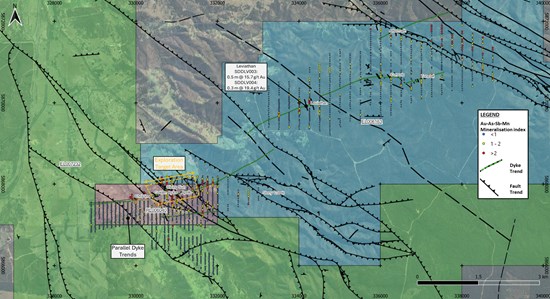
Figure 3: Sunday Creek regional plan view showing soil sampling, structural framework, regional historic epizonal gold mining areas and broad regional areas. The main regional drill areas are at Tonstal, Consols and Leviathan located 4,000 m to 7,500 m along strike from the main drill area at Golden Dyke- Apollo. Map in GDA94/ MGA Zone 55.
To view an enhanced version of this graphic, please visit:
https://images.newsfilecorp.com/files/11541/307857_b04e528d14d639f4_004full.jpg
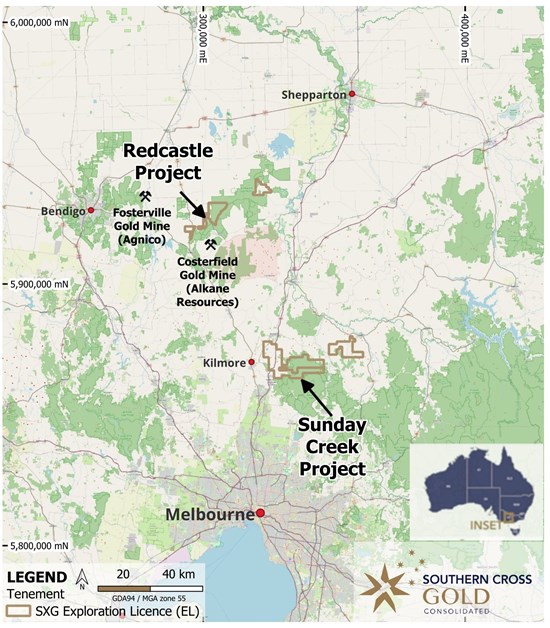
Figure 4: Location of the Sunday Creek project, along with the 100% owned Redcastle Gold-Antimony Project
To view an enhanced version of this graphic, please visit:
https://images.newsfilecorp.com/files/11541/307857_b04e528d14d639f4_005full.jpg
JORC Table 1
Section 1 Sampling Techniques and Data
| Criteria | JORC Code explanation | Commentary |
| Sampling techniques | - Nature and quality of sampling (e.g. cut channels, random chips, or specific specialised industry standard measurement tools appropriate to the minerals under investigation, such as down hole gamma sondes, or handheld XRF instruments, etc.). These examples should not be taken as limiting the broad meaning of sampling.
- Include reference to measures taken to ensure sample representivity and the appropriate calibration of any measurement tools or systems used.
- Aspects of the determination of mineralization that are Material to the Public Report.
- In cases where 'industry standard' work has been done this would be relatively simple (e.g. 'reverse circulation drilling was used to obtain 1 m samples from which 3 kg was pulverized to produce a 30 g charge for fire assay'). In other cases more explanation may be required, such as where there is coarse gold that has inherent sampling problems. Unusual commodities or mineralization types (e.g. submarine nodules) may warrant disclosure of detailed information.
| - Sampling has been conducted on drill core (half core for >90% and quarter core for check samples), grab samples (field samples of in-situ bedrock and boulders; including duplicate samples), trench samples (rock chips, including duplicates) and soil samples (including duplicate samples).
Locations of field samples were obtained by using a GPS, generally to an accuracy of within 5 metres. Drill hole and trench locations have been confirmed to <1 metre using a differential GPS.
Samples locations have also been verified by plotting locations on the high-resolution Lidar maps - Drill core is marked for cutting and cut using an automated diamond saw used by Company staff in Kilmore.
Samples are bagged at the core saw and transported to the Bendigo On Site Laboratory for assay.
At On Site samples are crushed using a jaw crusher combined with a rotary splitter and a 1 kg split is separated for pulverizing (LM5) and assay. - Standard fire assay techniques are used for gold assay on a 30 g charge by experienced staff (used to dealing with high sulfide and stibnite-rich charges). On Site gold method by fire assay code PE01S.
- Screen fire assay is used to understand gold grain-size distribution where coarse gold is evident.
- ICP-OES is used to analyze the aqua regia digested pulp for an additional 12 elements (method BM011) and over-range antimony is measured using flame AAS (method known as B050).
- Soil samples were sieved in the field and an 80-mesh sample bagged and transported to ALS Global laboratories in Brisbane for super-low level gold analysis on 50 g samples by method ST44 (using aqua regia and ICP-MS).
- Grab and rock chip samples are generally submitted to On Site Laboratories for standard fire assay and 12 element ICP-OES as described above.
|
| Drilling techniques | - Drill type (e.g. core, reverse circulation, open-hole hammer, rotary air blast, auger, Bangka, sonic, etc.) and details (e.g. core diameter, triple or standard tube, depth of diamond tails, face-sampling bit or other type, whether core is oriented and if so, by what method, etc.).
| - HQ or NQ diameter diamond drill core, oriented using Axis Champ orientation tool with the orientation line marked on the base of the drill core by the driller/offsider.
A standard 3 metre core barrel has been found to be most effective in both the hard and soft rocks in the project.
|
| Drill sample recovery | - Method of recording and assessing core and chip sample recoveries and results assessed.
- Measures taken to maximise sample recovery and ensure representative nature of the samples.
- Whether a relationship exists between sample recovery and grade and whether sample bias may have occurred due to preferential loss/gain of fine/coarse material.
| - Core recoveries were maximised using HQ or NQ diamond drill core with careful control over water pressure to maintain soft-rock integrity and prevent loss of fines from soft drill core. Recoveries are determined on a metre-by-metre basis in the core shed using a tape measure against marked up drill core checking against driller's core blocks.
- Plots of grade versus recovery and RQD (described below) show no trends relating to loss of drill core, or fines.
|
| Logging | - Whether core and chip samples have been geologically and geotechnically logged to a level of detail to support appropriate Mineral Resource estimation, mining studies and metallurgical studies.
- Whether logging is qualitative or quantitative in nature. Core (or costean, channel, etc.) photography.
- The total length and percentage of the relevant intersections logged.
| - Geotechnical logging of the drill core takes place on racks in the company core shed.
Core orientations marked at the drill rig are checked for consistency, and base of core orientation lines are marked on core where two or more orientations match within 10 degrees.
Core recoveries are measured for each metre
RQD measurements (cumulative quantity of core sticks > 10 cm in a metre) are made on a metre-by-metre basis. - Each tray of drill core is photographed (wet and dry) after it is fully marked up for sampling and cutting.
- The ½ core cutting line is placed approximately 10 degrees above the orientation line so the orientation line is retained in the core tray for future work.
- Geological logging of drill core includes the following parameters:
Rock types, lithology
Alteration
Structural information (orientations of veins, bedding, fractures using standard alpha-beta measurements from orientation line; or, in the case of un-oriented parts of the core, the alpha angles are measured)
Veining (quartz, carbonate, stibnite)
Key minerals (visible under hand lens, e.g. gold, stibnite) - 100% of drill core is logged for all components described above into the company MX logging database.
- Logging is fully quantitative, although the description of lithology and alteration relies on visible observations by trained geologists.
- Each tray of drill core is photographed (wet and dry) after it is fully marked up for sampling and cutting.
- Logging is considered to be at an appropriate quantitative standard to use in future studies.
|
| Sub-sampling techniques and sample preparation | - If core, whether cut or sawn and whether quarter, half or all core taken.
- If non-core, whether riffled, tube sampled, rotary split, etc. and whether sampled wet or dry.
- For all sample types, the nature, quality and appropriateness of the sample preparation technique.
- Quality control procedures adopted for all sub-sampling stages to maximise representivity of samples.
- Measures taken to ensure that the sampling is representative of the in situ material collected, including for instance results for field duplicate/second-half sampling.
- Whether sample sizes are appropriate to the grain size of the material being sampled.
| - Drill core is typically half-core sampled using an Almonte core saw. The drill core orientation line is retained.
- Quarter and half core is used when taking sampling duplicates (termed FDUP in the database).
- Sampling representivity is maximised by always taking the same side of the drill core (whenever oriented),and consistently drawing a cut line on the core where orientation is not possible. The field technician draws these lines.
- Sample sizes are maximised for coarse gold by using half core, and using quarter core and half core splits (laboratory duplicates) allows an estimation of nugget effect.
- In mineralized rock the company uses approximately 10% of core duplicates, certified reference materials (suitable OREAS materials), laboratory sample duplicates and instrument repeats.
- In the soil sampling program duplicates were obtained every 25th sample and the laboratory inserted low-level gold standards regularly into the sample flow.
|
| Quality of assay data and laboratory tests | - The nature, quality and appropriateness of the assaying and laboratory procedures used and whether the technique is considered partial or total.
- For geophysical tools, spectrometers, handheld XRF instruments, etc., the parameters used in determining the analysis including instrument make and model, reading times, calibrations factors applied and their derivation, etc.
- Nature of quality control procedures adopted (e.g. standards, blanks, duplicates, external laboratory checks) and whether acceptable levels of accuracy (i.e. lack of bias) and precision have been established.
| - The fire assay technique for gold used by On Site is a globally recognised method, and over-range follow-ups including gravimetric finish and screen fire assay are standard. Of significance at the On Site laboratory is the presence of fire assay personnel who are experienced in dealing with high sulfide charges (especially those with high stibnite contents) - this substantially reduces the risk of inaccurate reporting in complex sulfide-gold charges.
- Where screen fire assay is used, this assay will be reported instead of the original fire assay.
- The ICP-OES technique is a standard analytical technique for assessing elemental concentrations. The digest used (aqua regia) is excellent for the dissolution of sulfides (in this case generally stibnite, pyrite and trace arsenopyrite), but other silicate-hosted elements, in particular vanadium (V), may only be partially dissolved. These silicate-hosted elements are not important in the determination of the quantity of gold, antimony, arsenic or sulphur.
- A portable XRF has been used in a qualitative manner on drill core to ensure appropriate core samples have been taken (no pXRF data are reported or included in the MX database).
- Acceptable levels of accuracy and precision have been established using the following methods
¼ duplicates - half core is split into quarters and given separate sample numbers (commonly in mineralized core) - low to medium gold grades indicate strong correlation, dropping as the gold grade increases over 100 g/t Au.
½ duplicates - core is split into halves and given separate sample numbers (commonly in mineralized core) - low to medium gold grades indicate strong correlation, dropping as the gold grade increases over 100 g/t Au.
Washes - washes are inserted post visible gold or >1% visible stibnite to ensure contamination is minimised during the preparation stage
Blanks - blanks are inserted after visible gold and in strongly mineralized rocks to confirm that the crushing and pulping are not affected by gold smearing onto the crusher and LM5 swing mill surfaces. Results are excellent, generally below detection limit and a single sample at 0.03 g/t Au.
Certified Reference Materials - OREAS CRMs have been used throughout the project including blanks, low (<1 g/t Au), medium (up to 5 g/t Au) and high-grade gold samples (> 5 g/t Au). Results are automatically checked on data import into the MX database to fall within 2 standard deviations of the expected value.
Laboratory splits - On Site conducts splits of both coarse crush and pulp duplicates as quality control and reports all data. In particular, high Au samples have the most repeats.
Laboratory CRMs - On Site regularly inserts their own CRM materials into the process flow and reports all data
Laboratory precision - duplicate measurements of solutions (both Au from fire assay and other elements from the aqua regia digests) are made regularly by the laboratory and reported. - Accuracy and precision have been determined carefully by using the sampling and measurement techniques described above during the sampling (accuracy) and laboratory (accuracy and precision) stages of the analysis.
- Soil sample company duplicates and laboratory certified reference materials all fall within expected ranges.
|
| Verification of sampling and assaying | - The verification of significant intersections by either independent or alternative company personnel.
- The use of twinned holes.
- Documentation of primary data, data entry procedures, data verification, data storage (physical and electronic) protocols.
- Discuss any adjustment to assay data.
| - The Independent Geologist has visited Sunday Creek drill sites and inspected drill core held at the Kilmore core shed - 11 December 2024 S.Tambanis.
- The CP & QP, Mr Kenneth Bush has visually inspected the drill core from holes in this release. The drill intersections match both the geological descriptions in the database and the expected assay data (for example, gold and stibnite visible in drill core is matched by high Au and Sb results in assays).
- In addition, on receipt of results Company geologists assess the gold, antimony and arsenic results to verify that the intersections returned expected data.
- The electronic data storage in the MX database is of a high standard. Primary logging data are entered directly by the geologists and field technicians and the assay data are electronically matched against sample number on return from the laboratory.
- Certified reference materials, ¼ core field duplicates (FDUP), laboratory splits and duplicates and instrument repeats are all recorded in the database.
- Exports of data include all primary data, from hole SDDSC077B onwards after discussion with SRK Consulting. Prior to this gold was averaged across primary, field and lab duplicates.
- Adjustments to assay data are recorded by MX, and none are present (or required).
- Twinned drill holes are not available at this stage of the project.
|
| Location of data points | - Accuracy and quality of surveys used to locate drill holes (collar and down-hole surveys), trenches, mine workings and other locations used in Mineral Resource estimation.
- Specification of the grid system used.
- Quality and adequacy of topographic control.
| - Differential GPS used to locate drill collars, trenches and some workings
- Standard GPS for some field locations (grab and soils samples), verified against Lidar data.
- Downhole surveys are collected by either electronic single-shot, REFLEX EZ-TRAC multi-shot or Imdex/Axis north-seeking gyro or a combination. During drilling, surveys are completed at a maximum of 30m intervals, with multi-shot surveys completed at hole completion or upon request by geologists at 3m intervals during drilling unless ground conditions are unsuitable.
- The grid system used throughout is Geocentric datum of Australia 1994; Map Grid Zone 55 (GDA94_Z55), also referred to as EPSG: 28355. Reported azimuths also relate to MGA55 (GDA94_Z55).
- Topographic control is excellent owing to sub 10 cm accuracy from Lidar data.
|
| Data spacing and distribution | - Data spacing for reporting of Exploration Results.
- Whether the data spacing and distribution is sufficient to establish the degree of geological and grade continuity appropriate for the Mineral Resource and Ore Reserve estimation procedure(s) and classifications applied.
- Whether sample compositing has been applied.
| - The data spacing is suitable for reporting of exploration results - evidence for this is based on the improving predictability of high-grade gold-antimony intersections.
- At this time, the data spacing and distribution are not sufficient for the reporting of Mineral Resource Estimates. This however may change as knowledge of grade controls increase with future drill programs.
- Samples have been composited to a 1 g/t AuEq over 2.0 m width for lower grades and 5 g/t AuEq over 1.0 m width for higher grades in table 3. All individual assays above 0.1 g/t AuEq have been reported to two decimal places with no compositing in table 4.
|
| Orientation of data in relation to geological structure | - Whether the orientation of sampling achieves unbiased sampling of possible structures and the extent to which this is known, considering the deposit type.
- If the relationship between the drilling orientation and the orientation of key mineralized structures is considered to have introduced a sampling bias, this should be assessed and reported if material.
| - The true thickness of the mineralized intervals reported is interpreted to be approximately 40-90% of the sampled thickness.
- Drilling is oriented in an optimum direction when considering the combination of host rock orientation and apparent vein control on gold and antimony grade.
The steep nature of some of the veins may give increases in apparent thickness of some intersections, but more drilling is required to quantify. - A sampling bias is not evident from the data collected to date (drill holes cut across mineralized structures at a moderate angle).
|
| Sample security | - The measures taken to ensure sample security.
| - Drill core is delivered to the Kilmore core logging shed by either the drill contractor or company field staff. Samples are marked up and cut by company staff at the Kilmore core shed, in an automated diamond saw and bagged before loaded onto strapped secured pallets and trucked by company staff to Bendigo for submission to the laboratory. There is no evidence in any stage of the process, or in the data for any sample security issues.
|
| Audits or reviews | - The results of any audits or reviews of sampling techniques and data.
| - Continuous monitoring of CRM results, blanks and duplicates is undertaken by geologists and the company data geologist. Mr Kenneth Bush for SXG has the orientation, logging and assay data.
|
Southern Cross Gold (SXG) ASX Announcement
Section 2 Reporting of Exploration Results
| Criteria | JORC Code explanation | Commentary |
Mineral tenement
and land tenure
status | - Type, reference name/number, location and ownership including agreements or material issues with third parties such as joint ventures, partnerships, overriding royalties, native title interests, historical sites, wilderness or national park and environmental settings.
- The security of the tenure held at the time of reporting along with any known impediments to obtaining a licence to operate in the area.
| - The Sunday Creek Project, previously known as the Clonbinane Project, is covered by the Retention Licence RL 6040 and is surrounded by Exploration Licence EL6163 and Exploration Licence EL7232. All the licences are 100% held by Clonbinane Goldfield Pty Ltd, a wholly owned subsidiary company of Southern Cross Gold Ltd.
|
Exploration done by
other parties | - Acknowledgment and appraisal of exploration by other parties
| - The Sunday Creek project is a high level orogenic (or epizonal) Fosterville-style deposit. Small scale mining has been undertaken in the project area since the 1880s continuing through to the early 1900s. Historical production occurred with multiple small shafts and alluvial workings across the Clonbinane Goldfield permits. Production of note occurred at the Clonbinane area with total production being reported as 41,000 oz gold at a grade of 33 g/t gold (Leggo and Holdsworth, 2013)
- Work in and nearby to the Sunday Creek Project area by previous explorers typically focused on finding bulk, shallow deposits. Beadell Resources were the first to drill deeper targets and Southern Cross have continued their work in the Sunday Creek Project area.
- EL54 - Eastern Prospectors Pty Ltd
Rock chip sampling around Christina, Apollo and Golden Dyke mines.
Rock chip sampling down the Christina mine shaft. Resistivity survey over the Golden Dyke. Five diamond drill holes around Christina, two of which have assays. - ELs 872 & 975 - CRA Exploration Pty Ltd
Exploration focused on finding low grade, high tonnage deposits. The tenements were relinquished after the area was found to be prospective but not economic.
Stream sediment samples around the Golden Dyke and Reedy Creek areas. Results were better around the Golden Dyke. 45 dump samples around Golden Dyke old workings showed good correlation between gold, arsenic and antimony.
Soil samples over the Golden Dyke to define boundaries of dyke and mineralization. Two costeans parallel to the Golden Dyke targeting soil anomalies. Costeans since rehabilitated by SXG. - ELs 827 & 1520 - BHP Minerals Ltd
Exploration targeting open cut gold mineralization peripheral to SXG tenements. - ELs 1534, 1603 & 3129 - Ausminde Holdings Pty Ltd
Targeting shallow, low grade gold. Trenching around the Golden Dyke prospect and results interpreted along with CRAs costeans. 29 RC/Aircore holes totalling 959 m sunk into the Apollo, Rising Sun and Golden Dyke target areas. - ELs 4460 & 4987 - Beadell Resources Ltd
- ELs 4460 and 4987 were granted to Beadell Resources in November 2007. Beadell successfully drilled 30 RC holes, including second diamond tail holes in the Golden Dyke/Apollo target areas.
- Both tenements were 100% acquired by Auminco Goldfields Pty Ltd in late 2012 and combined into one tenement EL4987.
- Nagambie Resources Ltd purchased Auminco Goldfields in July 2014. EL4987 expired late 2015, during which time Nagambie Resources applied for a retention licence (RL6040) covering three square kilometres over the Sunday Creek Project. RL6040 was granted July 2017.
- Clonbinane Goldfield Pty Ltd was purchased by Mawson Gold Ltd in February 2020.
- Mawson drilled 30 holes for 6,928 m and made the first discoveries to depth.
|
| Geology | - Deposit type, geological setting and style of
- mineralization.
| - Refer to the description in the main body of the release.
|
| Drill hole Information | - A summary of all information material to the understanding of the exploration results including a tabulation of the following
- information for all Material drill holes:
- easting and northing of the drill hole collar
- elevation or RL (Reduced Level - elevation above sea level in metres) of the drill hole collar
- dip and azimuth of the hole
- down hole length and interception depth
- hole length.
- If the exclusion of this information is justified on the basis that the information is not Material and this exclusion does not detract from the understanding of the report, the Competent Person should clearly explain why this is the case.
| |
| Data aggregation methods | - In reporting Exploration Results, weighting averaging techniques, maximum and/or minimum grade truncations (e.g. cutting of high-grades) and cut-off grades are usually Material and should be stated.
- Where aggregate intercepts incorporate short lengths of high-grade results and longer lengths of low-grade results, the procedure used for such aggregation should be stated and some typical examples of such aggregations should be shown in detail.
- The assumptions used for any reporting of metal equivalent values should be clearly stated.
| - See "Further Information" and "Metal Equivalent Calculation" in main text of press release.
|
Relationship
between
mineralization
widths and
intercept lengths | - These relationships are particularly important in the reporting of Exploration Results.
- If the geometry of the mineralization with respect to the drill hole angle is known, its nature should be reported.
- If it is not known and only the down hole lengths are reported, there should be a clear statement to this effect (e.g 'down hole
- length, true width not known').
| - See reporting of true widths in the body of the press release.
|
| Diagrams | - Appropriate maps and sections (with scales) and tabulations of intercepts should be included for any significant discovery being reported. These should include, but not be limited to a plan view of drill hole collar locations and appropriate sectional views.
| - The results of the diamond drilling are displayed in the figures in the announcement.
|
| Balanced reporting | - Where comprehensive reporting of all Exploration Results is not practicable, representative reporting of both low and high-grades and/or widths should be practiced to avoid misleading reporting of Exploration Results.
| - All results above 0.1 g/t Au have been tabulated in this announcement. The results are considered representative with no intended bias.
- Core loss, where material, is disclosed in tabulated drill intersections.
|
| Other substantive exploration data | - Other exploration data, if meaningful and material, should be reported including (but not limited to): geological observations; geophysical survey results; geochemical survey results; bulk samples - size and method of treatment; metallurgical test results; bulk density, groundwater, geotechnical and rock characteristics; potential deleterious or contaminating substances.
| - Preliminary testing was reported on January 11, 2024. This established the general metallurgical test procedure for samples from the Sunday Creek deposits and demonstrated the basis for confidence in establishing prospects for economic recovery of contained gold and antimony to three separate products:
- Metallic gold product by gravity recovery
- Antimony-gold flotation concentrate
- Pyrite-arsenopyrite-gold flotation concentrate
- Testing has now been expanded to include samples from additional zones of the mineral deposits and to refine metallurgical processes. The aim was to improve aspects of antimony concentrate production, maximise gold recovery to a high-grade metallic product, and to further investigate the nature of gold occurrence.
- The work, conducted by ALS Burnie Laboratories, focused on:
- Improving selectivity between sulphide minerals in the antimony flotation stage whilst maintaining high overall gold recovery.
- Further processing of the flotation concentrates, to assess the metallurgical response of contained gold.
- Mineralogical examination of selected product samples.
- It was demonstrated that, with appropriate process conditions, high antimony and gold recovery could be maintained whilst rejecting arsenic and iron sulphides in the first flotation stage. The antimony concentrate produced (~50% Sb, <0.2% As) is deemed to be attractive to the smelter market.
- Recovery of antimony to concentrate varied with feed type, and ranged from 83% to 93% for the samples tested from the antimony-rich zones.
- Additional metallic gold was recovered from the flotation concentrate by gravity separation.
- The gold grade of the concentrate is a function of the proportion of feed gold associated with arsenic-iron sulphides, the ratio of gold to antimony in the feed, the gold recovered to the metallic gold product, and the flotation rate of gold in the first flotation stage.
- High overall gold recovery was achieved with all samples tested.
- Stage 2 metallurgical test work reported in August 2025 demonstrated successful selective flotation processing that produces a high-grade, low-arsenic antimony-gold concentrate from the upper antimony-rich zones of the deposit, alongside excellent recovery of native gold. Overall gold recovery of 92.3% to 95.6% across three product streams:
- Gravity gold concentrate (37.3 - 51.4% recovered gold).
- Antimony-gold concentrate (28.8 - 36.5% recovered gold): Antimony grades 48.2 - 53.1%, gold grades up to 93.2 g/t and arsenic grades 0.1% to 0.2% (well below the 0.6% threshold).
- Antimony recovery 83.2% to 92.7%.
- Sulphide concentrate (15.5 - 18.0% recovered gold)
- Further Work
- Additional characterization testing across deposit zones
- Locked cycle testing to confirm overall recoveries
- Multi-stage cleaning optimization to maximize concentrate quality
- Pilot plant evaluation of larger samples
- Process plant design studies targeting Q1 2027 completion
|
| Further work | - The nature and scale of planned further work (e.g. tests for lateral extensions or depth extensions or large-scale step-out drilling).
- Diagrams clearly highlighting the areas of possible extensions, including the main geological interpretations and future drilling areas, provided this information is not commercially sensitive.
| - The Company has stated it will drill 200,000 m through 2025 to Q1 2027.
- See diagrams in presentation which highlight current and future drill plans.
|

To view the source version of this press release, please visit https://www.newsfilecorp.com/release/307857

Source: Southern Cross Gold Consolidated Ltd.